Florence: Uffizi Timed Ticket & Masterpieces Audio App
7.148 reviews
Buy now
From 27,20€ per person
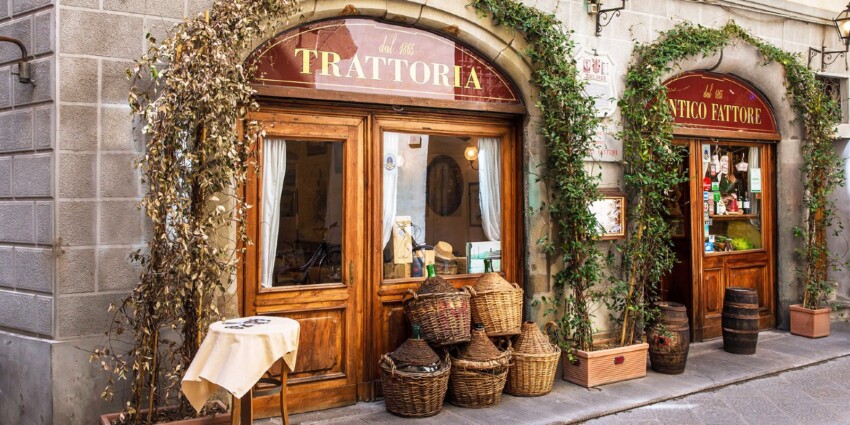
Many food lovers come to Tuscany and particularly to Florence solely to enjoy the excellent local cuisine. The gastronomic offering in Florence is extensive and has two distinct sides: on one hand, there are numerous establishments rooted in the time-honoured Tuscan tradition, featuring simple and genuine recipes, whilst on the other, there are the new frontiers and trends in food, fusion or gourmet restaurants serving more avant-garde cuisine with a keen eye on current fashions. There is no shortage of ethnic cuisine options, along with a number of venues designed primarily for foreign tourists and several street food stalls.
Whatever your culinary preferences and taste in food, if you’re planning to visit Florence, you’re probably wondering where the best place to eat is. You should know that the historic centre is absolutely brimming with restaurants for all budgets; however, many are unfortunately designed specifically for tourists and don’t always offer good value for money.
It’s worth noting that a large proportion of Florence’s tourists are foreigners, who are notoriously keen on any food that vaguely resembles Italian cuisine. However, Italian tourists, as we know, are far more discerning when it comes to lunch or dinner time, and for this reason you’ll need to do a bit more research to avoid leaving the table disappointed.
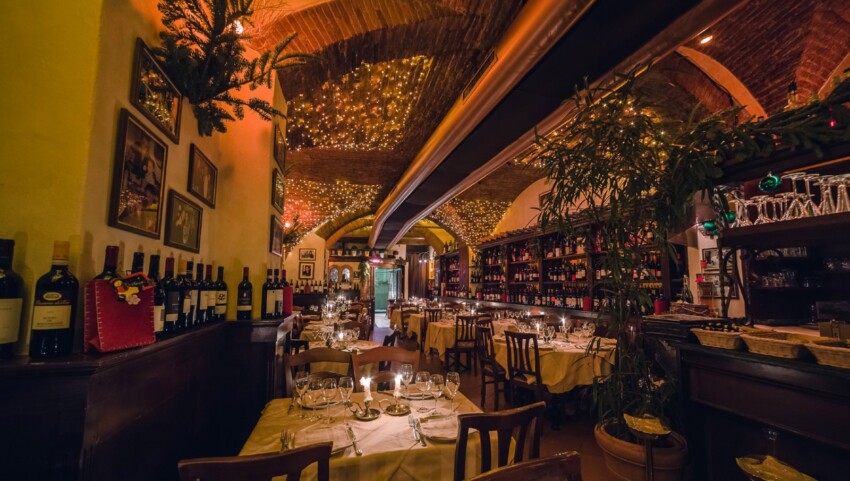
In a city boasting more than 1000 restaurants, the majority of which are concentrated in the historic centre, drawing up a ranking of the best is no easy task. In fact, it’s practically impossible given that culinary tastes are subjective, and what appeals to one person might turn another away. However, the city does have some unmissable names: so here are what we consider the best restaurants in Florence. This isn’t a fine dining ranking – we’ve chosen to include a wider range of alternatives for all types and budgets, whilst remaining in or very close to the historic centre.
We begin our list of Florence’s best restaurants with Enoteca Pinchiorri, the most prestigious name in Florentine fine dining. Three Michelin stars — awarded consistently since 2004 — one of the world’s most renowned wine cellars with over 100,000 bottles and 3,500 labels, and an ever-evolving culinary offering: these are the hallmarks of this temple of world gastronomy, certainly not within everyone’s reach, but undoubtedly one of those gourmet experiences worth having at least once in a lifetime. Opened in 1974, the restaurant boasts over 50 years of history and remains the only three-Michelin-starred establishment in Tuscany.
Enoteca Pinchiorri is located at via Ghibellina 87, right in the heart of Florence’s historic centre, not far from the Basilica of Santa Croce. Owners Giorgio Pinchiorri and Annie Féolde founded and carefully built this restaurant with passion, and it has always been one of the symbols of Florence in the world of fine dining. Today, chef Riccardo Monco leads the kitchen.
On via Santo Spirito, where restaurants line the street one after another, Santo Bevitore stands out for its use of local ingredients and traditional dishes, with an eye towards presentation and refinement. The setting is lovely and the service attentive.
Santo Bevitore is located at via Santo Spirito 64R, in the Oltrarno neighbourhood, in one of the trendiest areas of Florence’s nightlife. Its offering is complemented by two other establishments under the same ownership: the S. Forno bakery at via di Santa Monaca 3R and Il Santino delicatessen at via di Santo Spirito 60.
Another of the most celebrated names among Florentines, Cibrèo is a truly iconic restaurant. Opened in 1979 by Fabio Picchi — chef, writer and Florentine intellectual who passed away in 2022 — it is now run by his son Giulio Picchi and chef Oscar Severini, who preserve its original spirit.
In fact, the Cibrèo group operates several establishments: the main restaurant offers fine dining across two locations, in piazza Sant’Ambrogio and within the luxury Helvetia & Bristol hotel on via dei Vecchietti. Alongside it is the Cibrèo trattoria, also known as Cibreino, serving revisited traditional Tuscan fare at considerably more reasonable prices, the Cibrèo Caffè in piazza Sant’Ambrogio, the Teatro del Sale (opened in 2003), an innovative concept where you dine whilst enjoying theatrical performances under the artistic direction of Maria Cassi, and finally Cibléo, a Tuscan-Oriental bistro, the latest addition to its varied gastronomic offerings.
Another of Florence’s most famous restaurants is Cantinetta Antinori, situated in piazza degli Antinori at the far end of via Tornabuoni, the city’s luxury boutique street. At Cantinetta, run by the renowned wine-producing family and company, you can savour local specialities revisited with a gourmet touch, naturally accompanied by fine vintage wines from the Antinori cellar.
The key words for Cantinetta Antinori’s gastronomic offering are passion and innovation: the chef is dedicated to discovering new solutions whilst never compromising on quality and the freshness of ingredients, which are seasonal and local whenever possible.
Mercato Centrale is a concept born in 2014 from entrepreneur Umberto Montano‘s vision, located on the first floor of the historic market building in piazza San Lorenzo. Long the home of the ancient city market, today it is clearly divided into two zones: on the ground floor are the traditional fruit, meat and fish stalls, along with some small shops selling trinkets and souvenirs, whilst on the first floor an expansive space has been created to celebrate Florentine culinary tradition reimagined in a modern way by over 20 vendors, who cook and sell takeaway food that can be enjoyed whilst sitting at large tables in the centre of the hall.
There are countless options, from truffle pizza to fried food and obviously the area’s typical specialities. Prices are on the higher side, and although the quality is objectively good, it’s not always the best choice for eating in Florence. However, the welcoming atmosphere and elegant interiors make Mercato Centrale in Florence one of the must-see destinations for gourmet enthusiasts visiting the city. The concept has been replicated in Milan, Turin and Rome.
Finally, among Florence’s best restaurants, we couldn’t leave out Antico Vinaio, which in just a few years has become one of the city’s foremost gastronomic institutions. It’s not strictly a restaurant, as it serves exclusively sandwiches and flatbreads; but the long queues that form every day on via de’ Neri demonstrate to anyone the significance of this phenomenon which shows no sign of slowing down.
Today Antico Vinaio is largely the domain of tourists, whilst Florentines are evenly split between critics and fans. The former claim its sandwiches are nothing special and that much of the venue’s success stems from marketing and the charming owner’s tricks. The latter, sadly, often give up on enjoying its offerings, put off by the queue length. Fact is, Antico Vinaio was the most-reviewed establishment in the world on Tripadvisor in 2014, and the prestigious French magazine Saveur Magazine named it the world’s best sandwich shop.
Antico Vinaio is located on via de’ Neri, a historic centre street connecting the Uffizi to the Basilica of Santa Croce.
To avoid long queues, we strongly advise against visiting at lunchtime: it’s far better to arrive before noon, or in the afternoon. Remember that food is sold exclusively to take away, and therefore the establishment has no seating. Antico Vinaio Florence’s success has been such that within a few years it has opened branches in Rome, Milan, New York and Los Angeles, among others.
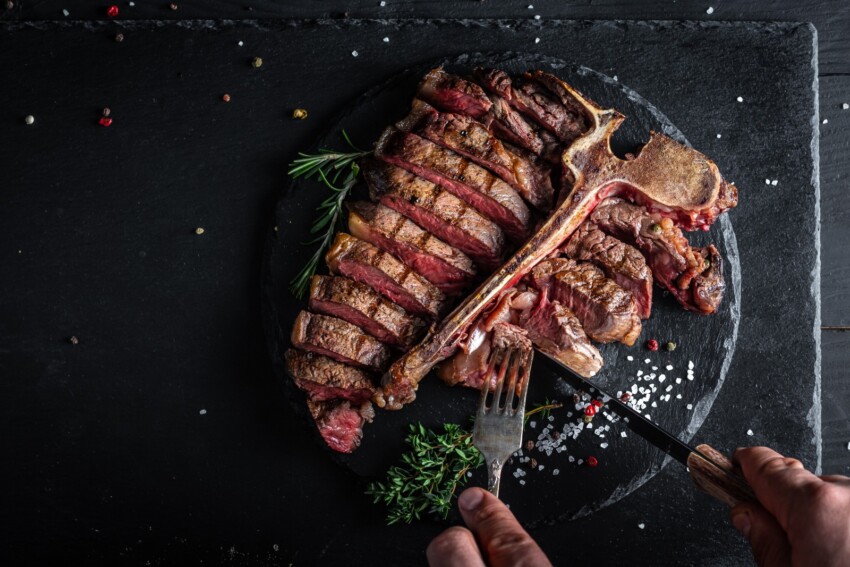
Among the typical dishes of Florence’s gastronomy, bistecca alla fiorentina certainly occupies the highest place on the podium. Succulent, rare, bone-in and four fingers thick: these are the secret ingredients of the perfect steak! You’ll find it practically everywhere in the centre, with prices varying roughly between €5 and €9 per 100g — sometimes more at the most renowned venues — bearing in mind that it will be served in portions generally exceeding a kilo. Many restaurants even display cuts in their windows, as if showcasing the meat that will then be served on your plate.
Unfortunately, though, as mentioned, many of Florence’s historic centre restaurants don’t shine when it comes to value for money: in other words, spending so much to eat a steak “in the dark” could be risky. It’s better therefore to follow our recommendations, to be sure you don’t go wrong and leave the table happy and satisfied.
The Florence addresses that have always been synonymous with excellent steak are Trattoria Da Que' Ganzi7, at via Ghibellina 70R, or the osteria I'Brindellone8, which is in the Oltrarno neighbourhood, not far from piazza del Carmine and the Brancacci Chapel. Also of considerable interest is the quality offered by Trattoria Coco Lezzone9, at via Parioncino 26R, by Buca Lapi10, in a narrow alleyway off the elegant via Tornabuoni, and by Osteria Antica Mescita San Niccolò11, in the heart of the San Niccolò neighbourhood.
If you fancy a stroll whilst enjoying an excellent fiorentina, walk the entire length of via San Gallo to piazza della Libertà, then cross it and turn into viale Giovanni Don Minzoni. Almost at the start, at number 10R, you’ll find Ristorante Perseus12, a true point of reference in the city for steak enthusiasts. If instead you can move slightly beyond the centre, even by bus, opt without hesitation for Trattoria Da Burde13, a restaurant known practically to all Florentines, located at via Pistoiese 154.
Finally, if you have the opportunity, know that the best bistecche alla fiorentina are eaten outside Florence: whether you choose the surrounding areas or open countryside, if you have a car, venture a few kilometres away from the centre’s tourist restaurants and experience the authentic dining of provincial establishments, often featuring superior ingredients and lower prices.
As a general rule, always ask the locals for advice: they’ll be proud to point you towards their favourite restaurant, which, as a natural corollary, will almost always be frequented largely by Florentines; all the establishments we’ve mentioned certainly are!
In the following map you can see the location of the main places of interest mentioned in this article.
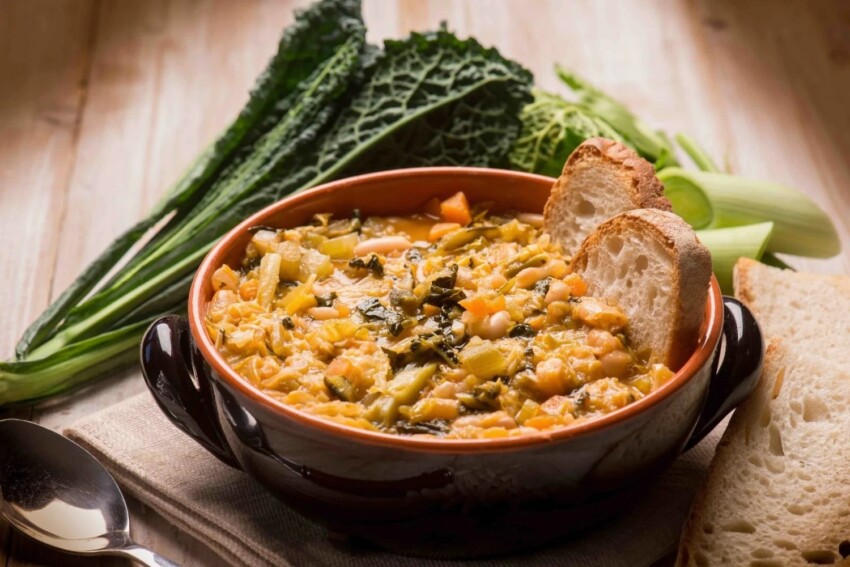
Florentine cuisine, like Tuscan cooking as a whole, is historically rooted in humble, peasant traditions. Many of the region’s signature dishes—now often reimagined with a gourmet twist by contemporary restaurants—were originally built from yesterday’s leftovers. Take the numerous bread-based soups, such as ribollita, crafted from stale bread and fresh garden vegetables. The name itself tells the story: “reboiled,” meaning prepared the day after to avoid waste and allow the flavours to meld together beautifully.
Other essential Florentine soups to savour during your stay include pappa al pomodoro, a comforting blend of bread, fresh and tinned tomatoes, finished with a dusting of Parmesan, basil and a drizzle of extra virgin olive oil; panzanella, the classic chilled summer soup made with stale Tuscan bread, extra virgin olive oil, onions, tomatoes and cucumbers; and cavolo nero soup, traditionally served only when black cabbage is in season—between autumn and winter.
Continuing in this spirit of resourceful cooking, lesso rifatto con le cipolle stands as another cornerstone of Florentine fare. Leftover boiled beef from the previous day is simmered again and transformed into a flavourful stew enriched with onions.
Beyond bread and extra virgin olive oil, meat is fundamental to local cooking. Apart from the excellent—and pricey—bistecca alla fiorentina, most other meat dishes also stem from peasant traditions. Lampredotto, for instance, is a true icon of Florence’s culinary heritage. It’s beef tripe, a cut typically discarded elsewhere, yet it has become quintessentially Florentine. Today, you’ll find it mostly as a street-food sandwich from market stalls, though osterie and restaurants also serve it plated, accompanied by sauces or even stirred into risotto.
When discussing offal, tripe deserves mention—in its Florentine preparation, it’s cooked in a tomato sauce with onions and Parmesan. As for Tuscan appetisers, crostini di fegatini reign supreme: simple bread (fresh or soaked in broth if stale) topped with a spread of chicken liver, capers and anchovies, mellowed by a touch of butter.
 Hotel
Hotel  Budget accommodations
  Apartments
  Family Hotel
  Luxury Hotel
  Resorts