Hotel Granduca SPA & Parking
Grosseto - Via Senese 170
Book now
Situated in the heart of the Maremma, on a plain crossed by the River Ombrone not far from the coast, Grosseto is the Tuscan city for anyone wanting art and sea on the same day.
Probably founded in 935, Grosseto took on its present appearance only in the 20th century following the drainage of the surrounding marshes. The historic centre, enclosed within well-preserved city walls, is rich in palaces, churches and museums to feast your eyes upon. Writers and film stars of the calibre of Italo Calvino, Sophia Loren, Dino Risi and Federico Fellini have done the same before you.
Once you’ve done the walking tour of Grosseto’s centre, get in the car and head straight for the Maremma Nature Park: at this point you’ll need to decide whether to spend the day stretched out in the sun on a breathtaking beach or walk one of the park’s 16 trails to discover a great variety of plants and animals.
Wild nature is just minutes’ drive from the centre: a happy combination that makes Grosseto an ideal destination for a holiday in Tuscany away from the usual tourist trails. Perfect for a weekend, it’s so easy to fall in love with that you’ll want to come back for a whole week.
What are the attractions not to miss in Grosseto and its surroundings? There’s something for everyone: historic palaces, churches, museums, ancient ruins, nature parks… Here are the things we think are most worth seeing.
Piazza Dante Alighieri is the heart of Grosseto’s historic centre: the classic Italian square flanked by historic buildings with elegant arcades, a popular meeting place for locals and venue for numerous outdoor events. The square’s current appearance dates from the 13th and 14th centuries.
It’s also known as Piazza delle Catene or Piazza Duomo; the latter is a sort of small square within the square.
The centre of Piazza Dante is marked by the Monumento al Canapone, a 19th-century statue depicting Grand Duke Leopold II crushing a serpent’s head: it’s an allegory of the Maremma population’s victory over malaria.
Among the most beautiful buildings overlooking the square are certainly the Cathedral, Palazzo Aldobrandeschi and Palazzo Comunale.
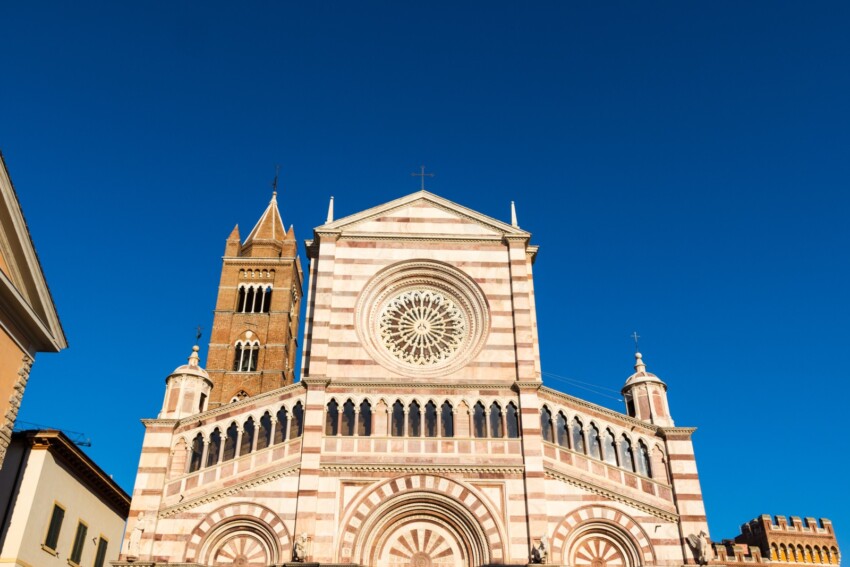
Set between Piazza Dante and its namesake square, the Duomo di San Lorenzo is Grosseto’s architectural jewel, immediately recognisable by its two-tone façade in white and pink stone.
Construction began at the end of the 13th century but the church was enlarged and modified several times over the centuries. The result is a mixture of styles and a riot of artwork that takes your breath away.
Particularly beautiful is the portal, still fairly faithful to its original appearance, with sculptural decorations depicting saints, floral motifs and symbolic animals.
Among the most interesting works that can be admired inside are the baptismal font by Antonio Ghini, the decorated Gothic windows by Benvenuto di Giovanni and a painting by Matteo di Giovanni.
Palazzo Aldobrandeschi is a magnificent neo-Gothic building built in the 20th century to a design by Tuscan architect and restorer Lorenzo Porciatto; it’s inspired by medieval Sienese style. It’s also known as Palazzo della Provincia.
The walls of Grosseto date back to the 13th century and are still visible today; they were damaged and rebuilt several times and their current appearance dates from work carried out in the second half of the 16th century at the behest of Francesco I de’ Medici.
You can still see the hexagonal perimeter of the walls and the bastions placed at the corners; nearly all the guard posts that stood on the bastions have been destroyed and the outer moat has been filled in.
It’s possible to walk along the walls, most of which have been transformed into a tree-lined pedestrian promenade. During your walk you’ll come across the gates that allowed access to the historic centre and the preserved bastions.
In order, you’ll encounter: Porta Vecchia, Bastione Cavallerizza, Porta Corsica, Bastione Molino a Vento, Bastione Garibaldi, Porta Nuova, Bastione Rimembranza, Bastione Fortezza (includes Cassero Senese, Piazza d’Armi and Cappella di Santa Barbara), Porta Santa Lucia, Bastione della Vittoria and Bastione Maiano.
The Cassero Senese is perhaps the most well-known building on Grosseto’s city walls: it’s a tower with a rectangular base set above the Bastione Fortezza. It was built in the 14th century; the covered terrace was added in the 16th century.
Initially the tower had a defensive function, but later it was used as a collection point for salt extracted along the coast, which was then distributed from here: for this reason the tower is also called Cassero del Sale.
It’s currently used as an exhibition space and event venue.
Although far simpler than the Duomo di San Lorenzo, the Chiesa di San Pietro deserves to be included in the list of things to see in Grosseto. Its simple appearance shouldn’t fool you: it was indeed one of the most important churches in the city’s history.
It’s an ancient church, and it seems the original core was built as early as the late 8th or early 9th century.
Four prestigious museums housed within a historic building of great value: this is the Polo Culturale Le Clarisse, an important institution managed by the Grosseto Cultura Foundation; the venue is the former Convent of Santa Chiara, in the historic centre of Grosseto.
The ground floor hosts the Museo Collezione Gianfranco Luzzetti, which displays works of art created between the 15th and 19th centuries.
The first floor is occupied by Clarisse Arte, a space dedicated to temporary exhibitions and services for local artists such as an archive, library and media library.
Head up to the third floor to visit MuseoLab, a modern interactive museum that tells the story of Grosseto and surroundings from the end of antiquity to Italian unification.
The third floor also houses the Roberto Ferretti Ethnographic Collection, dedicated to the life and work of an important anthropologist who dedicated much of his research to the folk traditions of the Grosseto Maremma.
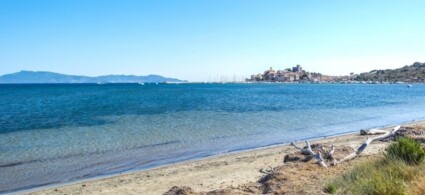
Just 10 km from Grosseto’s centre lies a completely different world, totally immersed in nature. This is the Maremma Nature Park, a protected area stretching from the Talamone promontory to the mouth of the Ombrone river, established in the 1970s and affectionately called “L’Uccellina” by the locals.
Within its territory, which covers an area of about 100 sq km, the park comprises very varied natural habitats: sandy beaches, cliffs, marshes, pine forests, woods and pastures.
The park can be explored on foot, by bike, on horseback, by canoe and even by carriage!
If you’re an archaeology enthusiast, add the Roselle Archaeological Park to your list of attractions in Grosseto and surroundings. About ten kilometres from the centre heading north, along the road to Siena, you’ll find an area rich in Etruscan and Roman remains: it’s the most important archaeological site in the Maremma.
These are the remains of the ancient city of Roselle, which stood on a hill at about 150 metres high, overlooking the sea that once covered the Grosseto plain (which later became marshland and was eventually drained). You can see the ruins of an Etruscan necropolis, the civic basilica, forum, baths, some Roman houses and an amphitheatre.
A descending path leads to the Etruscan walls, once 3 km long with large stretches still preserved. Walking along the walls you can enjoy a fine view over the Grosseto plain.
The proximity to the coast makes Grosseto a good base for a weekend or holiday combining seaside and culture.
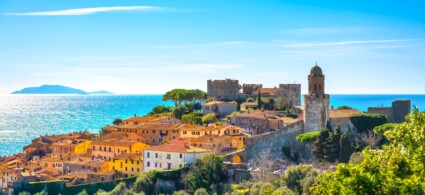
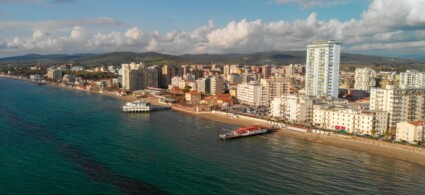
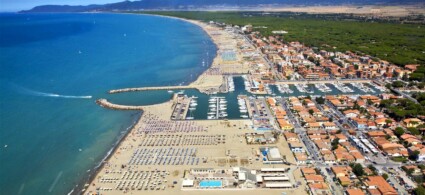
The closest beaches are those at Marina di Grosseto, located just 15 km away and easily accessible by car or public transport. The charming fishing village of Castiglione della Pescaia can also be easily reached on a day trip (just 25 km away), as can Follonica (50 km).
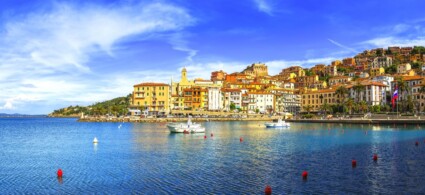
Marina di Grosseto, Castiglione della Pescaia and Follonica are north of Grosseto. Heading in the opposite direction you can reach the enchanting beaches of Monte Argentario. The most famous spots on the promontory, Orbetello and Porto Santo Stefano, are both about 50 km from Grosseto’s centre.
If you’re an experienced diver, don’t miss a dive in the waters of Le Formiche di Grosseto, three small islands rising from a seabed 100 metres deep.
The city of Grosseto doesn’t have a strong tourism focus: the most beautiful holiday accommodation is concentrated along the coast and in the countryside, about ten kilometres or more from the centre.
However, there are options for those who prefer to stay in the centre of Grosseto: you can find a good choice of hotels, apartments and bed & breakfasts in the mid-range category, mostly in the lower-to-mid price bracket.
Grosseto is reached by car via the SS223 state road, connected to major routes such as the Florence-Siena expressway and the E80 Aurelia. It’s therefore possible to arrive quickly from several directions.
For those travelling by public transport, the train is the best option: Grosseto is located on the railway line connecting Rome to Pisa, served by frequent regional trains. It’s more difficult to reach Grosseto by train from Florence: direct trains are few, so expect a change at Pisa or Livorno.
From Grosseto you can reach all the most important seaside resorts and villages of the Maremma by train. The bus is a good alternative to the train both for arriving in the city and for getting around the surrounding area.
The city has a civil airport, but it’s not served by commercial flights: if you want to arrive by air you should consider Florence, Pisa and Rome Fiumicino airports.
What's the weather at Grosseto? Below are the temperatures and the weather forecast at Grosseto for the next few days.
Grosseto is a municipality in southern Tuscany and lies in the heart of the Maremma region; it is the capital of its eponymous province. It is approximately 150 km from Florence, 75 km from Siena and 160 km from Pisa.
 Hotel
Hotel  Budget accommodations
  Apartments
  Family Hotel
 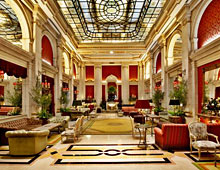 Luxury Hotel
 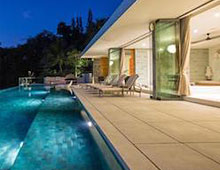 Resorts