Grand Hotel Impero
Castel del Piano - Via Roma 7
Book now
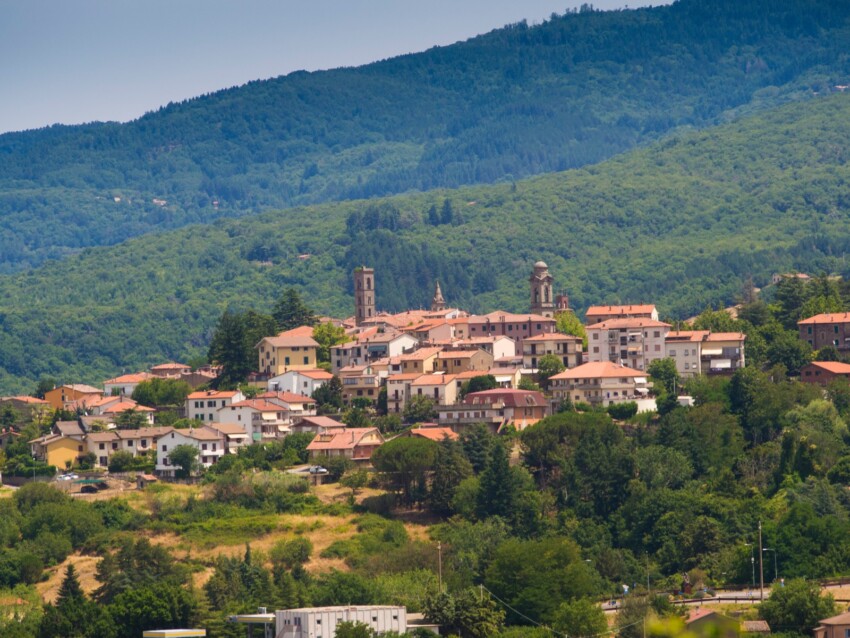
The municipality of Castel del Piano, in the province of Grosseto, has been home to human settlements since the Neolithic period. This ancient village, situated at an altitude of 637 metres and with approximately 4,000 inhabitants, offers its visitors the Church of San Niccolò and Lucia and Palazzo Nerucci, dating from the 14th century.
From 890 onwards, Castel del Piano was one of the possessions of the Abbey of San Salvatore, which exercised its authority over the territory for at least four centuries. At that time it was referred to in its documents as “casale Plana”. In the 11th century, the Aldobrandeschi family succeeded in wresting the nearby village of Montenero from the Abbey. A century later, this powerful family of Lombard origin also established itself over Castel del Piano. When the family was divided in 1274, the territory corresponding to today’s municipality was assigned to the Santa Fiora branch.
In 1331, the Santa Fiora family ceded the village to the Republic of Siena, which had subjugated the Aldobrandeschi at the end of a lengthy military campaign led by the Sienese military commander Guidoriccio da Fogliano. With the fall of Siena in 1559, the authority of the Medici and their Grand Duchy of Tuscany was established over all the municipalities in the Grosseto mountains. The municipality shared their fortunes until Italian unification. During the Second World War, Castel del Piano was one of the first centres to organise a National Liberation Committee.
The town commemorates its medieval history each year with the Palio delle Contrade of Castel del Piano, dedicated to the veneration of the Madonna Santissima delle Grazie. The origins of this event date back to the “Fair of Goods and Livestock” of the 15th century, when, according to historians, the first horse races began to be held. From 1431, the event also took on a religious character. According to legend, an intercession by the Virgin saved four soldiers from Castel del Piano, warning them to abandon the battlefield before the enemy arrived. The four then fled, bringing to their homeland the sacred icon that had spoken to them.
The modern Palio was born in 1765 and was first held on 7 July 1771, ceasing during the 20th century due to armed conflicts. In the post-war period, horse racing resumed but only from 1967 was the division into city districts (Borgo, Monumento, Poggio and Storte) reinstated. Today, the Palio is held every 8 September and is preceded by a historical procession that commemorates events from the 14th and 15th centuries.
A late Renaissance building (inspired by Vignola in ashlar stone), commissioned in 1490 and consecrated around the mid-16th century. It is dedicated to the Nativity of the Madonna.
The façade and bell tower (designed by painter and architect Orazio Imberciadori) were only completed in 1870. The pediment is characterised by an image of God and angels. In the niches are statues of Saint Peter, Saint Paul, Saint Vincent Ferrer and Saint Nicholas; there are also the coats of arms of the Municipality, the Medici and the House of Savoy. The stained-glass window is modern, by Prof. Bruno Buracchini. The bell tower, built in 1829, is an ashlar stone structure standing 35 metres high. The main door is protected by a metal lock from 1630 (still functioning).
The vault (15th-century style) was painted in 1905 by Francesco Notari; it depicts: “glory of angels and the Holy Spirit dove, Saint Joseph, Saint Aloysius” (first section), “Christ in the mandorla, Saint Anne and Saint Isidore” (second section), “Saint Vincent Ferrer, Saint Nicholas and Saint Lucy” (transverse arch leading to the presbytery). The dome dates from the 18th century. The organ is by Agati, from 1866; the baptismal font dates from 1890.
The main altar is a work by Mazzuoli, with lateral statues of Saint Rocco and Saint Sebastian; the large canvas (485 x 270 cm) depicts the “Nativity of the Virgin Mary” and was painted by Giuseppe Nicola Nasini (1657–1737) in 1705.
The façade in peperino ashlar was only completed in 1932, Renaissance in style; on the lateral wall in Via San Giovanni, there is a large niche for “collecting donations for the redemption of Christian slaves” (1656); the building was commissioned in the mid-15th century, consecrated from 1504 and enlarged in 1512.
On the right wall of the single nave are paintings of “Madonna of Carmine” by Francesco Nasini (1611 or 1621–1695) and “Madonna of the Rosary with Saint Catherine of Siena, Saint Dominic, Saint Francis of Assisi and Pope Pius V” from the 17th century. On the left wall is the canvas “Immaculate Conception” by Anna Muschi of Castel del Piano and Alessandro Teerlink, painted in 1838 as a copy of an original work by Spanish painter Murillo now housed in the Hermitage Museum in Saint Petersburg.
On the theatrical 18th-century altar by Swiss artist Cremoni, you can admire a gold-background panel derived from Sano di Pietro (1460–1481), depicting the “Madonna and Child between Saint John the Baptist and Saint Bartholomew and angels”; the reverse, partially visible from the 19th-century choir, shows the monogram of Saint Bernardino, perhaps due to the influence of the nearby Convent (founded in 1221) of the Saint at Colombaio in the Municipality of Seggiano (of which today only ruins remain).
The church, one of the oldest, stands on a pre-existing Benedictine monastery cell from the 9th century, to which another cell was adjoined—later a baptismal church of Saint John the Baptist, now demolished. The first records date from 1198, from a papal bull by Pope Innocent III to the abbot of the Abbey of San Salvatore to which it belonged. A building of ashlar stone in Romanesque style, enlarged in 1451 together with the bell tower, at which time the Pievano (rural church) of Saint John was suppressed. In 1520, a new bell tower was erected using materials from the old fortress, now demolished.
The façade underwent numerous alterations that transformed the original Romanesque style into Neo-Gothic in 1915 (entrance portal and rose window).
The interior is laid out in three naves, the central one with a timber roof. On the left wall is a worked peperino shrine, followed by the baptistry, once a precious tabernacle of the small church, transferred here in the Renaissance period, made of alabaster.
The organ of 1854, a work by the Agati brothers of Pistoia. Near the altar of Saint Jerome are two marble slabs with inscriptions and the noble coat of arms of the Nerucci family (dove with an olive branch in its beak). Above this altar is a painting of Saint Jerome, perhaps from the school of the Nasini. On the right nave, above the altar of Saint John, is the canvas “Birth of Saint John the Baptist” attributed to Francesco Vanni. On the right wall are traces of frescoes, probably from the 15th century; in some of these you can perhaps make out the angel of the Annunciation and Saint Christopher.
The church is located in the historic part of the town and was built in the early 13th century; of Romanesque taste, it has undergone considerable alterations from 1600 onwards. The first mention dates from 1216, though its construction likely dates to the 11th century.
In 1587 it became the propositura of Saint Nicholas and Lucy and with this title administered numerous properties. In a description from 1653, it is noted that the church has a single nave, a sacristy and a small bell tower built above the choir. Externally, on a lateral wall, the one leading to the old pretorio street and above the arch, there are carved crosses in the shape of a Tau (perhaps a legacy of Templar influence?). The church underwent various modifications over the centuries until 1858; the new bell tower was only completed in 1900.
Inside is preserved the statue of “Madonna of Loreto” from 1634, carved in wood and painted in polychrome, restored in 1987. The people of Castel del Piano hold a particular devotion to the Madonna of Loreto: in 1634, local devotees made a pilgrimage to Loreto and brought back a copy of the Madonna. The particularity of this image is that—the original Lauretian one, which dated from the 14th century, having been lost in a fire in 1921—paradoxically the Castel del Piano copy turns out to be older than the statue now found in Loreto. Starting from the main entrance, we find on the right the altar of the Holy Cross and Saint Desiderio, with above it the canvas “Verification of the True Cross” attributed to Francesco Nasini; some critics have seen an influence from Correggio’s “Day” (1523) in this work.
A second altar dedicated to Saint Anthony with the image of the saint above. Nearby is a “double-sided” painting (probably a professional standard), depicting on one side the “Glory of the Most Holy Sacrament” (1771) and on the other “The Miracle of Bolsena”, a work by Gioacchino Sorbelli. Worth noting is a travertine holy water stoup.
A modest chapel, probably from the 17th century, now entrusted to the Confraternity of Mercy (established by public-spirited citizens in 1870). The external façade is extremely austere; note beside the door a stone alms box shaped like a shell. Inside, with a single nave, you can admire one of the most beautiful paintings by Francesco Nasini, “The Marriage of the Virgin” (1664); on either side of the altar are two paintings by Giuseppe Nicola Nasini and his son Apollonio, “Rest during the Flight into Egypt” and “Dream of Saint Joseph”. The chapel, despite its small size, evokes a certain atmosphere; architect Vincenzo Vincenti wrote: “But what most characterises this space architecturally is the stucco altar that takes on the typical forms of the ‘baroque machine’, intended to produce here too, in this small church, the emotion produced by the tangibility of the supernatural”. The church was recently restored (1995).
An ancient Benedictine monastery cell from the 9th–10th centuries, built by monks of San Salvatore. A modern statue by Professor Baracchini depicting Santa Lucia was kept here.
Remains of a Franciscan convent suppressed in 1784 and now completely ruined; only the remains of the bell tower remain. It appears that both Saint Bernardino and Saint Catherine stayed here. Although never confirmed by any scholar, local tradition speaks of an underground tunnel between San Processo and the Pieve di Lamulas (a Romanesque parish church in the municipality of Arcidosso, which is nonetheless worth a visit).
This was a rural chapel located near the town, founded by the Aldobrandeschi in 1097, later passing to the Camaldolese monks of the Vivo hermitage; it is mentioned in the tithes of 1200 and 1300. The dilapidated building, in ruins since the 17th century, was rebuilt by Francesco Aurelio Ginanneschi, papal protomedicus, between 1752 and 1754 with a new small church dedicated to the Sacred Heart, which we can still see today though the roof has collapsed and the interior is overgrown with vegetation; the altar is nonetheless still clearly distinguishable, which must have housed the Madonna of Noceto, now in the Church of the Opera.
This mysterious figure of a penitent pilgrim, precursor alongside the mystic Brindano (born Bartolomeo Marosi of Petroio, 16th century) of the millennialist prophet Davide Lazzaretti (1834–1878), erected dozens of crosses, perhaps in fulfilment of a vow or as a sign of profound piety around the mid-19th century—although to this day the real purpose remains unknown.
Popular tradition wanted him to be a French bishop or Belgian official; according to others, he was not French at all, but originally from Vercelli with the name of Audiberti. He proclaimed himself a penitent to atone for the guilt of having voted, as a member of the Republican Convention during the French Revolution, for the death sentence of Louis XVI and Marie Antoinette. For this reason, he abhorred the philosopher Voltaire and thundered against every form of modernism, against enemies of the Church and the established order.
His crosses, which in most cases are found at road intersections, at the entrances to villages and in places of greatest significance, were recently restored. About sixteen can be counted in the Municipality of Castel del Piano and in neighbouring municipalities. The most significant ones are: the Cross of Federico near the small church of Santa Lucia (noteworthy because a face is carved on it, perhaps a “Veronica” or other Templar symbol, as in certain Cathar Crosses in France; this unlikely hypothesis would seem to be corroborated by Audibert’s epithet “l’omo bono”, which echoes the “bonhomme” of French heretics); the Cross of Montoto near the campsite, on the road to Arcidosso; the Cross of Casidore near Pian del Ballo.
To see all the facilities and book accommodation in Castel del Piano use the form below, entering the dates of your stay.
 Hotel
Hotel 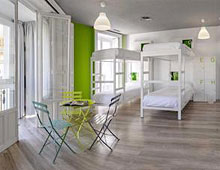 Budget accommodations
  Apartments
  Family Hotel
 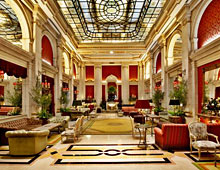 Luxury Hotel
 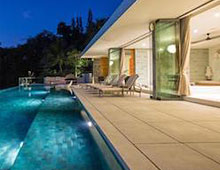 Resorts