Hotel L'Approdo
Castiglione della Pescaia - Via Ponte Giorgini 29
Set on Castiglione della Pescaia Harbour at the mouth of the Bruna River, Hotel L'Approdo features a rooftop breakfast terrace.
Book now
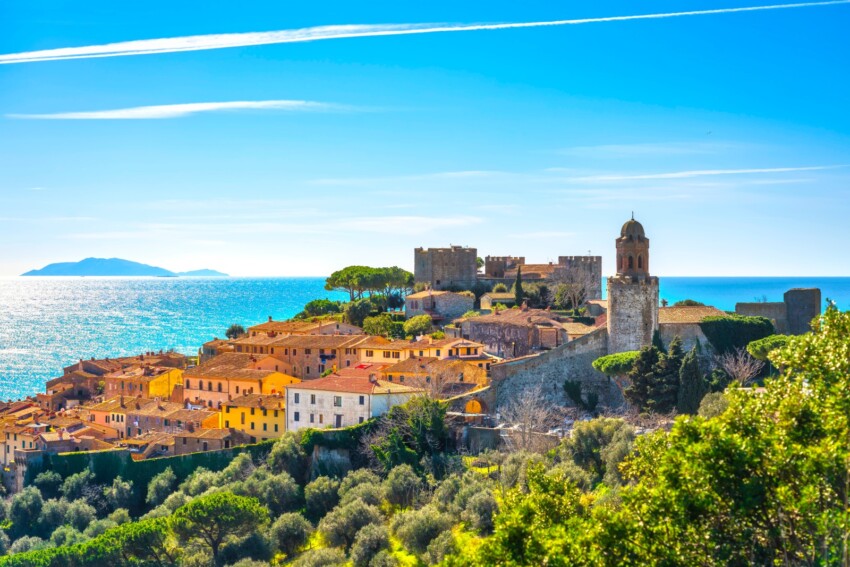
Castiglione della Pescaia is the gem of the Maremma Grossetana that brings together lovers of ancient villages and devoted beach holiday enthusiasts. There’s no need to choose here – you can have both.
The historic heart of Castiglione della Pescaia is a charming medieval village perched on Monte Petriccio, complete with town walls, towers, a castle, characteristic corners and sweeping panoramic views. Wandering through its narrow lanes in search of the finest vistas is pure magic, just as it is in all of Tuscany’s most beautiful villages.
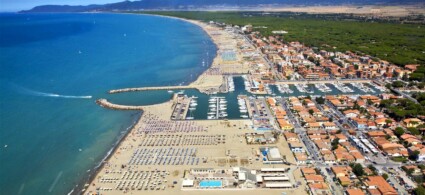
At the foot of the hill lies the coastal zone, and here you’ll find everything you’d expect from a lively seaside resort: a waterfront promenade, beaches, a fishing port-canal where fishing boats depart from, and a marina where you can hire private boats to reach the finest beaches of Argentario and the islands of Elba, Capraia and Giglio. This is also where the nightlife happens.
The romance of the village and the carefree spirit of beach holidays are Castiglione della Pescaia’s two best-known faces, but this resort is equally suited to those who love nature and culture.
For the former, Castiglione offers a pine forest, a lagoon and countryside perfect for a pleasant escape from city life and seaside relaxation; for the latter, historic palaces, a contemporary art park and the tomb of one of the 20th century’s most important writers.
The attractions in Castiglione della Pescaia are scattered throughout the town, from the historic village perched on the hillside to the waterfront and its immediate surroundings.
The iconic building of Castiglione della Pescaia is the magnificent castle sitting at the top of the hill on which the old village stands. Unfortunately it’s privately owned and is only open to the public on special occasions, but if you get the chance we recommend stepping inside, as the castle offers splendid panoramic views over the sea and the countryside behind the village.
The original core is extremely ancient, dating back to the 10th century, and consisted solely of a square-based watchtower. Its present appearance is more recent, owing to the Aragonese in the 15th century, with some modifications made by Cosimo I de’ Medici a century later.
The walls connect 11 medieval and Renaissance towers and 3 gates.
Another attraction in the upper part of Castiglione della Pescaia is the Church of San Giovanni Battista, a religious building built against the town walls. Locals affectionately call it the Chiesona.
It was built in the 16th century, converted from a former weapons storage; the bell tower, fashioned from one of the castle’s towers, was completed in the early 20th century to a design by Lorenzo Porciatti.
The interior reflects the simple and austere appearance of the exterior and is rather dark, but it houses an important 17th-century silver shrine and above all the relics of San Guglielmo of Aquitaine, known as San Guglielmo di Malavalle, the town’s patron saint.
Among the historic palaces to be admired in Castiglione della Pescaia’s old village, the most famous is Palazzo Centurioni. Built during the Renaissance, it was for centuries the heart of administrative life; today it is an active cultural centre.
Moving to the lower part of Castiglione della Pescaia, the modern section, the top attraction is the waterfront promenade, the nerve centre of town life and the nightlife scene. As you stroll along the waterfront, look up at the upper town to admire the castle and the Church of San Giovanni from below.
In the evening, if you want bars, entertainment and crowds, stay on the waterfront; if you prefer a quieter drink, head to the Corso della Libertà area.
The Diaccia Botrona Nature Reserve is an extensive wetland area stretching alongside the Pineta del Tombolo between Castiglione della Pescaia and Grosseto and represents what remains of an ancient lake reclaimed in the 18th century.
The landscape is typically lacustrine, characterised by reeds and reed beds amongst which numerous birds hide.
Within the reserve you can walk or cycle along trails and take part in birdwatching activities with ornithologists or photography workshops. The unmissable experience, however, is a guided tour of the reserve by small boat.
The Museo Casa Rossa Ximenes is an ideal gateway to the Diaccia Botrona Nature Reserve. It’s a building erected in the second half of the 18th century that served as a lock and regulated the flow of water between the marsh and the sea. It takes its name from the architect who designed it, commissioned by Grand Duke Pietro Leopoldo of Lorraine.
Today it houses the visitor centre for the nature reserve and an interactive multimedia museum.
Perhaps not an unmissable attraction for everyone, but if you love literature, take a moment during your stay in Castiglione to pay your respects to Italo Calvino, one of Italy’s greatest 20th-century writers who spent long periods here and wrote many of his works.
The tomb of Italo Calvino is in the municipal cemetery: as per the writer’s wishes, it is extremely humble – a simple marble slab surrounded by hedges of aromatic plants.
The Giardino Viaggio di Ritorno is an Environmental and Contemporary Art Park conceived by bio-architect and artist Rodolfo Lacquaniti. It’s an open space where contemporary art languages (installations, video art, sculptures, photography, live arts…) are employed for reflection on consumer society. Many works are indeed created using recycled materials, waste and scraps.
The park is only open by reservation.
The beaches in Castiglione della Pescaia are able to cater to all tastes, whether you’re looking for comfortable beaches with all the facilities or want to immerse yourself completely in nature.
The two town beaches, closest to the historic village, are Spiaggia di Ponente and Spiaggia di Levante: both are long sandy stretches with shallow waters. The first is reached on foot, while the second is easily accessible by local bus.
Both are equipped beaches with numerous beach clubs and facilities. Ponente is the busier one and is recommended if you want entertainment and social opportunities; Levante is quieter, suited to families and generally to those who want comfort but don’t like crowds.
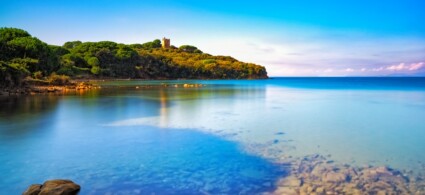
Completely different landscapes and atmospheres await those who venture a few kilometres from Castiglione’s centre to lay their towel at Spiaggia Rocchette, in the Roccamare area.
It’s a wild-looking beach nestled between tall rocky walls covered with dense vegetation; it’s largely sandy, but there’s also a small zone of pebbles and rocks. It’s reached on foot along a path of around 400 metres; the path entrance is reachable by bus.
Further north of Spiaggia Rocchette is the beach resort of Punta Ala, located near a headland at the southern tip of the Gulf of Follonica. Here there are two beaches, both sandy, with both free and equipped areas.
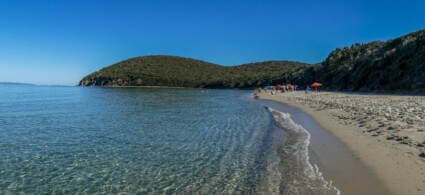
Even further away, accessible only by car, is Cala Violina, a beach renowned for a truly unusual characteristic: the presence of particular quartz means that when you walk on the sand you can hear a sweet sound, comparable to the melody of a violin.
The main choices for booking accommodation in Castiglione della Pescaia are two: stay in the historic village or near the beach. The guest facilities in the village are mostly bed and breakfasts, guesthouses and small apartments; on the waterfront the offer consists mainly of hotels, studio flats, holiday homes, campsites and holiday villages.
Staying in the village is recommended for a romantic weekend, whilst for a beach holiday it’s more convenient to be near the beaches. Sea view rooms are always the most sought-after, so if you want to secure one book well in advance.
There’s also a third option – staying in the surrounding countryside: this is the ideal choice if you want to immerse yourself in nature, away from the hustle and bustle. Be aware, however, that farm stays and rural houses a few kilometres from Castiglione tend to be in the mid to upper price range.
If you want to treat yourself to something special they’re perfect, but if you’re looking for something budget-friendly it’s better to look elsewhere.
We offer a selection of hotels at Castiglione della Pescaia to suit all categories of travellers. The most booked by tourists are the sea-facing hotels, often right on the beach. If you want to play it safe, choose one of the following: they are among the most booked hotels in Castiglione della Pescaia, sorted by number of reviews.
If you prefer space, privacy and the ability to prepare your own meals to a hotel holiday, book a holiday home at Castiglione della Pescaia. We recommend a few below, but in this case we advise you to book early because houses and apartments for rent at Castiglione della Pescaia are in high demand.
Getting to Castiglione della Pescaia by car is very straightforward. If you’re coming from the north take the Livorno-Grosseto motorway, exit at Follonica Nord and follow the signs to Castiglione.
If you’re coming from the south the recommended exit is Grosseto Sud. Follow signs to Marina di Grosseto and join the SS322, from there you’ll find signs to Castiglione della Pescaia.
Arriving at Castiglione della Pescaia by public transport almost always requires at least one change. The town has no railway station: the nearest is Grosseto, served by regional trains on the Rome-Pisa line; from Florence a change at Livorno is usually necessary. From Grosseto railway station you can reach Castiglione della Pescaia by local bus.
If you’re already in Tuscany, the bus is perhaps a more convenient option than the train. Regional buses connect Castiglione della Pescaia to the main towns in the provinces of Grosseto, Arezzo and Siena.
The nearest airport to Castiglione della Pescaia is Pisa.
What's the weather at Castiglione della Pescaia? Below are the temperatures and the weather forecast at Castiglione della Pescaia for the next few days.
Castiglione della Pescaia is a municipality in the province of Grosseto situated along the northern Tuscan coast. It lies roughly twenty kilometres from the provincial capital, 170 km from Florence, 135 km from Pisa and 95 km from Siena.
 Hotel
Hotel  Budget accommodations
  Apartments
  Family Hotel
  Luxury Hotel
  Resorts