Hotel Relais Santa Genoveffa
Paganico - Podere Santa Genoveffa, 29
Book now
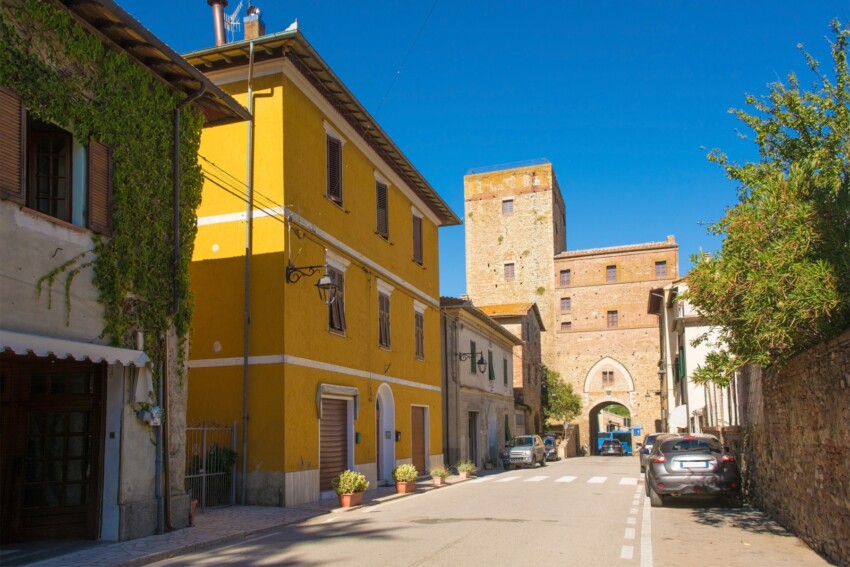
The municipality of Civitella Paganico is located in the province of Grosseto, bordering Siena province to the north, the municipalities of Campagnatico and Cinigiano to the south, and the municipality of Roccastrada to the east.
The landscape – predominantly hilly and intersected by the River Ombrone and numerous streams – boasts an exceptionally well-preserved natural environment where dense Mediterranean scrubland alternates with cultivated fields, testament to an economy based primarily on agriculture and the environment.
The villages in the municipality, almost all perched on hillsides with the exception of Paganico and Monte Antico, are surrounded by woodland and the unspoilt countryside of the Tuscan landscape celebrated worldwide. Oak and cypress trees alternate across the hills and plains, while dense shrubs such as strawberry tree, myrtle, heather and gorse cover them with vibrant colours throughout the year. This environment is home to wild boar, roe deer, hares, pheasants, partridges and, along the banks of the Ombrone, numerous species of water birds. The municipality’s territory also features a rare species of broom known as pendulous broom (genista aetnensis), which in late spring becomes adorned with thousands of tiny yellow flowers.
Beyond the treasure of the area’s natural beauty, the municipality of Civitella Paganico boasts a rich heritage of artistic testimonies from different eras, including churches and castles of considerable value. Its location along one of the major communication routes, the E78, makes Civitella Paganico’s territory an ideal base for exploring Tuscany’s most celebrated areas: from Siena to the Maremma coast, from the Val d’Orcia to the Metalliferous Hills, from Monte Amiata to the Val di Merse.
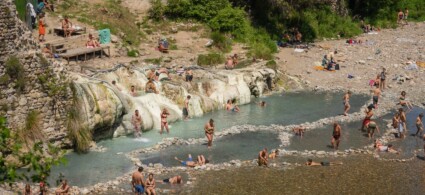
Among the area’s major attractions, one cannot overlook the Petriolo Thermal Spa, located on the border between Civitella Paganico and Monticiano municipalities.
The food and wine traditions offer yet another reason to visit the municipality. The local festivals held annually in the hamlets, the many accommodation facilities, excellent restaurants and trattorias, and the local wineries and olive presses offer visitors the best of local traditions throughout the year.
The village has a rich and well-documented history.
The “walled town” of Paganico was indeed created by the Sienese to guard the Ombrone Valley, serving as an outpost of the hills leading to Siena. It was built from scratch to serve Siena’s ambitions over the Maremma and its access to the sea.
That Siena held particular importance in the creation of this borough – also known as Castelfranco or Borgo-franco because it was exempt from any tax or duty for at least ten years – is also demonstrated by the appeals made to neighbouring municipalities to facilitate the construction of Paganico in various ways and by the incentives offered to those willing to settle there. Land plots were indeed distributed for building houses, and the municipalities of Civitella and the castles of Campagnatico, Sasso, Gello, Monteverdi, Casenovole and Montecodano were ordered to prepare special lime kilns for the necessary lime.
By 1295 the walls had already been begun and the gates constructed, with orders issued to find workers to complete the church. Paganico must have already been a very active centre, as early as 1273 it had been decided to hold a market every week, and September’s feast day of Sant’Angelo had been set for the grand celebration which for three consecutive days attracted merchants from neighbouring territories and Siena itself. This tradition survives today in the village festival organised to coincide with the feast of San Michele Arcangelo.
The fortification was completed in 1335 at an exceptional cost, testament to how much Siena valued this borough, necessary for controlling the Maremma and accessing the coast, particularly the port of Talamone. The Republic had indeed purchased it in 1303 from the Abbey of San Salvatore on Monte Amiata.
After the fall of the Sienese republic in 1555, Paganico too was ransacked by imperial forces, partially destroyed and its inhabitants massacred. Its territory was annexed to the Tuscan Grand Duchy which in 1602 made it a marquisate for Prince Antonio dei Medici, purportedly the son of Francesco I. The raising of the cassero gate was commissioned by the latter himself as a residence for the Marquis of Paganico.
Perched on the hilltop of one of the area’s hills, over which looms the highest, Poggio dei Lecconi (600m), Pari, like other villages within Civitella Paganico municipality, was a small settlement dating back to the Archaic Upper Paleolithic.
It was later inhabited by the Etruscans and Romans, as evidenced by archaeological finds now held in the museums of Grosseto, Siena and Florence.
Like Civitella, the Ardenghesca Counts chose it as their residence, and it later came under Siena’s influence between 1179 and 1254.
In the late thirteenth century the territory passed to other Sienese noble families, including the Rinuccini, Squarcialupi, Forteguerri, Buonsignori and finally the Malavolti. The latter acquired full ownership and jurisdiction of Pari to levy tolls.
The raids and insalubrity in the Ombrone valley caused a gradual decline of this fortress too, though with less impact than other castles.
With the Leopoldine reforms of 1766, Pari briefly came within the boundaries of the Lower Province with Grosseto’s jurisdiction, thus linking its fate to this province.
Pari is the birthplace of the great early twentieth-century writer Federigo Tozzi.
Casale, now referred to as Casal di Pari due to its proximity to the larger borough, sits on a hill at 470m altitude. It too was a small centre of the Ardengheschi who later submitted to Siena.
Little or nothing remains of the old settlement which should date back to the twelfth century, save for the ancient structure with its narrow lanes and a small square flanked by terraces and small arches.
In ancient times Casale comprised few dwellings for families working the fields and what is still called the Bishop’s Residence. This residence was built by Fabio De Vais, a Sienese nobleman, in 1573, as indicated by the coat of arms on the arch leading into the courtyard on Via Costeggio. Unfortunately, little remains of this noble building: some modest dwellings were created within it, destroying its original and clear architectural form.
The Church of San Donato dates to the fifteenth century and was completely rebuilt in 1700. The building is characterised by great simplicity both inside and out. An interesting feature is a stone inserted crosswise in the left jamb supporting the lateral portal known as the Porta degli Uomini (Men’s Gate). This stone bears a fragmentary inscription which appears to read S. Monachi De Ecclesis Vaecto (“Transported from the Church of the Holy Monk”). This suggests that this fragment came from the very ancient Convent in Val d’Aspra, dedicated to Sant’Antonio, of which only historical records and the ruins of a perimeter wall now remain.
Casale, an ancient village hidden among the woods, today remains a small village with fresh, healthy air and an old-world charm. Almost opposite stands the tall hill of Monteacuto, once the seat of a small commune and today covered by dense vegetation concealing ancient ruins.
To see all the facilities and book accommodation in Civitella Paganico use the form below, entering the dates of your stay.
 Hotel
Hotel  Budget accommodations
  Apartments
  Family Hotel
  Luxury Hotel
  Resorts