Casa Diana
Isola di Giannutri - Via cala spalmatoio Giannutri
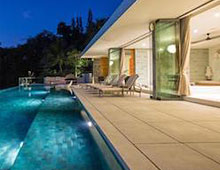
Located in Isola di Giannutri in the Tuscany region, Casa Diana features accommodation with access to a solarium.
Book now
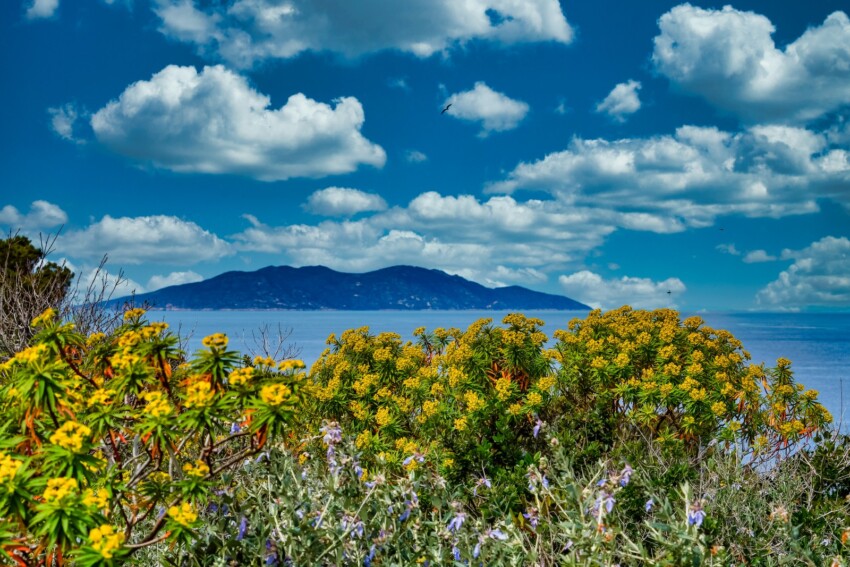
The tiny Giannutri, in the province of Grosseto, is the southernmost of the islands that make up the Tuscan Archipelago. A small strip of land in the middle of the Tyrrhenian Sea, reachable by ferry from Porto Santo Stefano, it is almost completely uninhabited, aside from the roughly 30 residents who live there year-round.
Giannutri is an almost entirely pedestrian island, and distances are never excessive: from the northern tip, Punta Secca, to the southern one, Punta del Capel Rosso, there is less than 3 kilometres as the crow flies. The inhabited centre, officially called Spalmatoio-Ischiaiola, is located roughly halfway along the island, on the eastern side, and this is where ferries from the mainland dock.
Unfortunately, or fortunately depending on your perspective, much of Giannutri is protected by the authority that governs the Tuscan Archipelago National Park. For this reason, you cannot wander freely around the island; you can only walk along the path that connects the two main coves, Cala Maestra and Cala Spalmatoio respectively, where you can swim without restrictions. The rest of the island is subject to strict restrictions and can only be visited with an authorised tour guide. Part of the coastline is a protected area, where access is forbidden both by land and by boat.
There are two coves freely accessible on Giannutri: Cala Maestra and Cala Spalmatoio. Others can be reached by following the numerous trails on the island, but only when accompanied by a guide, or by boat.
The ferry arrives at Giannutri via Cala dello Spalmatoio, which overlooks most of the island’s buildings. It is a fairly deep cove where the coastline is almost entirely rocky. The water is crystalline and offers stunning shades of turquoise, but being the easiest to reach and right next to the inhabited centre, it is also the busiest on the island.
On the opposite side of Cala Spalmatoio, reachable on foot via a convenient path less than a kilometre long, you’ll find Cala Maestra, the second of Giannutri’s freely accessible beaches. Here you can stretch out on the small sandy and pebbled beach, whilst at one end there is a concrete platform where you can sunbathe surrounded by rocks.
Cala Schiavone, or Cala dello Schiavo, makes up much of Giannutri’s eastern coastline, just south of Cala Spalmatoio. It can only be reached by boat, and there are no beaches: the shoreline is entirely rocky, with difficult sea access—it’s better to moor just a few metres from shore and enjoy it from there.
Cala Volo di Notte sits just below Cala dello Schiavone, in a very calm and serene area with deep blue waters. You can reach it on foot from Cala Spalmatoio in roughly a 40-minute walk along well-marked trails. Getting into the water is tricky because of the sheer rock faces, but it’s worth stopping at the top just to admire the stunning views.
On tiny Giannutri, the only notable cultural attraction is a series of Roman remains: the ancient port at Cala Spalmatoio and an ancient villa near Cala Maestra. This is Villa Domizia, built by the Domitii Ahenobarbi, who owned Giannutri at the time. The villa boasts marvellous sea views and covered 5 hectares of land. There was even a terrace from which you could access the sea directly via a staircase.
Following archaeological excavations conducted in the last century, the floors have been brought to light, decorated with splendid marble and mosaics in black and white tones. Inside, Giannutri’s Roman villa included an area dedicated to the imperial family, as well as a slave quarters and even bathhouses.
The Roman villa, part of a series of villas that extends across Argentario and the island of Giglio, can only be visited with one of the park’s guides. There is a maximum limit of 75 people per day.
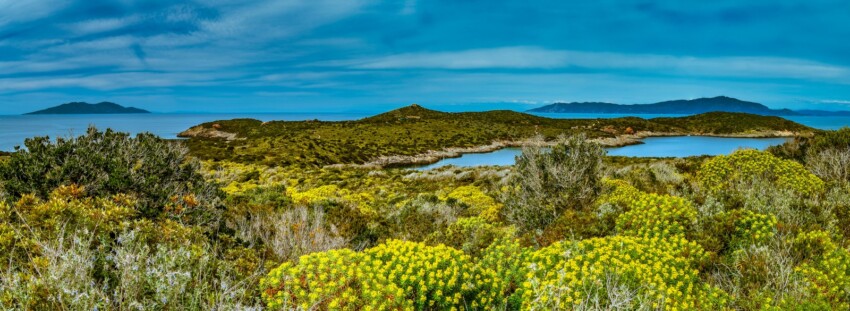
Giannutri is part of the Tuscan Archipelago National Park, and much of its surface is a protected area, so you cannot move freely around the island.
Entry requires purchasing a ticket costing €4 per day, valid all year round, except for children under 12, school groups, people with disabilities and island workers, as well as residents, property owners and tenants of course. Tickets are purchased together with the ferry ticket at Porto Santo Stefano, or from the Giglio Island tourist office, or online on the park’s website.
Once on the island, some areas are freely accessible, whilst others can only be visited with a guide.
Freely accessible areas include the entire path from Cala Maestra to Cala Spalmatoio, a roughly one-kilometre route that cuts across the island from west to east starting directly from the port. Both coves are suitable for swimming without restrictions.
Other areas of Giannutri can only be visited with a guide, for reasons of environmental protection and safety. These include the entire network of trails, which stretches for over 8 kilometres, obviously excluding the freely accessible section between Cala Maestra and Cala Spalmatoio. Island residents, property owners and tenants are not required to be accompanied by a guide.
The coastline of Giannutri is also regulated: there is a free zone corresponding to Cala Maestra and Cala Spalmatoio, whilst the rest of the island is divided into Zone 1, or Zone A, which is an integral reserve where access, navigation, fishing, diving are all forbidden, and Zone 2, which is a nature reserve and therefore fishing is regulated by the Park Authority, and boat mooring is allowed.
Zone 1 (or Zone A) includes the north-east section, with Cala dello Scoglio and the right part of Punta Secca, a stretch of coastline just north of Cala Maestra, and the entire southern part of the island including Punta del Calettino, Cala Brigantina and Punta del Capel Rosso.
Zone 2 (or Zone B) includes a section of the northern coast of Giannutri, between two Zone 1 areas, and a section of the western coast where Cala Ischiaiola is located.
Accommodation options on Giannutri are extremely limited; a common solution for those wanting to visit the island is to stay on Monte Argentario instead.
Giannutri is typically a summer destination, whilst there is little to do in winter. The days of late spring are also highly recommended, when it is pleasant to walk along the island’s numerous trails, though you won’t be able to swim in the sea. Keep in mind that outside the season, practically all tourist services are closed, including bars and restaurants.
Giannutri is reached by ferry from Porto Santo Stefano, located on the Argentario promontory. The route is operated by Maregiglio using the motorship Costa d’Argento, which has a capacity of 350 passengers; ferries depart on Wednesdays and Saturdays throughout the year. The crossing takes about an hour.
Note that vehicles cannot be transported, unless you are a resident or travelling for work. If you’re driving, you’ll need to leave your car in one of the long-stay car parks at Porto Santo Stefano; there are several near the port.
The ferry ticket to Giannutri is purchased directly at Porto Santo Stefano, at the ferry ticket office located right in front of the port. Alternatively, to be sure of getting a place, you can book online in advance using the platform provided by the official Maregiglio website.
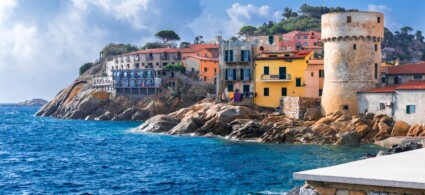
 Hotel
Hotel  Budget accommodations
  Apartments
  Family Hotel
  Luxury Hotel
  Resorts