Pian Dei Mucini Resort
Massa Marittima - Localita' Pian Dei Mucini
Set in the peaceful Tuscan countryside, Pian Dei Mucini Resort is a 5-minute drive from the centre of Massa Marittima.
Book now
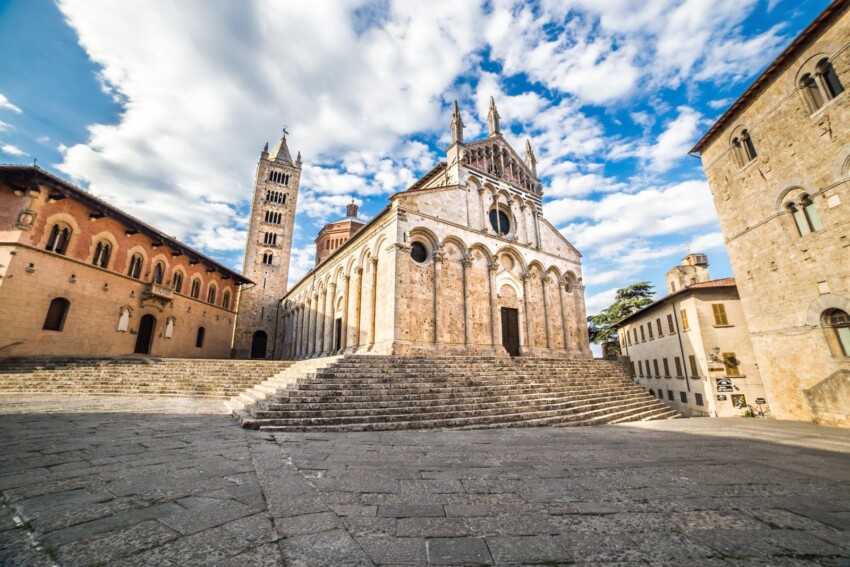
Massa Marittima is located in Grosseto province, and despite what its name might suggest, it sits not on the coast but inland. You’ll find it in the heart of the Metalliferous Hills, which rise behind the Tyrrhenian Sea for much of Tuscany’s coastline, in an area of considerable natural, historical and artistic value.
When you visit Massa Marittima, you’ll be able to admire a beautiful Romanesque cathedral, a noteworthy museum housing numerous sacred artworks, as well as elegant palaces and the remnants of old town walls. It’s a true gem that spreads across just a handful of streets and piazzas, making it very straightforward to explore on foot—even for visitors staying on the more prestigious and busy Grosseto coast: the resort town of Follonica, for instance, is just a 20-minute drive away.
For this reason, you might even use Massa Marittima as a base for your seaside holiday in the Grosseto Maremma: you can stay in a beautifully preserved medieval village, enjoy the peace and quiet of the Metalliferous Hills, and still be just minutes by car from the beaches.
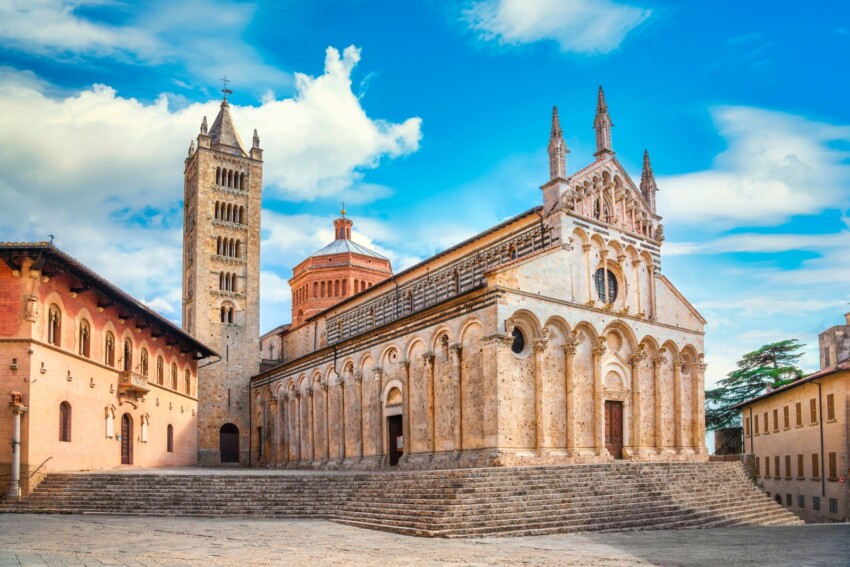
Despite its compact size, Massa Marittima’s centre has plenty of things to see. Start your visit at Piazza Garibaldi, the town’s beating heart, then explore on foot through the narrow side streets, making sure you don’t miss any of the main monuments and attractions.
The Cathedral of San Cerbone, designated as an Italian national monument by the state, is Massa Marittima’s cathedral. It’s a Romanesque church built between the 11th and 14th centuries, with various additions over subsequent centuries that have given it the appearance we see today.
At 60 metres long with a bell tower standing at nearly 40 metres high, the church is by far the largest in the entire municipal area and one of the most important in all of Grosseto province. Externally, the façade clearly shows the influence of Pisan Romanesque style. The panels of the main portal feature low-relief sculptures of the Stories of San Cerbone, dating from the early 13th century, whilst inside there are three naves separated by hefty columns, where you can admire splendid works including a notable 13th-century baptismal font, the 14th-century stained glass in the central rose window and Duccio di Buoninsegna’s Majesty from 1316.
Opened in 1867, the Archaeological Museum of Massa Marittima occupies rooms within the Palazzo del Podestà. It was founded by Stefano Galli di Modigliana, a scholar of local history, whose father donated a collection of artefacts and finds to the newly established institution.
The exhibition layout spreads across two floors of the palace.
Within the San Pietro all’Orto museum complex, at Corso Diaz 36, you’ll find the Museum of Sacred Art of Massa Marittima, established in 2005. Most works come from the cathedral, and the exhibition flows across five rooms spread over two floors.
On the ground floor, you can see alabaster bas-reliefs, capitals, Gothic sculptures, a fine crucifix by Giovanni Pisano and an extensive section dedicated to 14th-century art, notably including Antonio Lorenzetti’s Majesty and a Crucifix by his brother Pietro Lorenzetti.
On the upper floor, there are ceramics from across Italy, a large room devoted to 15th-century painting and art, and three interesting installations displaying furnishings and floor tiles from surrounding churches.
From the museum you can also access the Angiolino Martini contemporary art exhibition centre, where 20th-century paintings and graphics are on display.
The elegant Town Hall of Massa Marittima stands at Piazza Giuseppe Garibaldi 10, and its distinctive feature is that it comprises the union of two tower houses from different periods—one from the 13th century and another from the following century, to which also belongs the central section connecting them.
The façade bears the emblem of the Medici family, placed there in 1555 when the territory was conquered by the Grand Duchy of Tuscany. Inside the town hall is a splendid 16th-century chapel, the Chapel of the Priors, now the mayor’s office, whilst in the atrium you can admire the sculpture Icarus by Polish sculptor Igor Mitoraj.
On the other side of Piazza Garibaldi stands the fine Palazzo del Podestà, another of Massa Marittima’s historic palaces. It was built in the early 13th century, and as is often the case in Tuscan villages, its original purpose was to house the podestà—the official who represented the city’s executive authority. For this reason, its façade still displays the coats of arms of the various podestà who served throughout the centuries.
Since 1978, the palace has housed the exhibition rooms of the Archaeological Museum of Massa Marittima.
The Convent of the Clarisse, or Santa Chiara Convent, is located in Piazza XXIV Maggio. Founded by Saint Bernardino of Siena, who was born and lived in Massa Marittima, it now houses the town’s public library, named after Gaetano Badii, a historian native to Massa Marittima.
The library holds approximately 30,000 volumes, including around 300 from its precious antiquarian collection. The mining archives are also noteworthy, preserving documentation produced in the 20th century by mining companies operating in the area.
The medieval town walls of Massa Marittima encircle the historic core of the city. Construction began around the 12th century, featuring watchtowers and gates for entering and leaving the old town, of which only a few remain standing. The walls were expanded in subsequent centuries under Sienese rule, who also built the symbolic Cassero Tower. They began to deteriorate and fall into disrepair around the 19th century. Fortunately, today, thanks to numerous restoration projects, several sections and various gates have been restored to their former glory.
Founded in 1993 on the initiative of the Photography Group of Massa Marittima, the festival, particularly in recent years, has enjoyed considerable public success, featuring exhibitions by some of the most significant contemporary photographers, from Oliviero Toscani to Lucien Clergue to Antonio Salgado.
The Tuscany Photo Festival opens in August with photographic exhibitions, talks and screenings, while in September it offers enthusiasts workshops conducted by internationally renowned figures on techniques and secrets that allow visitors to experiment and understand how photography can become authentic artistic expression.
In Massa Marittima’s small historic centre there are plenty of accommodation options to choose from, ranging from hotels to bed and breakfasts, family-run apartments to holiday homes. There are options for every budget and category, so you’ll be spoilt for choice. Staying in the centre puts you close to all the monuments and amenities such as shops, bars and restaurants.
If instead you’re seeking maximum tranquillity and want to spend your holiday immersed in the Tuscan countryside, venture a few kilometres out and you’ll be surrounded by nature and bucolic landscapes. Here you’ll find several farmhouses, country cottages and agriturismos, all finely restored properties offering maximum comfort and top-tier services to their guests.
We offer a selection of hotels at Massa Marittima to suit all categories of travellers. The most booked by tourists are the sea-facing hotels, often right on the beach. If you want to play it safe, choose one of the following: they are among the most booked hotels in Massa Marittima, sorted by number of reviews.
If you prefer space, privacy and the ability to prepare your own meals to a hotel holiday, book a holiday home at Massa Marittima. We recommend a few below, but in this case we advise you to book early because houses and apartments for rent at Massa Marittima are in high demand.
Massa Marittima lies north of Grosseto province, not far from the border with Livorno province. It’s situated inland yet just 20 minutes from the coast, and so, although its position is somewhat isolated, it’s never too complicated to reach.
From Florence you have two options: the longer route—but by far the more convenient—involves heading to Livorno via the SGC FI-PI-LI and then continuing on the A12 motorway heading south to the Rosignano Marittimo tollbooth, continuing along the SS1 Aurelia to Follonica, and finally taking the SR439 Volterrana regional road to Massa Marittima. The alternative is about half an hour shorter but more inconvenient: it takes you through the heart of Tuscany, via the inland Siena region and the Val d’Elsa, entering Grosseto province from the north. Except for a stretch of the Florence-Siena junction motorway as far as Colle Val d’Elsa, there are no fast roads: it does, however, allow you to enjoy the scenery and make the most of your Tuscan holiday.
From other Tuscan cities, the routes are far more straightforward: from the coast, for example from Pisa or Livorno, it takes roughly an hour, following the SS1 Aurelia heading south to Follonica, then continuing on the SR439 Volterrana. From Siena the distance is also about an hour, using provincial roads SP73bis and SP441, passing near the San Galgano Abbey.
Finally, from the provincial capital Grosseto it takes about 40 minutes for a distance of just under 50 kilometres. In this case you head north along the Aurelia to the Gavorrano Scalo junction, from where you take a short stretch of the Collacchia provincial road, then turn left at the entrance to the Accesa provincial road, which leads directly to Massa Marittima.
Regarding public transport, Massa Marittima is connected to Follonica by the 37F intercity bus, which departs roughly once an hour from the town’s railway station. The bus journey takes about 35 minutes. Regional trains serve Follonica on the Pisa-Grosseto line; from Florence Santa Maria Novella there are some direct services, particularly in the morning, but it’s far more convenient to change at Pisa Centrale due to the greater frequency of trains. The entire journey from Florence to Massa Marittima takes between 3.5 and 4.5 hours, depending on connection waiting times.
What's the weather at Massa Marittima? Below are the temperatures and the weather forecast at Massa Marittima for the next few days.
The history of Massa Marittima is closely tied to the silver, copper and pyrite mines of the Metalliferous Hills, exploited since the earliest metal age (3rd millennium BC) and particularly during the Etruscan and medieval periods.
Its development was greatly aided by the transfer of the bishop’s seat from Populonia, possibly as early as the 9th century, and around the castle of Monteregio, seat of the feudal bishop, the city grew. The period between the 13th and 14th centuries saw the city reach its peak of economic, political, demographic and cultural splendour, becoming a Free Municipality (1225) thanks to the wealth of its mining basins, reaching 10,000 inhabitants and minting its own currency, the “grosso massetano”.
The finest artistic and monumental structures date to this same period—those that still characterise Massa Marittima’s urban fabric today. On the main piazza (now Piazza Garibaldi) stood all the buildings necessary for a city’s public life: the Cathedral (12th-13th centuries with later additions), on which Nicola Pisano worked; the Palazzo del Podestà, now home to the Archaeological Museum, the Town Hall, the Market Loggia, the Public Fountain and the Mint.
In 1335 Massa Marittima lost its political independence when it fell to Siena’s conquest, as Siena had long sought to control the Massa mines. A period of economic and demographic decline followed, worsened further by the plague of 1348.
Despite these serious difficulties, mining activity was never completely abandoned, though it was certainly greatly reduced. The Medici, who from 1557 added the Sienese province to the Grand Duchy, attempted some measures to encourage the territory’s recovery, whilst a significant revival occurred from 1737 with the arrival of the Lorraines as successors to the extinct Medici family.
Mining activity began its definitive decline from the 1980s onwards. Since then Massa Marittima has discovered and developed its new tourism vocation, dedicating particular attention to enhancing its historical and artistic heritage.
Massa Marittima is located in the province of Grosseto, in the Maremma hinterland, not far from the border with the province of Livorno.
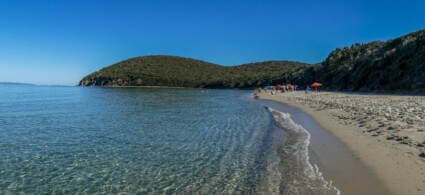
 Hotel
Hotel 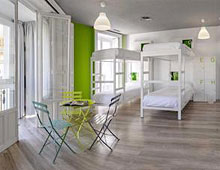 Budget accommodations
  Apartments
  Family Hotel
 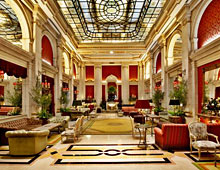 Luxury Hotel
 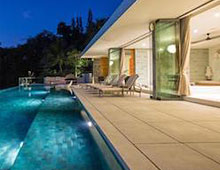 Resorts