Podere Montale Il Borgo
Seggiano - Località Casacce, 58038 Seggiano GR
Book now
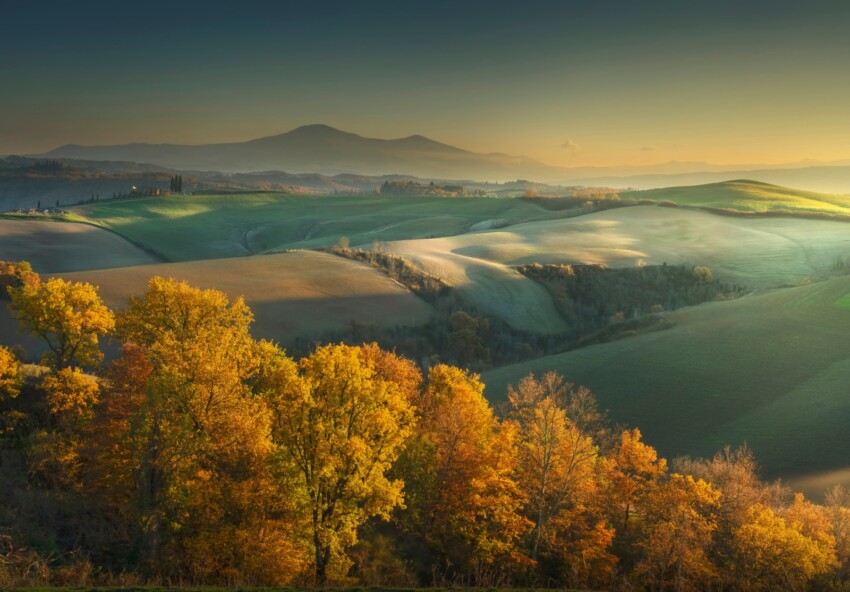
Breathtaking panoramas, abundant nature and crystal-clear skies. That’s a snapshot of Monte Amiata, originally a volcano, nestled in the heart of Tuscany straddling the provinces of Siena and Grosseto. A must-visit destination, whether you’re coming in summer or winter: during the warmer months, you can spend wonderful days outdoors walking the numerous trails in the area, whilst six months later Amiata turns white, allowing skiing and snowboarding enthusiasts to indulge in their favourite sport.
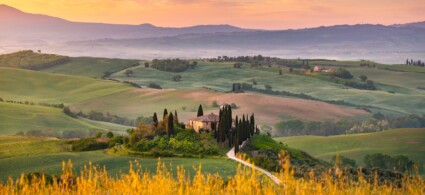
A year-round destination then, and don’t forget we’re in Tuscany, in an area that, Monte Amiata aside, showcases the famous rolling hills, vineyards, neat rows of vines and everything that makes this region one of the most beloved destinations for travellers from around the world. Spending a holiday here means you can combine a visit to one of central Italy’s highest and most imposing peaks with the discovery of classic Tuscan vistas, for a truly unique and winning mix centred on nature.
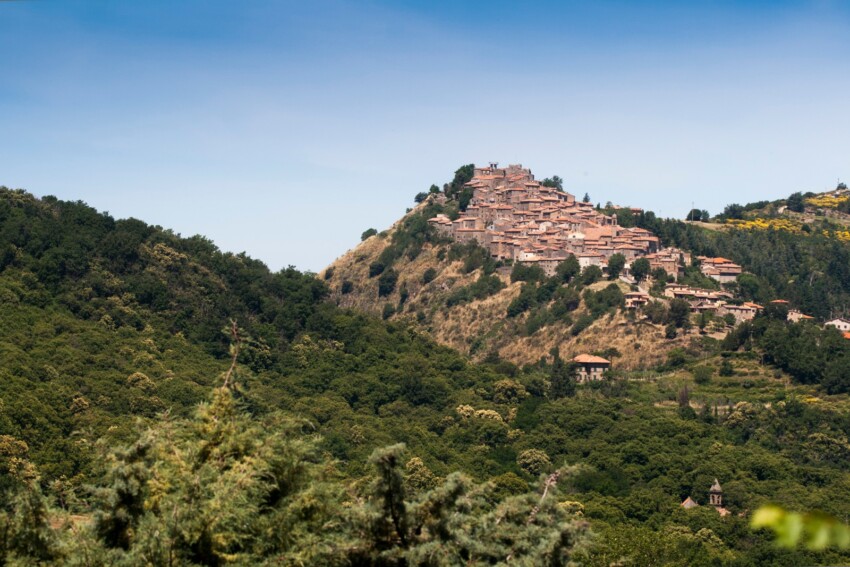
Monte Amiata comprises 8 municipalities, 3 in the province of Siena and 5 in the province of Grosseto: these are Arcidosso, Castell’Azzara, Castel del Piano, Santa Fiora, Seggiano, Abbadia San Salvatore, Castiglione d’Orcia and Piancastagnaio. A further 5 municipalities spread across the two provinces are added to these, which don’t directly include the mountain but are part of the Union of Monte Amiata Municipalities. In total, including the municipalities in the Union, the area has a population of 32,000 inhabitants.
Arcidosso is the chief town of the Union of Amiata Grossetano Municipalities, and has a population of around 4,500 inhabitants. Its historic centre sits on the summit of a hilltop, and among the sights worth seeing are the Church of San Niccolò, the oldest in the town, the lovely Capuchin convent and the fascinating Gompa di Merigar West, a Tibetan sacred building, located on Monte Labbro.
The small town of Castell’Azzara, at 815 metres altitude, holds the record for highest municipal seat in Grosseto province. When you visit, be sure to see the Church of San Nicola di Bari, which contains a fine 17th-century painting of the Assumption with Saints Martin and Niccolò, and walk along Via Dante Alighieri, where you can stop to admire the town hall, built in the 19th century in Renaissance style. The Rocca Aldobrandesca, or fortress of Castell’Azzara, is also well worth visiting – a 13th-century fortification built at the highest point of the settlement.
Castel del Piano is the largest and most populated municipality on the Grosseto side of Amiata. It’s home to nearly 5,000 inhabitants, and once in the centre, visit the Church of the Propositura, located just outside the Clock Gate, and the lovely Church of Santa Maria delle Grazie, in Piazza Madonna. The town is encircled by walls dating from the 13th century and still well preserved today. The three gates that open in them are the Clock Gate, the Castiglionese Gate and the Spennanziana Gate.
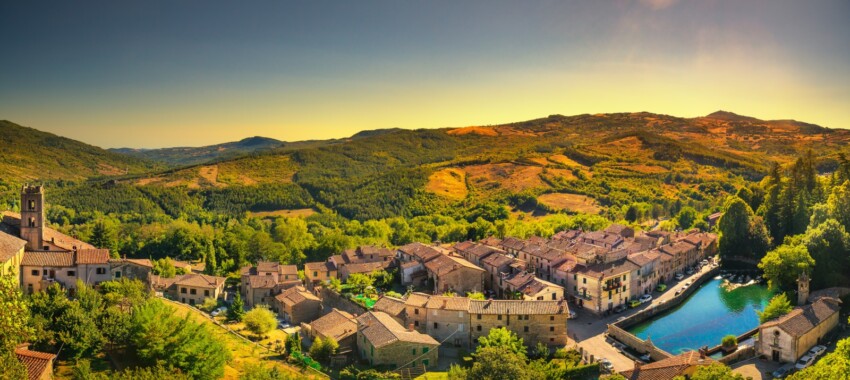
The municipality of Santa Fiora, in Grosseto province, is part of the most beautiful villages in Italy club, and at the same time has been awarded the prestigious Orange Flag recognition by the Touring Club Italiano, thanks to its tourist, environmental and historical-cultural qualities.
Visit its historic centre, whose heart is Piazza Garibaldi where you’ll find the clock tower, Palazzo Pretorio and Palazzo Sforza Cesarini, and don’t miss the Church of Saints Flora and Lucilla, dating from 1142. Particularly charming is the Peschiera, a garden park located in the Montecatino quarter, which features a pool that has served as a water trough and later as a public wash house throughout its history.
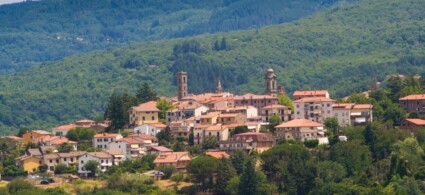
Among the Amiata municipalities is Seggiano, in Grosseto province. It’s the smallest of the 8, with fewer than 1,000 inhabitants, and is positioned on the summit of a hilltop not far from the Orcia river bed. Visit the Church of San Bartolomeo, the ancient Colombaio Convent and the lovely Sanctuary of the Madonna della Carità, restored multiple times since its construction to the present day.
Seggiano is encircled by walls that completely enclose it; access is through three gates, called San Gervasio Gate, Azzolini Gate and Market Gate.
Abbadia San Salvatore is located in Siena province and is one of the larger and more populated municipalities of Amiata. It takes its name from the Abbey of San Salvatore, which for over a thousand years housed the famous Amiatine Bible, the oldest Latin manuscript copy of the Bible, now held at the Biblioteca Medicea Laurenziana in Florence.
After visiting the abbey, don’t miss the Don Roberto Corvini Museum of Sacred Art, housed in the eastern wing of the cloister, where you can admire the monastery’s treasures. The mining heritage of Abbadia San Salvatore is on display at the Mining Museum, where you can explore a gallery around 300 metres long with reconstructed miners’ workplaces.
Castiglione d’Orcia is relatively distant from Monte Amiata, but is certainly the most significant tourist destination in the area, as it overlooks the famous Val d’Orcia, a UNESCO World Heritage Site since 2004. Among its hamlets is the renowned thermal resort of Bagni San Filippo.
Piancastagnaio, a municipality of Amiata in Siena province, is situated at the southern tip of Tuscany, on the border with Lazio and Viterbo province. In its small but charming historic centre you can visit the Aldobrandeschi Castle, an interesting 19th-century public wash house, and the monumental Witches’ Plate, a piperine stone plate accessible on foot via a path, at the centre of a curious legend that tells of three little girls abducted by witches who, unable to decide which one to eat, began to quarrel, and consequently released them.
In the following map you can see the location of the main places of interest mentioned in this article.
In the Monte Amiata area, in summer there’s an embarrassment of choice: combining historical and naturalistic itineraries, you can spend wonderful days outdoors enjoying an active holiday.
Don’t miss long walks through woods and forests, within the numerous nature reserves and protected areas in the zone, including the Monte Labbro Nature Reserve, the Amiata Faunistic Park and the WWF Bosco Rocconi Oasis.
Then explore the Hermitage of David Lazzaretti, the so-called “prophet of Amiata”, centre of the Giurisdavidic community that he founded in the mid-1800s, before being killed by a group of soldiers at the entrance to Arcidosso during a procession.
Monte Amiata in summer is synonymous with trekking: through its woods run 19 marked trails covering approximately 210 kilometres. You can walk them, or cover them on horseback or by mountain bike. Among these, the most famous is certainly the Amiata Ring Trail, a circular route of about 30 kilometres that circles the entire mountain, maintaining a constant altitude between 1,100 and 1,300 metres. The full route takes around a dozen hours.
Then head to the summit of Monte Amiata, where you’ll find a monumental iron cross, standing 22 metres high, created by Sienese craftsman Zalaffi. If you wish to follow in pilgrims’ footsteps, return to the valley and head towards Abbadia San Salvatore, which lies on the Via Francigena.
If travelling with children, don’t miss the Indiana Park acrobatic park and the adventure park, both located in the Prato delle Macinaie area.
In the wooded area below the perimeter of the Faunistic Park, to the North, North-East of Podere dei Nobili (Park Management), crossed by the Onazio stream, the nature trail winds through – a route purposefully organised with wooden handrails, fords for crossing the stream and indicator signs for the most significant plant species, allowing visitors to experience the forest, observe it, study the vegetation, cross the Onazio, and visit the gorge.
The route is pleasant and interesting, suitable for moderately demanding trekking, immersed in a mixed forest tending towards tall trees or along the bed of the Onazio stream and the gorge.
The nature trail winds through various types of vegetation until it reaches and crosses the Onazio stream. The forest, composed of aged coppice woodland, is bordered on its eastern and western edges by fruit chestnut groves and tall-tree forests.
Multi-day trekking enthusiasts can combine the routes in various ways, or use the marked trails that connect the Amiata paths with some of the most interesting locations in the Maremma and Siena areas. Along the routes marked by Grosseto Province you can reach Pitigliano, Saturnia, Scansano and Argentario, whilst the Siena Province routes allow you to reach Montalcino, Pienza, Montepulciano, Chiusi and Siena itself. The Florence-Siena-Rome Trail, opened in 1996, connects Tuscany’s capital with the capital of Italy through 25 stages, and crosses the Amiata forests and Monte Labbro pastures.
All the marked trails of the Amiata and its immediate surroundings can also be walked as part of horse-trekking trips organised by specialist operators.
Many routes (not all, though) can be used by mountain-bike enthusiasts for their itineraries. On most of the Amiata routes, however, the recommended vehicle is a comfortable gravel bike, capable of adapting to tarmacked roads, dirt tracks and all gradients.
Whilst the frame of these bikes ensures a relaxed saddle position, the mechanics are essentially the same as a mountain bike. Traditional cycle touring (limited to tarmacked roads) also finds a very wide range of possibilities on the roads of Monte Amiata, upper Maremma and Val d’Orcia. The only route crossed by very heavy traffic is the Via Cassia, so it’s wise to avoid it. On other routes, gradients can present challenges. The five roads that climb towards the Amiata summit, in particular, are recommended only for very fit cyclists.
For those wishing to venture into speleology, you can explore the Sassocolato or Bacheca cave, within the Monte Penna Nature Reserve. The presence inside the cavity of a bat colony that’s best left undisturbed means visits to the cave are limited to certain months of the year, and are guided by members of the L’Orso Speleological Group of Castell’Azzara.
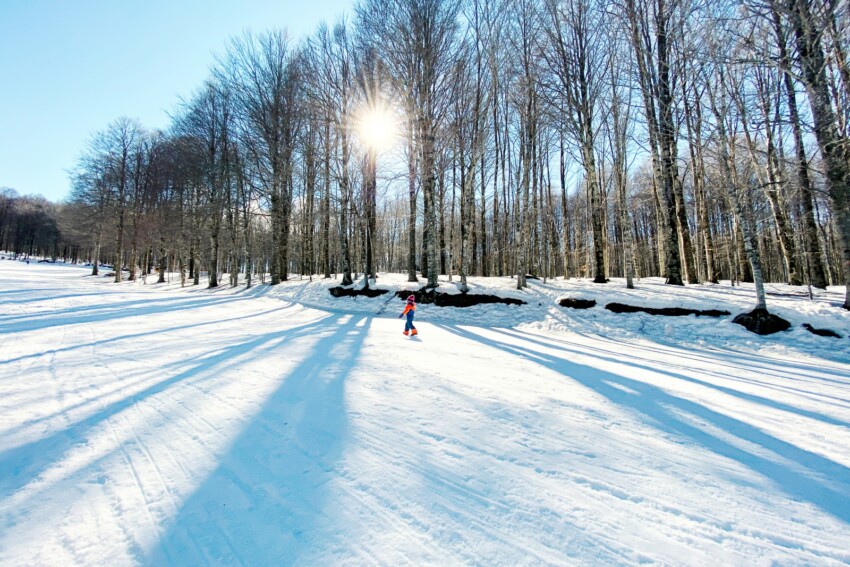
For skiing enthusiasts from southern Tuscany and northern Lazio, looking for a snowy weekend Monte Amiata is the ideal choice. It’s a small ski resort, comprising 10 downhill runs, a ski school area and a 2-kilometre cross-country skiing loop. There are also various trails for snowshoeing and routes for ski touring.
The resort is served by 8 ski lifts, comprising 3 chairlifts, 4 drag lifts and a conveyor belt. There are 12 downhill runs in total spanning 10 kilometres of skiable terrain, including 2 black runs, 7 red runs and 8 blue runs. The highest peak is at 1,738 metres above sea level; there are also several mountain refuges where you can have lunch or refreshments.
The ski lifts depart from the locations Macinaie and Contessa, in Grosseto province, and Cantore, in Siena province. To reach them you need to take the Monte Amiata provincial road, which winds along the mountain.
The Amiata wildlife park is set in a mountainous area of particular natural and scenic value, employs modern exhibition solutions and methodologies that respect animals, and provides the ideal environment for the presence and observation of numerous species of wild fauna.
The Monte Amiata wildlife park represents a new addition to the national park system; it takes inspiration from German Wild Parks, but adds newer content and objectives to those experiences, along with innovative ways of engaging visitors.
It serves as a technical and scientific tool for experimentation and natural territory management; it is run according to the directives of Local Authorities who use it to organise educational activities and awareness-raising initiatives, research and study projects, and the conservation of animal and plant species at risk of genetic erosion and extinction.
Within the integrated wildlife areas, there are animal species that have played, or have previously played, a role in the ecological balance of our region, and which, though not part of the area, is characterised by Apennine-type environments.
Visits are made by walking along specially equipped trails that must not be left. One distinctive feature is that there are no physical barriers between visitors and animals.
Many animal and plant species are presented here, including, to name just a few, deer, roe deer, fallow deer, chamois and mouflons; numerous species naturally present in the park’s territory, some of which are rather rare.
Walking along the trails, or from a specially built observation platform, you may spot the rare and proud Apennine wolves, otherwise extremely difficult to observe in their most natural behaviour.
Just near the Monte Amiata summit there are several accommodation options, ideal for being within arm’s reach of the peak and immersed in nature in every direction, whether in summer or winter. These are almost exclusively 2 and 3-star hotels, open year-round, and equipped with all necessary services. However, they are rather isolated, so you may prefer to stay in less remote locations.
For this reason, the two recommended places to stay near Monte Amiata are Abbadia San Salvatore, on the eastern side in the province of Siena, and Castel del Piano, on the western side in the province of Grosseto. Both are around 15 kilometres from the Amiata summit and offer various accommodation options, ranging from hotels to small flats, as well as bed and breakfasts.
From Florence, there are two equally viable routes to reach Monte Amiata in terms of distance and travel time. Whichever you choose, it will take around 2 hours and 15 minutes.
The first route passes through the province of Siena via the Florence-Siena motorway link to the provincial capital, then onto the SS223 state road to Paganico, finally taking the Cipressino provincial road through Montenero and Arcidosso. Arriving at Aiole, you take the Aiole provincial road which winds up to Monte Amiata.
The second route passes through the provinces of Arezzo and Siena: take the A1 motorway heading south to the Chiusi-Chianciano Terme junction, then take the SP146 provincial road towards Chianciano. After passing through the town, continue along the SP40 and SP61, passing through the famous Bagni San Filippo and continuing to Abbadia San Salvatore, then up the climb that leads to the Monte Amiata summit.
As for other Tuscan provinces, it takes around an hour and a half and 100 kilometres from central Siena, an hour and 40 minutes from Arezzo, two and a half hours from Pisa and Livorno, and just over an hour from Grosseto. Bear in mind that Monte Amiata is quite far from Tuscany’s main communication routes, so you’ll be dealing with provincial roads, many bends and fairly slow average speeds.
Bad news too for those wanting to reach Monte Amiata by public transport: there are no railway stations nearby; the closest ones are Siena, Grosseto and Chiusi-Chianciano Terme, all well served by regional and intercity trains, but several tens of kilometres away. If you’re travelling by train, once you’ve arrived at one of these three stations you’ll need to continue by bus to Arcidosso, on the western side of the mountain, or Abbadia San Salvatore, on the eastern side. Allow between 4 and 6 hours of travel time from central Florence.
When nature’s generosity combines with man’s age-old skill, authentic delights for the nose and palate are born, such as the extra virgin oils of the Val d’Orcia and other valleys descending from Monte Amiata. The main protagonist, though other varieties often accompany it, is a small, wrinkled and rather unattractive little olive, the Seggianese variety.
It produces an oil with an intense fruity character, fresh and herbaceous, medium bodied, with a fairly round taste that is astringent and peppery, very flavourful, with a distinctly bitter and spicy finish. Amiata at Table, an event held in May-June and November that will guide visitors through the magical mountain, will be an opportunity to offer more: learn from real experts how to recognise good oil and use it properly, perhaps accompanied by the typical savoury biscuit, an ingenious and delicious speciality that has oil as its base ingredient.
Another important presence in Amiata cuisine is mushrooms; in addition to porcini, there are chanterelles, verdone, cucchi, pinaroli, honey mushrooms and paiciole. The use of many different species characterises the Amiata mushroom soup. More recent is the attention given to truffles, neglected by traditional gastronomy but highly appreciated by modern cuisine. Present on Amiata are white truffle, hooked truffle, Burgundy truffle and black Norcia truffle.
Meat was a rare presence on the peasant table. As in many other parts of Italy, pork held an absolutely important role. Typical of Amiata is the Cinta Senese, a frugal and hardy breed that produces quality meat and prosciutto. Game specialities are not lacking in restaurants, embodied above all in wild boar in Tuscany. Among meat-based specialities worth mentioning are scottiglia served on bread and buglione prepared with the leftovers from celebrations.
Around Amiata there are five DOC wines: Montecucco and Orcia, Nobile, Brunello and Morellino. And whilst there is no doubt about the quality of wines from Montalcino and Montepulciano, which are the pride of southern Tuscany, there is now no doubt either about Montecucco and Orcia DOC, which from the 1990s onwards have proven their mettle.
There are, however, other wines on Amiata, those produced by grandfathers, whose origins are lost in the mists of time. Legend has it that Joseph Bonaparte, Napoleon’s brother, passing through Amiata to purchase wine in Pitigliano, was a guest of the Carli family – a noble family from Abbadia San Salvatore – who had him taste Amiata wine (what is now called Sinigiolo, Novembrino and Vermentino), fermented in enormous vats of local volcanic stone. The upshot of the story: the prince no longer went to Pitigliano, but always wanted to buy wine from Amiata.
Monte Amiata straddles the provinces of Siena and Grosseto. Located in southern Tuscany, it sits at the heart of a sparsely populated area yet is surrounded by a number of charming towns.
 Hotel
Hotel  Budget accommodations
  Apartments
  Family Hotel
  Luxury Hotel
  Resorts