FicOlivo
Pitigliano - Strada provinciale Farnese, Loc. Crocignano 1851/A
Book now
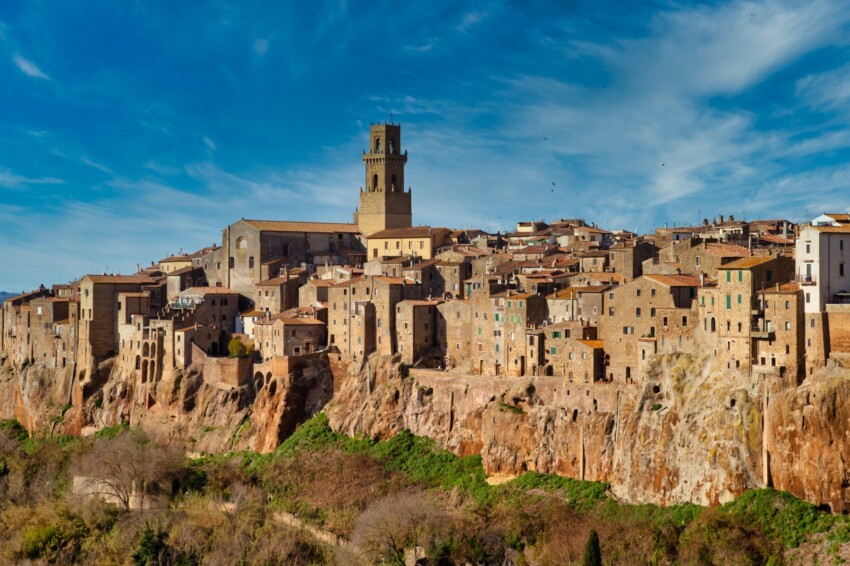
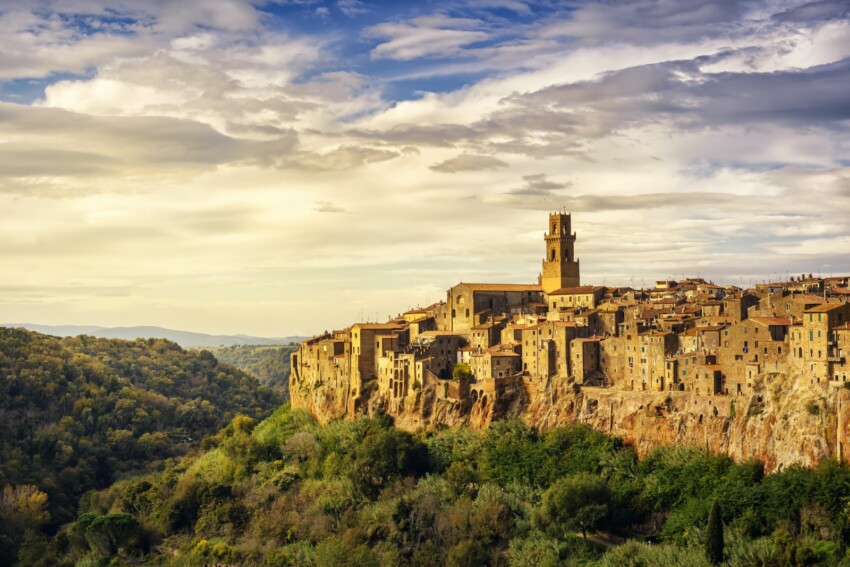
Be enchanted by Pitigliano: this stunning town in the province of Grosseto perched on a tufa ridge is one of southern Tuscany’s principal attractions, and once you catch sight of its profile in the distance, it’s easy to see why. You’ll be treated to a unique panorama that, whilst objectively less famous than it deserves, is absolutely breathtaking.
Pitigliano is a village waiting to be explored, thanks to its numerous monuments and museums in the historic centre, which retains the character of a typical Tuscan town, surrounded by countryside of remarkable beauty. But there’s more: Pitigliano holds within it traces of an important Jewish community that lived here from the 1600s until Italian unification, when local Jewish residents chose to relocate to larger, wealthier cities such as Florence and Rome.
Yet the Jewish past remains, so much so that it’s affectionately nicknamed “little Jerusalem“. Today, Pitigliano’s Jewish community has largely disappeared, but the ancient ghetto is one of the most interesting areas of the historic centre to visit, with its narrow streets and beautiful buildings lining them.
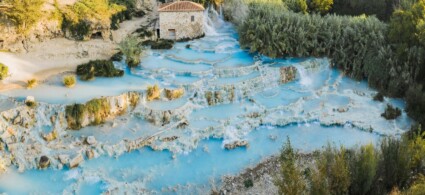
Finally, Pitigliano’s location in the heart of the Maremma makes the village an unmissable destination for anyone exploring this part of Italy. You can use it as a base for where to stay, and after thoroughly exploring it, enjoy the beautiful surrounding attractions such as the village of Magliano in Toscana or the Saturnia thermal springs, just 20 minutes away.
Begin your visit to Pitigliano by wandering aimlessly through the streets of the historic centre. This is the best way to immerse yourself and fall in love with it instantly. Discover the side streets and alleyways, pause to admire the valley below from the numerous panoramic terraces and viewpoints, and soak up the village, the typical Tuscan homes, flowers at the windows and magnificent vistas. Once you’ve done this, you’ll be ready to explore the monuments and main landmarks of Pitigliano.
The cathedral of Pitigliano, officially the Cathedral of Saints Peter and Paul, is a medieval church built from the 13th century, but completed only 500 years later, and therefore the entire building is a mix of styles.
The façade, for example, is baroque, with a 16th-century travertine doorway and some 18th-century stuccowork. To its left stands the bell tower, whilst inside you can admire a series of truly remarkable works from various historical periods, such as the 19th-century canvas of Saint Paul of the Cross Preaching, the Madonna of the Rosary with Saints by Francesco Vanni dating from 1609, or two 19th-century canvases by painter Pietro Aldi, The Predestination of Young Hildebrand and Henry IV at Canossa.
Also noteworthy are the wooden baptismal font dating from the 18th century and the side chapels, which are themselves rich in sacred artwork.
The walls of Pitigliano were built for defensive purposes in the Middle Ages by the Aldobrandeschi family. Two gates open onto the walls: the Sovana Gate2 and the Citadel Gate3, built at different times.
However, the earliest walls of Pitigliano date back to the Etruscans themselves, and are still partially visible today in the north-western part of the historic centre, not far from Sovana Gate. The rest of the wall today is only partially preserved in the centre, and some sections have even been incorporated into the outer walls of certain buildings; others have been demolished. Many sections of the walls are faced in tufa, and along them have been created some panoramic terraces overlooking the ridge.
The Medici aqueduct of Pitigliano was originally designed to supply water to the village, of which today remains the impressive structure. Work began in the 16th century and was greatly complicated by the irregularity of the terrain: this led to an extension of the construction period, which dragged on for over 100 years.
Even today you can admire the aqueduct in all its splendour, lined with tufa, which blends perfectly with the surrounding environment.
Piazza della Repubblica is the main entrance to Pitigliano’s historic centre, and for many it’s the first viewpoint where you’ll want to stop and take wonderful photos. It’s a plaza elongated in a north-south direction, with Via Roma, the main street of the centre, branching off from the east side. The square is well-maintained and clean, and is a mandatory stop on any visit to the town.
On the south side of Piazza della Repubblica stands the monumental fountain of the Seven Spouts, dating from the 16th century at the behest of Count Gianfranco Orsini; here you’ll also find the head of the Medici aqueduct, consisting of large arches faced in tufa. Water flows from spouts decorated with sculptures depicting the heads of various animals.
Palazzo Orsini in Pitigliano is a castle located in the historic centre, dating from the 12th century when it was actually a convent; it was later transformed into a fortress by the Aldobrandeschi to serve as their residence. The palazzo takes its name, however, from the Orsini, the family that succeeded the Aldobrandeschi and governed Pitigliano for the following centuries, until 1600.
Today it houses two museums: the diocesan museum of sacred art, known simply as the Palazzo Orsini Museum, and the archaeological museum of Pitigliano. The first displays in 18 rooms a series of masterpieces of sacred art, whilst the second, consisting of 6 rooms, is dedicated to artefacts from the Poggio Buco area and those from the ancient Pitigliano site.
If Pitigliano is called “little Jerusalem” there’s a reason: discover it by visiting the synagogue and the Jewish museum, testimony to the town’s ancient Jewish ghetto.
The synagogue dates from 1598, built in Romanesque style, whilst its interior furnishings date mostly from the 17th and 18th centuries. It has undergone many restorations over the centuries, most recently in 1995, by the municipality of Pitigliano. The Jewish museum, meanwhile, allows you to discover all the secrets of the local Jewish community, which lived in the ghetto established in the early 1600s.
Pitigliano’s synagogue and Jewish museum are open daily except Saturday.
The Church of the Madonna delle Grazie is located along regional road SR74, about a kilometre from the entrance to the town centre. It’s a small and very pleasant church, especially inside, where you can admire fine stuccowork.
But the main reason you’ll want to visit the Church of the Madonna delle Grazie is its extraordinary viewpoint, situated at a hairpin bend on the SR74, where you can park your car safely and enjoy a sensational panorama of Pitigliano silhouetted against the tufa ridge.
In the following map you can see the location of the main places of interest mentioned in this article.
The historic centre of Pitigliano is literally scattered with apartments and B&Bs, which you’ll find everywhere. They are mostly old houses completely renovated and made available to tourists, some furnished in traditional style, others in modern style, others still that echo the tufa and distinctive features of the town.
Choose to stay in the historic centre if you want to enjoy Pitigliano to the full, especially in the morning when day-trippers haven’t yet arrived, or in the evening, when they’ve already left. Note that in Pitigliano’s centre you cannot use a car, so you’ll need to leave it in car parks outside the centre. Contact your accommodation to arrange luggage transport.
If instead you prefer to spend a holiday immersed in the Tuscan Maremma, choose to move just a few kilometres away, and you’ll be surrounded by nature. Here, ancient farmhouses have been practically all renovated and converted into agriturismos (farm stays), where you can sleep in complete peace surrounded by vineyards, hills and rows of vines; many of them also have an in-house restaurant, so you can enjoy local specialities at kilometre-zero freshness. The obvious disadvantage of staying in an agriturismo in the countryside is that you’ll have to take the car to visit Pitigliano.
Pitigliano is located in an area of Tuscany rather distant from the main communication routes. This, combined with its geographical position at the south-eastern edge of the region, means it’s never particularly easy to reach: consider that from its provincial capital Grosseto it takes almost an hour and 15 minutes, for a distance of over 80 kilometres.
Certainly, it’s absolutely worth getting there, but allow for a journey of over two and a half hours from Florence and a distance of over 160 km to cover, via the A1 motorway to the Chiusi-Chianciano Terme junction, then taking a series of provincial roads that will lead you into the heart of Tuscany, passing through places such as San Casciano dei Bagni, Castell’Azzara and Sorano.
From other Tuscan cities the story doesn’t change: from Siena, for example, it takes 2 hours and over 110 km, following regional road SR2, the Via Cassia, to Ponte a Rigo, then entering SP20. The journey duration from Arezzo is the same, although the route is completely different, as you use the A1 motorway to Chiusi-Chianciano Terme. From coastal Tuscan cities, namely Pisa and Livorno, the journey is about 3 hours, first arriving at Grosseto and then Albinia, then continuing along the SR74 to Pitigliano.
As for travelling by public transport, Pitigliano is practically unreachable. On average it takes 4 bus changes from Florence, for a journey distance ranging from four and a half to six hours. Even from the provincial capital Grosseto the situation doesn’t change: you use provincial transport buses, but there are no direct buses from Grosseto to Pitigliano, and the journey takes up to three hours.
What's the weather at Pitigliano? Below are the temperatures and the weather forecast at Pitigliano for the next few days.
Pitigliano is located in the province of Grosseto, not far from the Lazio border, in the Tuscan hinterland.
 Hotel
Hotel  Budget accommodations
  Apartments
  Family Hotel
  Luxury Hotel
  Resorts