Albergo La Pietra
Roccalbegna - Via XXIV Maggio 69A-B
Book now
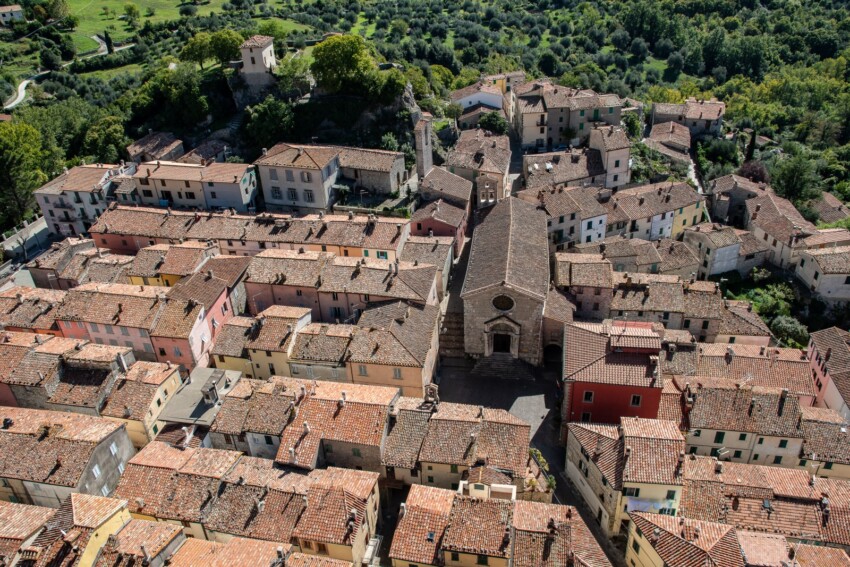
The local saying “if the stone cracks, goodbye to the fortress” tells you much about Roccalbegna’s geography. High up sits a rocky outcrop with boulders through which the Albegna river winds; then the crag with remains of fortifications (called SASSO or stone) positioned right above the village; and finally the houses squeezed between the sasso and the ROCCA, another rocky hilltop from which emerge the ruins of Aldobrandeschi fortifications and the Sienese keep.
The Cassero of Roccalbegna overlooking the village was a minor fortress, used essentially as a lookout point. It was probably built in the early 13th century by the Aldobrandeschi counts. At the beginning of the 15th century, due to its loss of strategic importance, the Cassero, then owned by the Sienese State, was left abandoned. In 1446 the Castellani Domenico d’Andrea and Gherardo di Mariano offered to restore it purely for residential purposes. In 1555 the Sienese State came under the Grand Duchy of Tuscany and in 1565 Roccalbegna was granted by the Grand Duchy to the Sforza of S. Fiora. It remained a grand-ducal fief until 1751. With the abolition of all fiefs, Roccalbegna once again became an independent community until 1838, when it was placed under the royal vicar of Arcidosso. Where the present-day garden now stands—comprising a wide lawn and tall trees—there once rose an Italian garden, equipped with a “small casino” dating to the 17th century. No traces of this garden remain, but detailed historical research suggests it was very similar to the contemporary garden connected to Santa Fiora’s palatial complex.
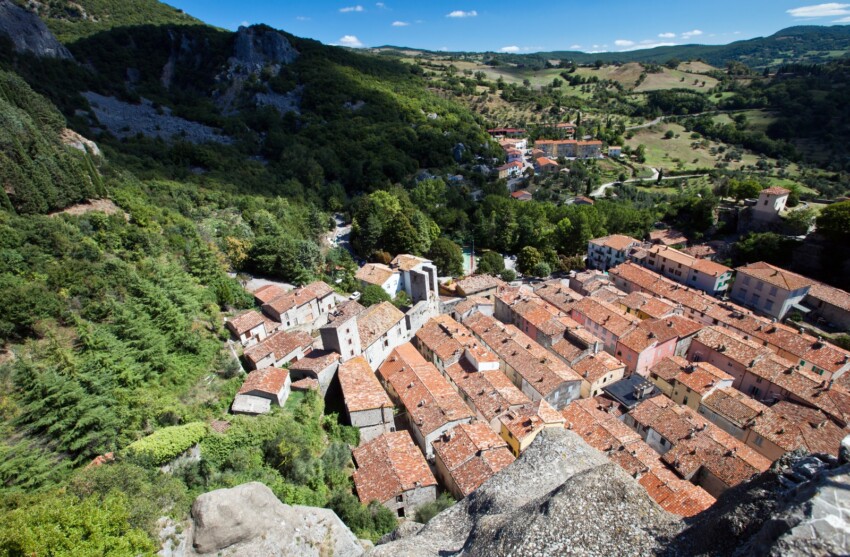
Rebuilt by the Sienese, who gave it an urban layout quite different from contemporary castles (1296). It was probably on that occasion that the fortifications with square towers were constructed, joining the two rocky outcrops dominating the village known as La Pietra or Sasso and La Rocca or Casse. The fortifications were restored in the mid-1400s. (There is a local saying that goes “If the stone cracks, goodbye La Rocca”). Last century, the Porta di Montagna or Porta di Sopra, formerly Porta Altis, was demolished for the construction of the grand-ducal road. For the same reason, several buildings within the settlement were also knocked down to allow modernisation of La Pietra’s natural bastion with a flatter layout that avoided the descent and subsequent climb towards the Porta di Maremma.
The castle of Triana stands on a rocky spur between the Poderone stream and that of Chiesacce, and has a single entrance gate rebuilt in period style in 1913.
It rises on a rocky spur between the Poderone stream and that of Chiesacce and has a single entrance gate rebuilt in period style in 1913. Certainly erected by the Aldobrandeschi after the year 1000, it was ceded in 1388 to the Piccolomini family, lay in ruins by the 1500s, and was later restored as the centre of the Triana estate. The only apparent addition seems to be the chapel, commissioned by Lelio Piccolomini and restructured in baroque style by Spinello in the early 1700s. In recent times it has passed to the charitable foundation Pie Disposizione of Siena. Particular attention may be paid to the small garden within the castle, which, echoing the more celebrated urban garden commissioned by Pius II Piccolomini in Pienza, is a hanging garden of unmistakably Italian character—albeit extraordinarily simple in both its design (four square beds) and plantings (box). The population today lives as they did then primarily in farmsteads which, in the 1706 inventory by surveyor Pasquale Furzi, were well documented: two without record roofed with channels, two storeys beneath with a walled courtyard, the most common type of farmstead in this part of the territory. Some tenant farmers inhabited houses belonging to the lord along the road leading to the castle, whilst other buildings, possibly including workshops, were situated beneath the cliff face.
To see all the facilities and book accommodation in Roccalbegna use the form below, entering the dates of your stay.
 Hotel
Hotel  Budget accommodations
  Apartments
  Family Hotel
  Luxury Hotel
  Resorts