Antico Casale Di Scansano Resort
Scansano - Loc. Castagneta
Book now
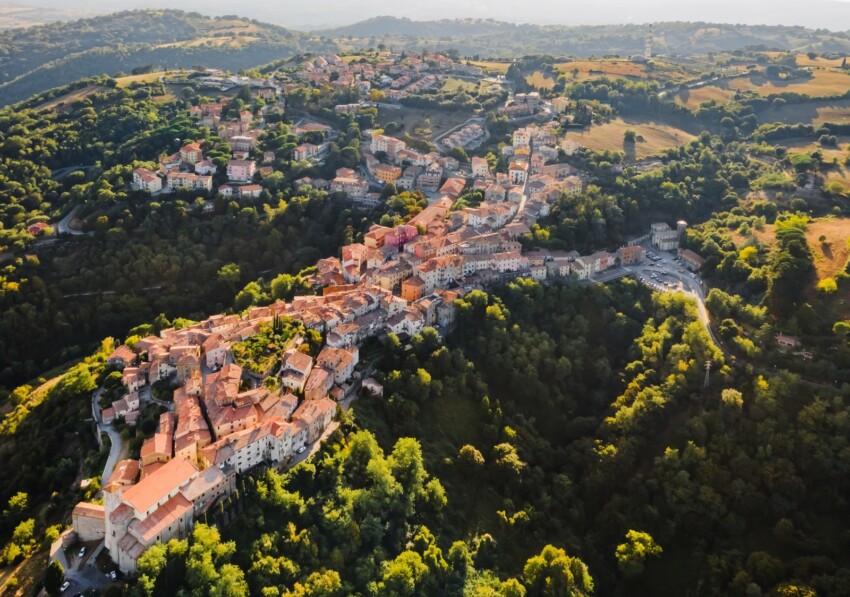
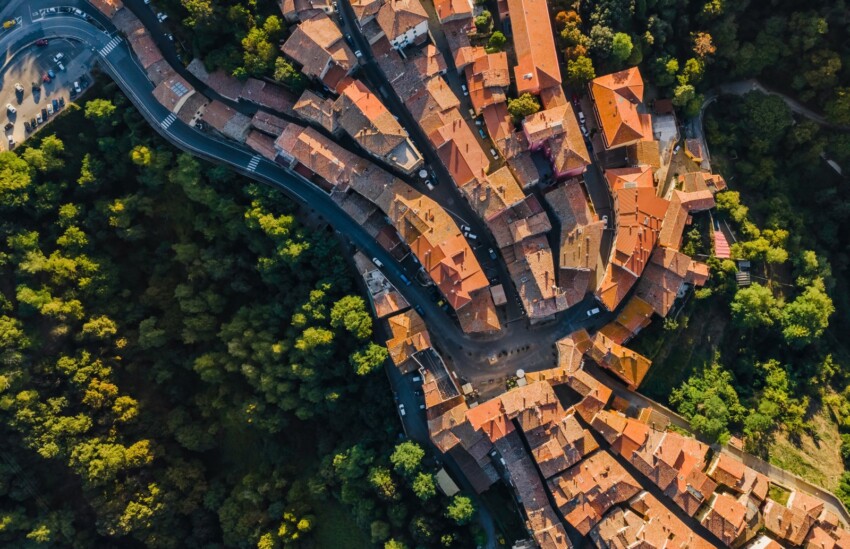
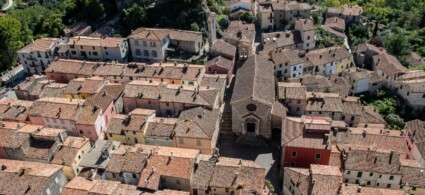
Scansano, nestled in the Maremma of Grosseto, sits on a mountain ridge that forms the watershed between the Ombrone and Albegna rivers.
Since ancient times, it has been considered a healthy retreat and holiday destination. Under Leopold II, the offices of Grosseto’s municipal government—the provincial capital of Maremma—would relocate there during the summer months, a practice known as the “estatura”, so that staff and their families could escape the risks of malaria.
The town offers spectacular views across both the coastline and towards Mount Amiata.
During the Middle Ages, its territory was divided between Sienese influence and the Aldobrandeschi family. In the 14th century, it became part of the County of Santa Fiora, which passed to the Sforza family in 1439. It remained under their rule until 1633, when it became part of the Medici Grand Duchy.
Beyond its agricultural resources—particularly viticulture—Scansano has held considerable importance in extractive industries since the 18th century, with mercury, antimony, sulphur and lignite mines operating until recent times.
The Church of San Giovanni Battista, originally medieval and elevated to collegiate status in 1630, was renovated in the first half of the 18th century and decorated with refined stucco ornaments.
The Sanctuary of the Madonna delle Grazie, better known as the “Madonna della Botte”, was established in the early 17th century as an oratory to house a Marian painting that had been particularly cherished by the Moorish community present in Scansano from the second half of the 16th century. Along the coast, there were indeed numerous so-called ‘africhielli’—offspring of Maremman mothers and Turkish fathers born during the wave of raids that devastated the areas of Talamone, Giglio Island and Cala di Forno between 1535 and 1543.
These individuals, generally abandoned by their mothers at a young age, had organised themselves into small, tight-knit communities. They fled after the Maremman fortresses came under Spanish rule in 1559, to avoid being captured and sold into slavery, as Philip II’s decrees required. A substantial colony of these exiles found refuge in the lands of Scansano, where they were warmly welcomed by the local inhabitants. Indeed, one of the local confraternities commissioned a painting of the Madonna del Soccorso (subsequently called the Madonna della Botte or of the Affrichelli) as a gift for the refugees who worked as agricultural labourers in Scansano’s vineyards.
According to the sanctuary’s foundation legend, some of these vineyard workers, whilst washing barrels just outside the town, found the image inside one of them—an episode that, immediately surrounded by an aura of miracle, began to attract the devout and pilgrims.
The Marian icon found an honoured place in the Church of the Madonna delle Grazie thanks to the efforts of the devout women of the Confraternity of Sant’Antonio Abate, known as “Le Scalzine”. During the first half of the 17th century, they worked tirelessly to collect alms and donations sufficient to build the church and provide it with its own rector. The icon became the object of such popular devotion that the building housing it was renovated in 1830 and subsequently enlarged between 1862 and 1867 by engineer Luigi Vannucci, partly due to a flood that had caused serious damage.
At Murci, the Church of San Domenico was built in the mid-19th century. At Montorgiali, an 18th-century oratory dedicated to San Giorgio remains today the venue for a folkloric ceremony that re-enacts Saint George’s battle with the dragon, symbolic of the unhealthy Maremman lands.
Petreto Castle first appeared in documents from 1274, on the occasion of a division between the two branches of the Aldobrandeschi Counts, and came under the rule of the Counts of the Santa Fiora branch.
Transformed into an oratory for Franciscan friars, it was submitted to the Republic of Siena in 1339.
The oratory is said to have hosted San Bernardino da Siena in 1422. In 1507, Count Guido Sforza opened the Convent with its adjoining Church dedicated to San Pietro al Petreto.
The convent buildings are currently in private ownership whilst the Church forms part of Scansano‘s parish heritage.
The Etruscan settlement at Ghiaccio Forte was identified in 1973 following trial excavations that, in addition to revealing large stretches of the defensive walls, also uncovered urban structures. Subsequent, though brief, excavation campaigns—the last in 1981—established that the settlement had been destroyed by fire, identified a votive deposit containing bronze and terracotta finds, located a smelting furnace, pinpointed three access gates to the settlement and uncovered several dwelling spaces.
The first records of Montorgiali Castle and Court date from a bull issued by Pope Clement III in 1188, addressed to the Bishop of Grosseto.
The Castle, impressive in appearance due to its exposed stonework structure, was built on the summit of a hillock and still displays important arched windows and corbels from now-vanished machiculations.
The Castle and settlement followed the fortunes resulting from hostilities between the Aldobrandeschi of the Santa Fiora branch and the Republic of Siena.
The Counts of Montorgiali, initially vassals of the Aldobrandeschi, sided with Siena in 1224 and supported costly wars that forced them, to meet expenses, to cede rights over certain properties including Castiglioncello and its surrounding territory.
In 1378, Montorgiali was sold to the Republic of Siena.
Montorgiali Castle, converted into residential dwellings, is in private ownership.
Montepò Castle, originally built by the Sienese nobleman Roberto Sergardi in the first half of the 14th century, is located approximately 7 km from Scansano.
Montepò is, in fact, a fortified farmstead—or walled castle—which, over the years, has been enlarged to assume its current rectangular layout with four corner towers, one at each angle.
Access to the spacious inner courtyard is situated on the south-west side and was once protected by the overhanging machicolated chimney above and two loopholes opening onto the two towers flanking the entrance.
Montepò Castle, recently completely restored, is in private ownership.
To see all the facilities and book accommodation in Scansano use the form below, entering the dates of your stay.
 Hotel
Hotel  Budget accommodations
  Apartments
  Family Hotel
  Luxury Hotel
  Resorts