Hotel Della Fortezza
Sorano - Via Benedetto Cairoli, 5
Book now
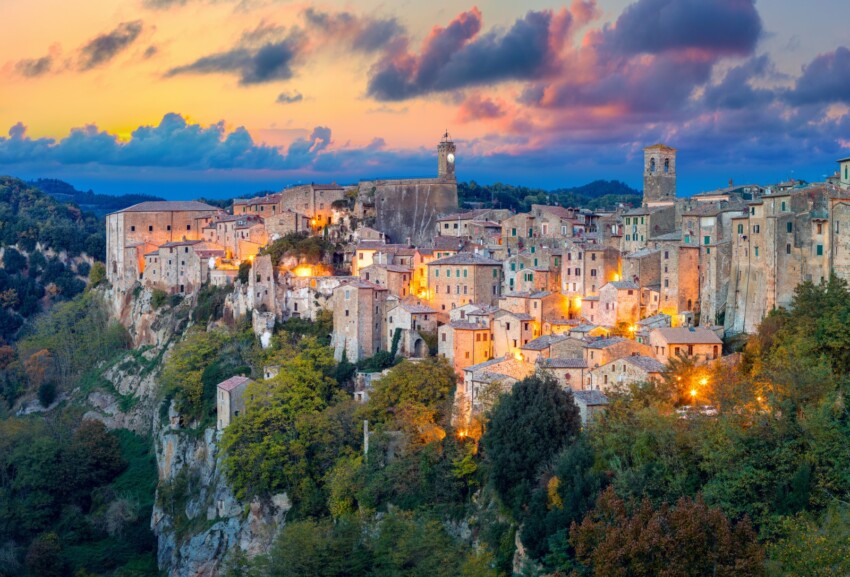
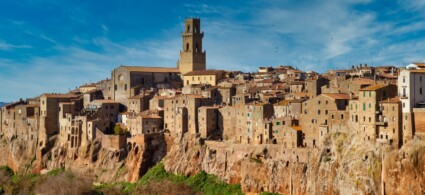
It’s hardly surprising that Sorano is affectionately dubbed “the Matera of Tuscany”. In this small village in the province of Grosseto, situated more in Lazio than Tuscany given its geographical position, you’ll feel genuinely transported into a parallel reality.
The village sits in the historic Maremma region, perched atop a tufa outcrop, at just under 400 metres altitude, and it’s genuinely delightful to visit. What’s more, Sorano’s tourist appeal is rounded out by two truly worthwhile destinations: the Sorano thermal baths, a must for devotees of spa culture and travellers seeking relaxation and wellness, and the charming village of Sovana, which absolutely deserves a visit thanks to the wealth of things to see packed into such a small space.
From Sorano, you can easily reach a series of must-see Tuscan attractions: Pitigliano, another town built atop a tufa ridge, and the Saturnia thermal baths. So use Sorano as your base, explore it thoroughly, then begin discovering its magnificent surroundings: you’ll spend a glorious Tuscan holiday steeped in culture, relaxation and fairytale landscapes.
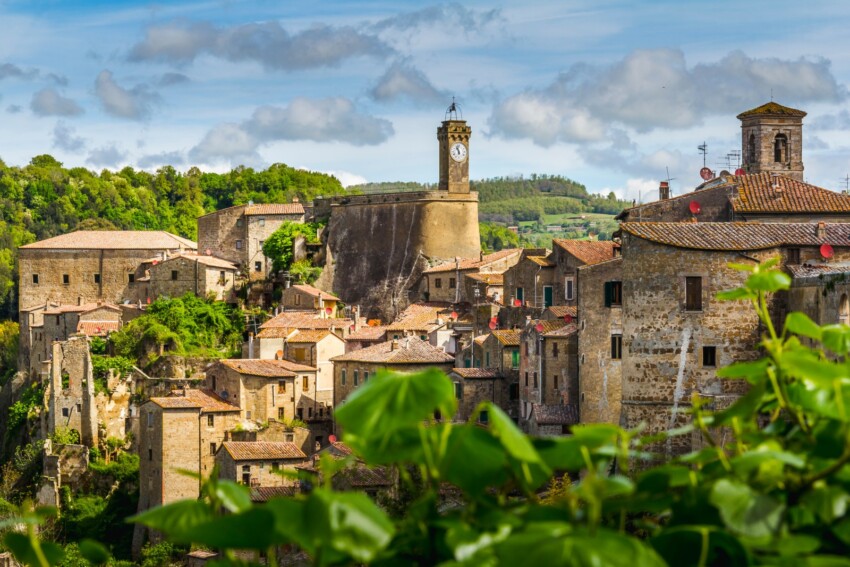
There’s plenty to see in Sorano: here are the main attractions to make the most of your time in town before exploring the surrounding area.
Sorano’s historic centre is a journey through time: you’ll find yourself in an urban area surrounded by pristine natural landscape, as the tufa walls of the outcrop on which it was built contrast beautifully with the ancient trees that encircle it, creating a truly captivating mix.
Sorano’s historic centre has earned the prestigious Orange Flag award from the Italian Touring Club, and there’s plenty to explore. Don’t just stick to the main streets – wander down the side lanes, savour the slow pace of life, and pause at every corner to take extraordinary photographs.
In the heart of Sorano there’s also an ancient Jewish Ghetto1, where a synagogue once stood. Established by the Medici in 1619, the Jewish community abandoned Sorano’s ghetto in the early 1900s; afterwards, following the Second World War, the area fell into neglect and disrepair until the 1990s, when virtually all the buildings were restored and revitalised.
Among Sorano’s attractions, Masso Leopoldino is undoubtedly the most fascinating. It’s an imposing fortress built for defensive purposes, positioned at the centre of the village atop one of its hills – a veritable fortified citadel and the city’s symbol. The structure was enhanced with a terrace and a crenellated tower, complete with bell and clock, between 1820 and 1822, by Grand Duke Leopold II; it’s from him that the castle takes its current name.
Vie Cave (Etruscan roads) are a series of open-air routes carved into the tufa hills by the Etruscans. Located within the Città del Tufo archaeological park, they’ll lead you to discover Etruscan necropolises, passing between tufa walls up to 20 metres high.
Walking along the Vie Cave, also known as “cuts”, will astound you, especially when you consider they were carved without mechanical aids – simply because tufo, when damp, is easily workable. Some of the Vie Cave formed part of an ancient road system connecting various settlements in the area.
In several rooms of the Orsini Fortress, an imposing 14th-century building positioned at Sorano’s highest point near the historic centre entrance, an interesting museum of medieval and renaissance art has been established, showcasing the city’s historical past. Particularly striking is the room within the octagonal tower with its frescoes, which some believe was the private chamber of Count Niccolò Orsini.
The 16th-century section of the Orsini Fortress encompasses the museum’s Renaissance area, featuring the central keep and two corner bastions, connected by external and internal passageways that visitors can explore, including via guided tours. Along the route you can observe the ventilation shafts built to aerate the underground chambers and expel toxic gases from gunpowder residue.
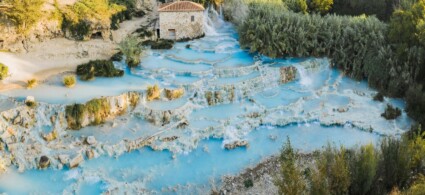
To the south of the main town, in the heart of the Tufo region, lie the Sorano Thermal Baths. The presence of thermal water in the area was actually known since medieval times, when the Church of Santa Maria dell’Aquila was built directly above one of the springs.
Extensively used by the ruling families of the area over the centuries – the Aldobrandeschi and Orsini – the Sorano baths were later abandoned for centuries until the 2000s, when meticulous restoration of the springs began, fortunately still active, with their development and the construction of a thermal spa facility.
The Sorano thermal springs emerge at a temperature of 37.5 degrees Celsius from a series of sources along a stream; the thermal water is magnesium-calcium rich, particularly suited for treating dermatitis and circulation disorders.
Within the spa facility is an expansive thermal pool, plus wellness zones and a 3,000-square-metre solarium with manicured lawn, where sun loungers and parasols are available. Particularly charming is the so-called “monks’ bath” pool, situated in the woodland adjacent to the facility and accessible via a path. The intriguing name stems from its use by friars who lived in the Church of Santa Maria dell’Aquila.
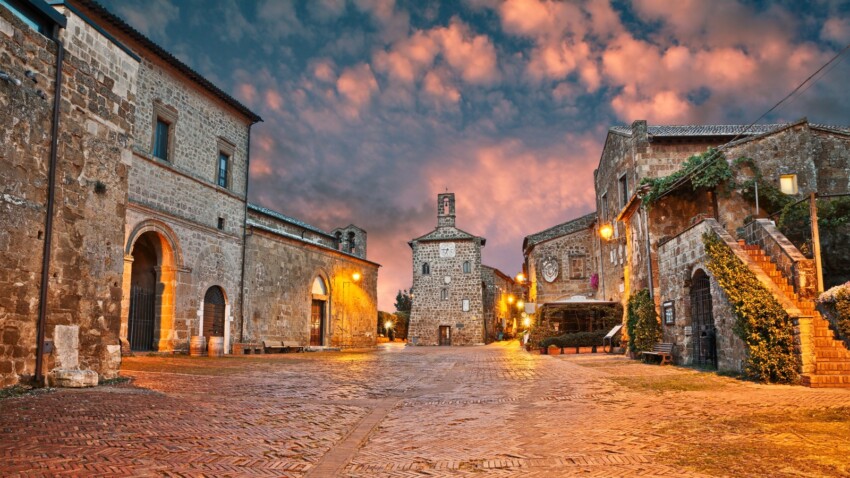
Don’t leave Sorano without visiting Sovana, administratively part of the same municipality but located roughly 10 kilometres south-west, easily accessible via the SP22 provincial road.
A delightful town in the Tufo region, Sovana is among Italy’s most beautiful villages and is a tiny settlement with quintessential Tuscan character and 460 residents, stretching along three main streets. A genuine little treasure chest of art and history, blending an abundance of architecturally and culturally significant buildings capable of telling the Etruscan and Roman story of this enchanting ancient village.
Though the village’s origins are placed in the Roman era, there’s no shortage of evidence of earlier Etruscan settlement, who left behind a genuine archaeological heritage, including one of Italy’s largest necropolises.
In the following map you can see the location of the main places of interest mentioned in this article.
In Sorano’s historic centre you’ll find an important hotel and a couple of small apartments; choose to stay in one of these if you want to make the most of the town centre. Outside the centre, but still within Sorano proper, there are further accommodation options that will let you better enjoy certain amenities, such as car parking or a private pool.
If you’d prefer to stay in a more secluded location, the Sorano area is dotted with farm stays, farmhouses and country cottages, all completely renovated and restored, so you can fully enjoy a Maremma holiday combining relaxation with peaceful countryside living.
And don’t forget the Sorano Thermal Baths Residence, ideal if you’re visiting this part of Tuscany primarily for the thermal facilities.
Sorano sits at the far south-eastern tip of Tuscany, bordered by Lazio. For this reason, it’s easy to see why it’s not easily accessible from other towns: for instance, from its provincial capital Grosseto, the journey takes over 1 hour and 20 minutes, crossing much of the province over a distance of roughly 90 kilometres.
Distances from other Tuscan cities are equally considerable: from Florence it takes two and a half hours, travelling down the A1 motorway towards Chiusi-Chianciano Terme and then continuing on smaller roads, including the Cetona Mountain Provincial Road and the Pitigliano-Santa Fiora Provincial Road.
From Siena it takes nearly two hours heading south along the SR2 Via Cassia regional road, and the same applies from Arezzo, though the route differs as you take the A1 motorway to the Chiusi-Chianciano Terme exit. From towns on Tuscany’s coast, the distance is even greater: from Pisa and Livorno it takes three hours, arriving first in Grosseto then heading inland.
For those travelling by public transport, unfortunately there’s bad news: Sorano and its surroundings are extremely poorly connected, and travel involves taking a train to Grosseto or Albinia, then continuing on local bus services. The journey from Florence or Pisa can easily exceed 6 hours.
What's the weather at Sorano? Below are the temperatures and the weather forecast at Sorano for the next few days.
Sorano is located in the province of Grosseto, just a few kilometres from the Lazio border. It sits a short distance north of Pitigliano, within the historic Maremma region.
 Hotel
Hotel  Budget accommodations
  Apartments
  Family Hotel
  Luxury Hotel
  Resorts