Sovana Hotel & Resort
Sovana - Via Del Duomo 66
Book now
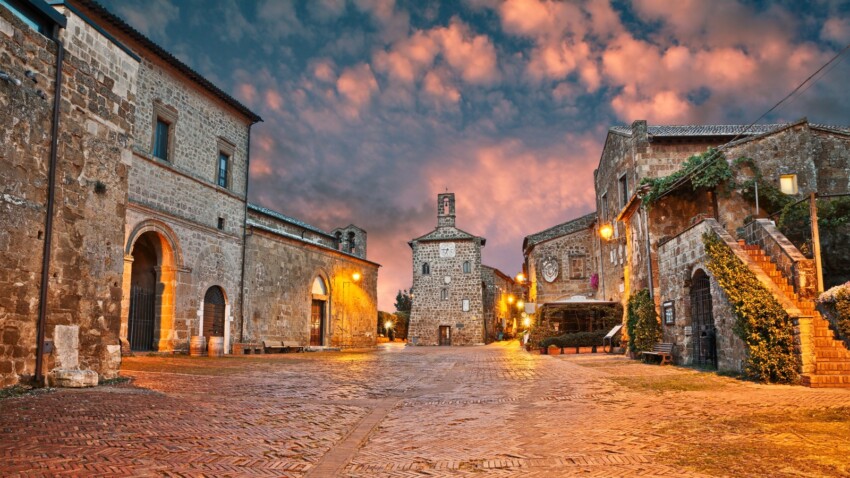
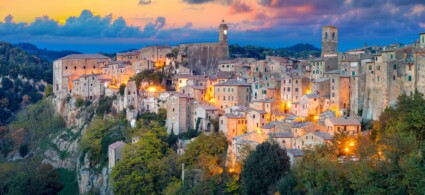
Sovana, a tiny hamlet within the municipality of Sorano with fewer than 500 inhabitants, is a small gem tucked away in the Grosseto Maremma. It sits in a rather remote location, far removed from mainstream tourist circuits, yet remarkably close to some of Tuscany’s most celebrated destinations, such as Pitigliano and the Saturnia hot springs.
Sovana will prove a delightful interlude in your travels: you’ll discover a charming village built into **tufa** stone, which originated in Etruscan times, flourished during the Middle Ages and expanded during the Renaissance. After centuries of decline and neglect, Sovana was rediscovered in the twentieth century thanks to its considerable tourist potential and the beauty of its surroundings, which within just a few years led it to become part of the **association of Italy’s most beautiful villages**.
In Sovana you can visit the quaint **historic village**, which despite its limited size boasts a remarkable selection of attractions, and then dedicate yourself to exploring the stunning **surrounding countryside**.
Despite its modest dimensions, there is plenty to see in Sovana. During your stay, don’t miss a single thing.
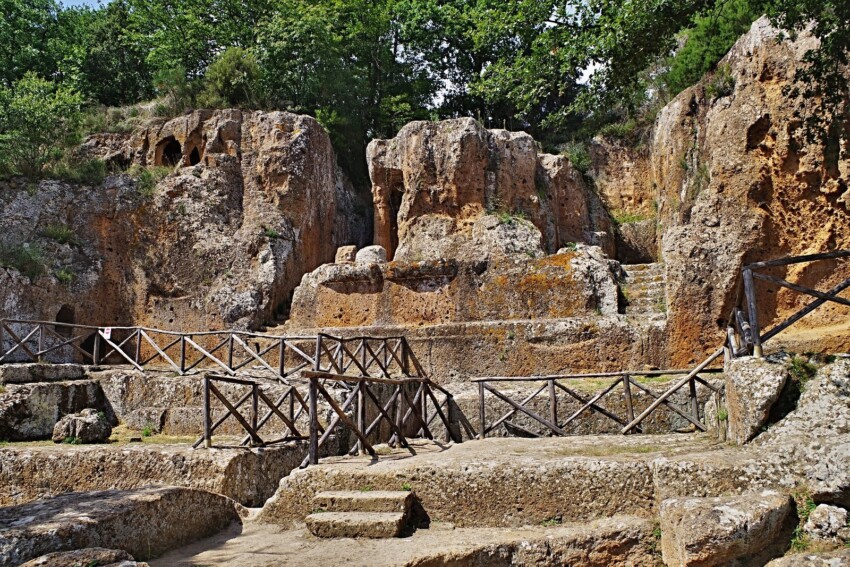
Situated along the road connecting the hamlet of Sovana to San Martino sul Fiora, the necropolis (discovered in 1843 by Ainsley) has long been a destination for both tourists and scholars who, beyond archaeological excavations, have left behind fascinating accounts of the necropolis itself and the surrounding landscape.
One such account, by George Dennis in 1848, brought Sovana and its discoveries international significance.
From that point onwards, many excavations were undertaken, though not always for scientific purposes, and only from 1925 can we speak of proper study and comprehensive documentation of the architectural elements of the tombs previously discovered (among these the Ildebranda Tomb, thanks to the Rosi brothers).
The Sovana necropolis is not the most extensive compared to necropolises in nearby areas, but it is certainly a unique example for the variety of tombs to be found there, showcasing the full beauty of Etruscan architecture and art.
This tomb most likely dates back to the 3rd century BC. Of the 8 columns that originally comprised it, only one remains today. At the centre of this colonnade was the entrance to the burial chamber. In this instance too, the façade would have been completely covered in stucco with colours typical of Etruscan taste. Inside the “pronaos” you can find rather simple coffered ceilings with plain panelling.
Dating to the 2nd century BC, this is a typical example of a gabled tomb with portico. The name derives from a decorative sculpture found inside depicting the head of Typhon, a mythological monster from ancient Greece. As with the Ildebranda tomb, the influence of Hellenic civilisation on Etruscan culture is very evident here.
Dated to around the 3rd century BC, this tomb owes its name to the discovery during excavations of a head of Silenus. Of the “aedicule” type, you can observe a certain departure from Hellenic style, starting with the style of the four columns, which is closer to Ionic than Doric. The legend of the Sileni also derives from Greek mythology, and they are depicted with features somewhere between human and bestial.
A splendid example of a “chamber” tomb, dating to approximately the 3rd century BC, it is entirely hewn from the tufa rock. It was probably used across multiple generations, comprising 9 interconnected chambers and quite spacious. Furthermore, remains have been found from various periods, from the 3rd to the 1st century BC, consisting mainly of Hellenistic ceramics with gilt bronze metalwork details. The name derives from the fact that it was discovered in 1963 by the Institute of Archaeology in Pisa.
Here too we have an example of an “aedicule” tomb dating to the 3rd-2nd century BC, consisting of a façade with a niche adorned with a pediment and sculptures. Among these sculptures, the most important is certainly that of Scylla, a figure half woman and half fish remembered by Homer, and beside it two other figures that probably represented the guardian spirits of the deceased.
Below the pediment lies, as we mentioned, a niche where you can find the figure of the deceased at a banquet. This motif appears in many Etruscan urns and sarcophagi. Unfortunately, this figure is now almost entirely worn smooth, perhaps because it was used as a sanctuary, as the cross carved on the bed would suggest.
The burial chamber is situated in front of the façade below, accessed by a narrow “dromos”. Both are positioned obliquely to the façade, which suggests this latter was constructed at a later stage and positioned this way due to the slope of the terrain.
The burial chamber is not large, and you can find three benches on which the urns containing the ashes of the deceased were probably placed.
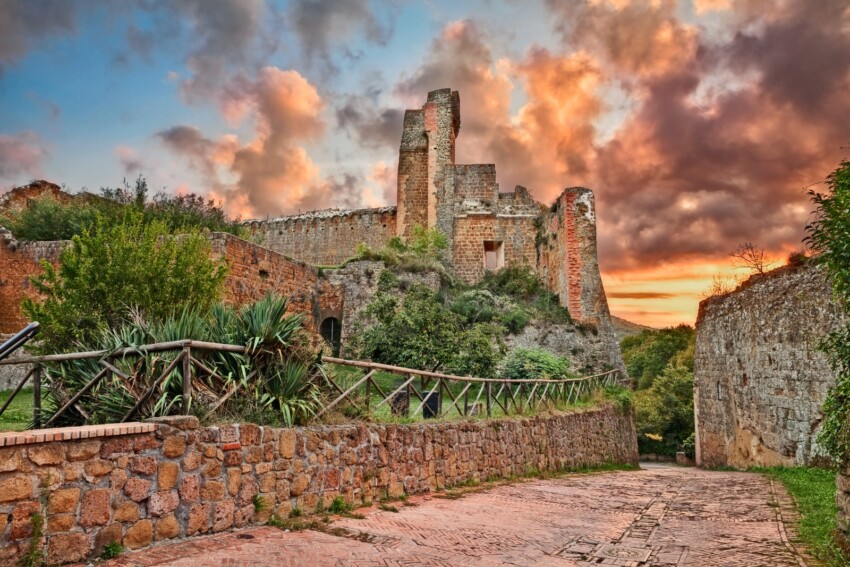
The **Rocca Aldobrandesca** is a ruined castle located outside the historic centre on the eastern side of Sovana. It’s a highly evocative place that testifies to the village’s troubled past, contested between Siena and Florence. What remains of the ancient castle are substantial **tufa ruins**, reasonably well preserved, along with remains of the curtain wall that rests upon the **primitive walls of Sovana**; this confirms the theory that the fortress was built atop an old Etruscan structure.
The Aldobrandesca fortress in Sovana underwent several restorations over the centuries: in the fifteenth century when the locality was conquered by the **Republic of Siena**, and in the sixteenth century, when it became part of the **Grand Duchy of Tuscany**. From then on, however, the structure was abandoned and fell into disrepair.
**Palazzo Bourbon del Monte** is located in Sovana’s main square, between the church of San Mamiliano and Santa Maria Maggiore. It is a sixteenth-century building featuring a handsome portico with arches, through which you access the main building itself, originally the residence of a bishop of the **Bourbon family**, later converted into a public office and municipal school.
The palace underwent restoration only a few years ago, following a collapse that occurred in the 1960s; since 2009, during August, the garden and main hall of Palazzo Bourbon del Monte have been the venue for the theatrical festival **”Sovana in arte”**, established by the cultural association I sogni in Teatro.
The **church of San Mamiliano** is the oldest place of worship in the town centre, built in Romanesque style as far back as the 6th century, though according to scholars it was originally dedicated to a different saint.
The church overlooks the left side of **Piazza del Pretorio**, and has recently been restored; the substantial work uncovered tombs, artworks and a treasure of 500 gold coins. Inside, the structure is a single nave with an unusual **double apse**, where almost certainly there was once a **crypt**.
The church of San Mamiliano remains without its roof (like the more famous **San Galgano Abbey**, though not nearly as striking), whilst the tufa walls stand intact.
The **Palazzo Pretorio of Sovana**, situated in Piazza del Pretorio, is an ancient medieval palace, now home to the **visitor centre for the Tufo Archaeological Park** and the **Sovana territory documentation centre**.
It has an attractive façade displaying the coats of arms of the ancient families that governed Sovana over the centuries. The façade on the left adjoins the Loggia del Capitano, a small medieval loggia clad in tufa stone blocks.
The **cathedral of Sovana** is an extremely ancient church, dating back to the 8th century, though it has been significantly altered over the centuries. Located at the eastern end of the inhabited centre, it is built in Romanesque style; during its numerous renovations, it has been embellished with decorative elements, including a beautiful barrel-vaulted crypt in tufa stone.
The **municipal building**, or **palazzo dell’Archivio**, is located in the heart of Sovana and is undoubtedly the town’s most photographed building. With its iconic shape and façade crowned by a small bell tower, it dates to the 12th century although it was reworked in subsequent centuries, with the addition of elements that gave it its present form.
Between the nineteenth and twentieth centuries the town hall fell into a state of decay and neglect, but a recent restoration has returned it to its former glory.
Also situated in Piazza del Pretorio, the **church of Santa Maria Maggiore** is located next to Palazzo Bourbon del Monte. Divided into three naves and dating to the 12th century, like many buildings in the town it was substantially modified in the 16th century, so today you can admire elements in both Romanesque and Gothic styles. Particularly fine are the frescoes on the right-hand nave wall, and it’s worth visiting the beautiful **ciborium** in stone, located in the apse and among the few examples of **pre-Romanesque art in Tuscany**.
In the small hamlet of **Sovana** there are several accommodation options to choose from, fairly evenly split between **apartments** and **hotels**. Staying in the village will allow you to enjoy moments of extraordinary tranquillity, especially early in the morning or late evening, when all the day-trippers return to their hotels on the coast or in the more celebrated Maremma destinations.
If you’d prefer to enjoy the beauty of the **surrounding countryside**, instead opt for one of the facilities in the surrounding area: these are almost exclusively **agriturismos** (farmhouse stays), country cottages, farmsteads or farmhouses, elegantly renovated and brought back to life, furnished in typical rustic Tuscan style, equipped with all modern comforts and often offering attractive amenities such as pools and restaurants, to make the most of your **Tuscan holiday**.
**Sovana** is located in a rather remote position, at the south-eastern edge of Tuscany a short distance from the border with Lazio. For this reason it is rather challenging to reach: needless to say it’s well worth the effort, but the distances, at least on the map, might seem a little daunting.
From **Florence**, for example, it takes approximately two and a half hours, entering the A1 motorway at the Florence South junction and heading towards Rome as far as Chiusi-Chianciano Terme. From there you take the provincial road SP478 della Montagna di Cetona as far as San Casciano dei Bagni, then continue on SP321 and then on **SP20** until you reach Sovana. The entire journey distance is nearly 200 kilometres.
From Tuscany’s coastal cities such as **Pisa** and **Livorno**, the journey is even longer. It takes approximately 3 hours, covering a total distance of around 240 kilometres. You head south along the SS1 Aurelia, crossing the entire Tuscan coast and reaching Grosseto, passing beyond it, and continuing to **Albinia**, from where you enter SP74 which leads to Sovana.
Sovana is also rather far from its provincial capital **Grosseto**, from which it is about one hour and 15 minutes away, covering a distance of 80 kilometres. In this case too, to get there you must first reach Albinia and then continue on SR74 to your destination.
From inland Tuscan cities such as **Siena** and **Arezzo**, it takes approximately two hours to reach Sovana, travelling along SR2 Via Cassia (from Siena) or the A1 motorway as far as Chiusi-Chianciano Terme and SP478 (from Arezzo), which converge at Valsacco, from where you proceed to Sovana via the provincial roads SP20 and SP22.
Finally, if you’re travelling by **public transport**, you’ll probably have to set aside your dreams of reaching Sovana: transport in these parts is practically non-existent, apart from a few long-distance buses connecting the hamlets and villages in the surrounding area.
What's the weather at Sovana? Below are the temperatures and the weather forecast at Sovana for the next few days.
Sovana is a hamlet of the municipality of Sorano, located in the province of Grosseto, in the Maremma countryside, just a few kilometres from Pitigliano and the Lazio border.
 Hotel
Hotel  Budget accommodations
  Apartments
  Family Hotel
  Luxury Hotel
 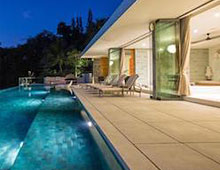 Resorts