Gitavillage Talamone
Talamone - Via Talamonese
Book now
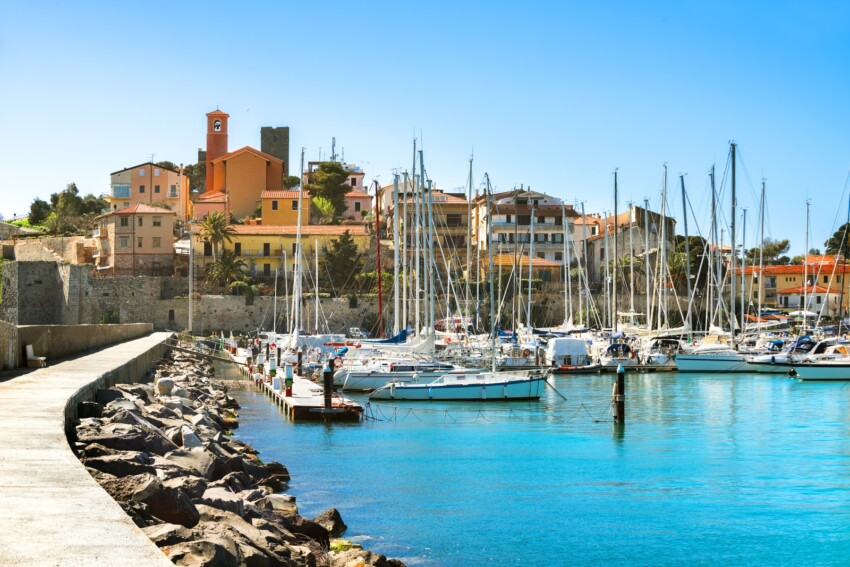
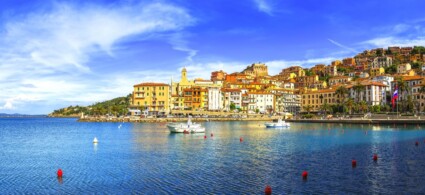
Talamone, a small hamlet within the municipality of Orbetello, sits in Grosseto province along the coast. It’s quite a celebrated destination, thanks to its charming historic centre perched on a rocky promontory that drops steeply to the sea, its beaches perfect for snorkelling enthusiasts, and its strategic position for exploring both the Grosseto coastline and the Maremma hinterland.
Talamone is the place to come for unwinding and escaping the daily grind, but equally for an active break, with plenty of opportunities to try water sports like kitesurfing or windsurfing, fishing, or alternatively heading out by boat to discover some of Tuscany’s loveliest coves, accessible only by sea. Furthermore, within Talamone’s historic heart you’ll find several interesting monuments worth visiting; meanwhile its marina, situated at the edge of the centre, serves as the departure point for numerous boat trips and excursions.
Though small, the resort is well developed tourism-wise: there’s no shortage of hotels, apartments and resorts, nor of services of every kind, from bars to restaurants, shops to surf schools.
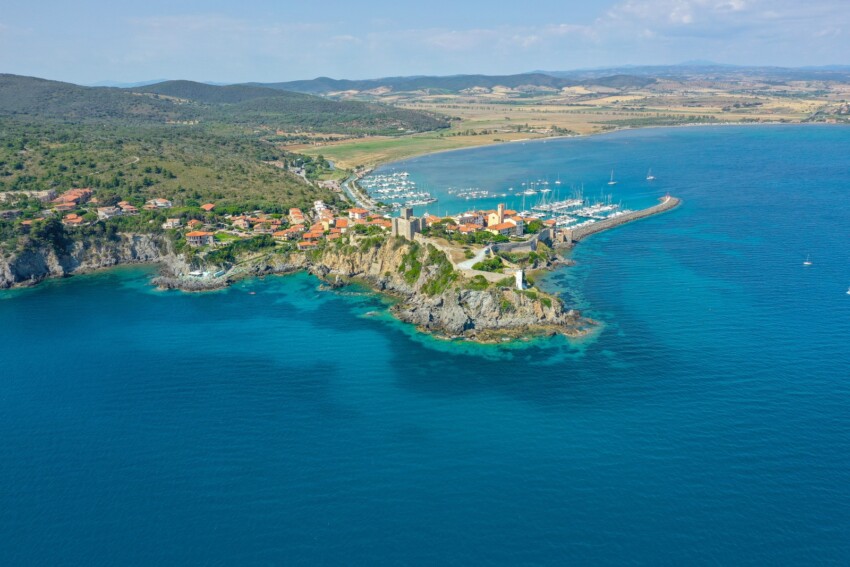
Both in Talamone’s centre and its immediate surroundings there are some lovely beaches. Here’s what’s on offer, so you can visit them all and pick the one that suits your holiday style best.
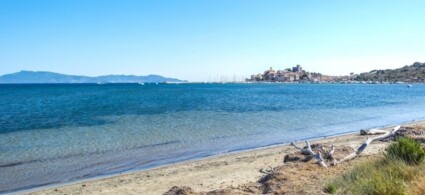
Right in the heart of the historic centre, facing south, you’ll find the Spiaggia Libera del Cannone, a tiny rocky beach that in some ways represents Talamone’s town beach. It gets busy, and the rocky outcrops make it somewhat awkward and impractical; however, the water is gorgeous and clean.
It’s a short walk from Talamone’s centre, for which we recommend wearing rock shoes or at least comfortable footwear. Its orientation means it’s almost always sheltered from the winds, whilst in the background you can make out the Argentario headland and the Isola del Giglio. The seabed is beautiful too, so snorkelling fans will find plenty to excite them.
Also adjoining the historic centre, but this time towards the east, lies the Bagno delle Donne, which is actually the name of the bathing establishment occupying the entire beach, situated on a platform built right up against the cliff face. The space is completely taken up with sunshades and loungers, and sea access is made simple by slopes and small steps, but it goes without saying that, given its minuscule size, during the season it gets absolutely rammed.
On its side is a wonderful natural backdrop, a splendid view of Talamone’s Rocca Aldobrandesca, and a sea displaying gorgeous shades of blue and azure. The Bagno delle Donne is perfect for snorkelling enthusiasts, given the beautiful and varied seabed, but also for the little ones, since there are some shallow-water spots where sea access is straightforward.
Administratively we’re already outside Talamone hamlet and within Orbetello municipality, but geographically, the Spiaggia della Fertilia is without doubt part of Talamone. This long free beach, facing south and contained within the small Talamone gulf, is located just a short way from Fonteblanda village. Behind it is a spacious car park where campervans also stay, and it’s used by kitesurfing, windsurfing and other water sports enthusiasts, as there are schools and equipment hire facilities on site.
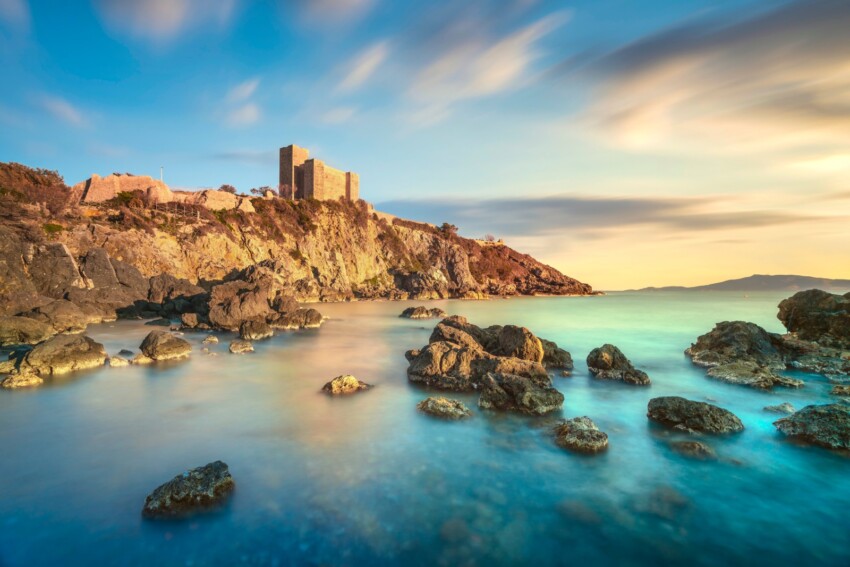
Talamone’s historic hamlet is small and clustered around its defensive walls. Wander aimlessly through its little streets, stop at the viewpoints to snap gorgeous coastal photos, and then turn your attention to visiting the main local landmarks.
The very symbol of Talamone, the Rocca Aldobrandesca is a fortress built precipitously over the sea, visible from kilometres away. Dating to the first half of the thirteenth century, following a troubled history it was last restored after the Second World War.
The fortress has a rectangular plan, with stone walls and 4 towers at its corners, one of which, the northern tower, is taller and more robust. The complex forms part of the coastal tower network of the Siena Republic, which served a defensive role protecting this stretch of sea in the sixteenth century.
The Rocca Aldobrandesca is an integral part of Talamone’s defensive system, as are its walls. Like the fortress, these date to the first half of the thirteenth century, and managed to protect the hamlet from a series of attacks in the centuries that followed. Talamone’s town walls were damaged many times, most recently during the Second World War through bombing. However, at the war’s end the walls were restored and rehabilitated.
Today Talamone’s walls, which are even mentioned by Dante in the Purgatorio, perfectly define the historic hamlet’s boundaries.
Located at 24 Via Nizza, the Orbetello Lagoon Aquarium opened in 1998. It documents the flora and fauna of the Orbetello lagoon, and is also home to a Tartanet centre, a veterinary clinic dedicated to caring for sea turtles.
Part of the Musei di Maremma museum system, the Orbetello Lagoon Aquarium features 4 exhibition rooms, perfectly depicting the lagoon ecosystem. There are fish such as sea bream, sea bass and eel, and you can also see the Tartanet’s sea turtles through a viewing window.
One section of the aquarium-museum is dedicated to lagoon traditions, illustrating fishing techniques such as trawl nets and objects and tools from the everyday lives of lagoon fishermen.
In Talamone’s historic centre there are numerous places to stay, from small hotels to apartments. Remaining in the hamlet is ideal if you’re after a special atmosphere, especially in the evening or early morning, and also for those wanting as many services as possible on tap.
Alternatively, if you prefer to get away from the built-up area, in the Talamone surroundings you’ll find various types of accommodation, from campsites to farmhouses, holiday residences to holiday homes. All in all, accommodation in Talamone isn’t hugely abundant in numbers, but its proximity to Orbetello makes the choice far wider than it might initially appear.
Talamone sits at the southern tip of Tuscany, in quite a remote position and far from the motorway: it’s no surprise, then, that journey times from the region’s major cities are lengthy. From Florence, for example, it takes two hours, covering around 170 kilometres, achieved by heading south via the Florence-Siena expressway, then continuing to Grosseto on the SS223 Paganico state road. Once at Grosseto, simply proceed along the SS1 Aurelia until the Fonteblanda exit, from which Talamone is just a few minutes away.
From Tuscany’s coastal cities, namely Pisa and Livorno, the journey takes roughly the same duration and distance. Again you head south, though this time using the A12 motorway as far as the Rosignano Marittimo toll barrier, then proceeding on the SS1 Aurelia to Fonteblanda whilst hugging practically the entire Livorno coast before continuing towards Grosseto.
Finally, from Tuscany’s interior, distances vary: from Siena it takes just over an hour, taking the SS223 Paganico, while from Arezzo the journey becomes two hours; the route involves first the SS715 Siena-Bettolle, then the SS223.
If you want to reach Talamone by public transport, be aware it’s not particularly convenient. The town has a small railway station, but is served by only a few regional trains arriving from Grosseto. We’d suggest instead using Albinia station, which is just under 15 kilometres away. Albinia sits on the Tyrrhenian railway, connecting Pisa to Rome via Livorno and Grosseto, and is therefore served by the regional trains passing through it, though due to its location, the journey is never particularly short. From Florence Santa Maria Novella, for instance, it takes around 3 hours, whether by the (few) direct options or those with a change at Pisa. The journey from Pisa Centrale to Albinia takes roughly 2 hours.
Once off the train at Albinia, just steps from the station on Via Maremmana, you’ll find extraurban bus number 390, which in approximately 20 minutes will take you directly to Talamone port.
What's the weather at Talamone? Below are the temperatures and the weather forecast at Talamone for the next few days.
Talamone sits on the Grosseto coast, roughly halfway between Marina di Grosseto and the Argentario headland.
 Hotel
Hotel  Budget accommodations
  Apartments
  Family Hotel
  Luxury Hotel
  Resorts