GH Palazzo Suite & SPA
Livorno - Viale Italia, 195
Book now
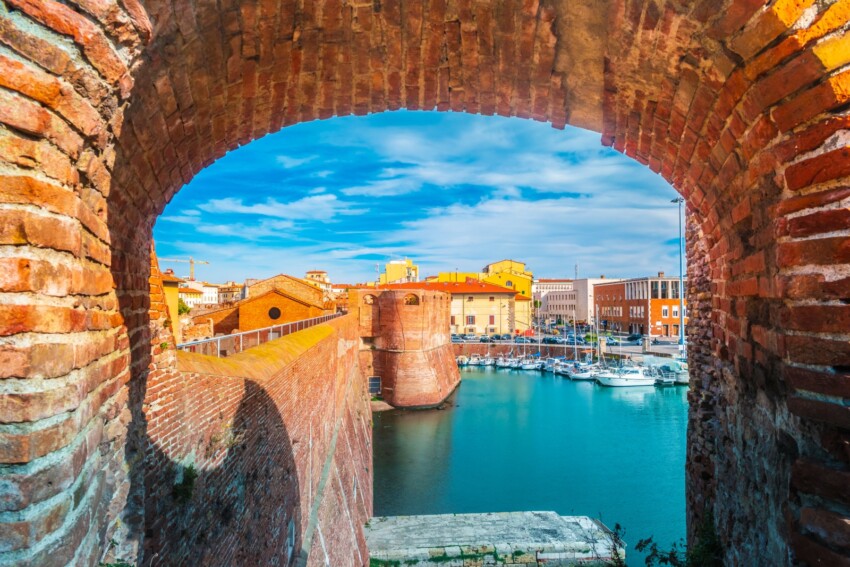
Livorno is Tuscany’s quintessential seaside city: a fishing village transformed into a strategic hub by the Medici in the sixteenth century. An economy built on the sea has made Livorno a historic crossroads of cultures and trade, which today translates into a multicultural, dynamic city brimming with cultural vitality: an unusual destination worth discovering.
Its bustling port is one of Italy’s and the Mediterranean’s most important, much to the chagrin of Pisa, which was once a powerful Maritime Republic but lost its maritime supremacy in the region to Livorno.
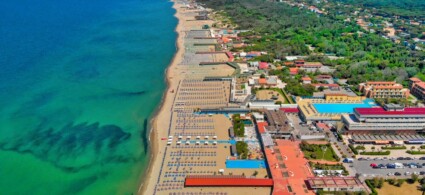
The beaches around the centre are beautiful and varied, catering to those who prefer sandy shores and rocky coves alike, and some of Europe’s earliest seaside resorts were established right here in Livorno.
Without leaving the centre, you can enjoy magnificent sea views from a splendid panoramic terrace and sample delicious seafood dishes such as sea salami and seafood carbonara.
True, Livorno was heavily damaged during the Second World War and looks far more modern than Tuscany’s better-known art cities, but it doesn’t present itself as a soulless industrial town. There are villas, fortresses, historic markets, museums and even a quarter of bridges and canals reminiscent of Venice.
Don’t relegate Livorno to merely a departure point for Sardinia or Corsica: stop for a while and you’ll discover an exciting city.
Livorno’s top attractions are tied to the sea: viewpoints, beaches, the Aquarium… But Livorno also boasts interesting cultural heritage and a vibrant city life.
Amongst history, art and urban atmosphere, here are the absolute must-sees in Livorno.
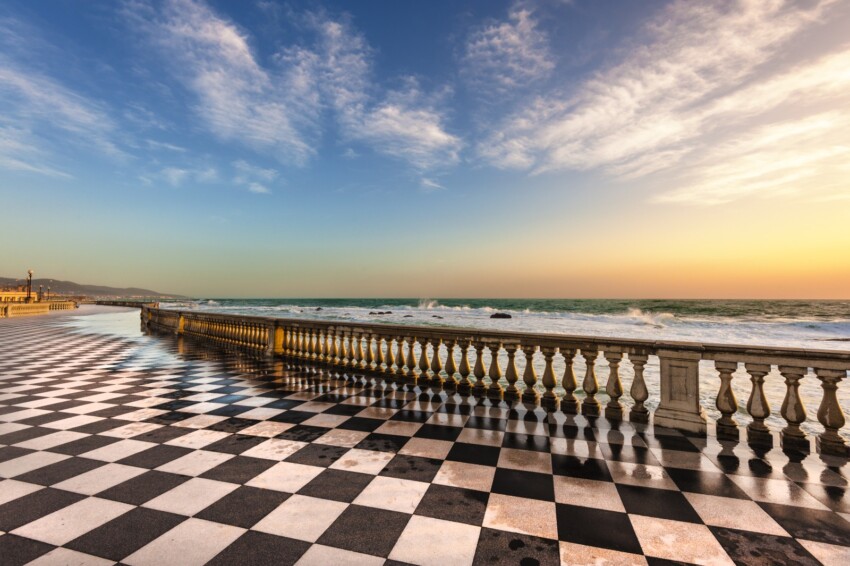
Terrazza Mascagni is Livorno’s iconic landmark: beloved by locals, it captivates anyone who visits the city, even for just a few hours, and is certainly an unmissable attraction for photographers seeking interesting vistas, couples after a romantic stroll and sunset lovers.
Part square, part viewpoint, it’s an enormous panoramic terrace that follows the coastline, characterised by a chequerboard paving and an elegant balustrade. From here you can enjoy a spectacular view of the nearby islands of the Tuscan Archipelago.
Its dimensions are impressive, with over 30,000 black and white tiles and more than 4,000 columns required to build it. The Forte dei Cavalleggeri once stood on this site before being demolished in the nineteenth century; the chequerboard terrace was built in 1925.
The terrace is named after Pietro Mascagni, a celebrated composer from Livorno.
Livorno’s most famous monument is the sculptural group of the Four Moors standing in the centre of Piazza Micheli, overlooking the Old Darsena. Created between the sixteenth and seventeenth centuries, the Monument to the Four Moors is linked to historical events and popular beliefs.
The man towering atop the statue is Ferdinando I de’ Medici and the chained Moors at his feet are four pirates he captured.
Originally only the statue of the Grand Duke stood there, but from 1621 onwards the four Moors were gradually added. The monument remains incomplete to this day: the original design called for two fountains, which were later placed in a Florence square.
Try to find the exact spot from which you can see all four Moors’ noses in a single glance: according to locals, finding this point brings good fortune.
Livorno’s Fortezza Vecchia is an irregular-plan defensive complex located in the port area and fundamental to the city’s fortune.
The first defensive structures forming the fortress’s core date back to the early Middle Ages; two towers were later added and connected by a perimeter wall. Its current appearance stems from modifications ordered by the Medici in the sixteenth century. The design is by Antonio da Sangallo the Elder, one of the era’s leading military architecture experts.
Originally the fortress was completely surrounded by sea and accessible only by floating barges; today it’s connected to the mainland and serves as a venue for cultural events.
Three bastions stand within the Fortezza Vecchia: Ampolletta, Canaviglia and Capitana. The most imposing and well-known structure is the Mastio di Matilde, a powerful cylindrical tower attributed to Countess Matilda of Tuscany.
This attribution is almost certainly incorrect, but the name has become established through usage.
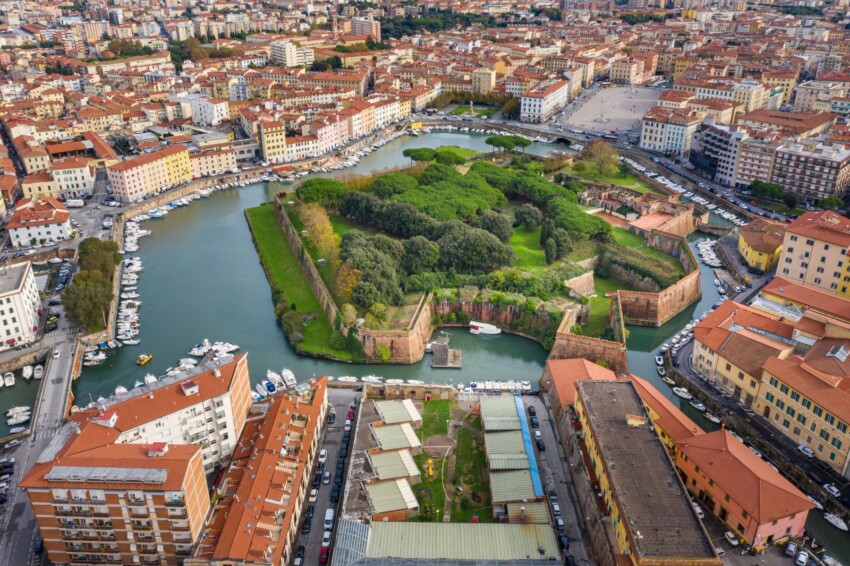
Fortezza Nuova is another defensive complex in Livorno that completed the city’s fortifications; construction dates to the sixteenth century. It serves as a connecting element between the historic town centre and the newer districts.
Today it’s a public park and frequently hosts events and exhibitions.
Livorno’s most charming neighbourhood is called Piccola Venezia: a corner in the heart of the historic centre where you can stroll along canals, bridges and little squares reminiscent of the famous lagoon city of the Veneto.
It’s a lovely neighbourhood to explore on foot, perhaps hunting for the best photo opportunities, but it’s also worth seeing from another perspective: treat yourself to a boat trip along the “fossi“. That’s what the navigable canals crossing the neighbourhood are called, giving it its distinctive atmosphere; these artificial waterways were built from the seventeenth to eighteenth centuries to facilitate cargo transport to and from the port. The most famous of all is the Canale dei Navicelli.
The fossi neighbourhood extends alongside the Fortezza Vecchia, in an area between the Ponte San Giovanni Nepomuceno and the Chiesa di Santa Caterina.
Within its bounds stand some of Livorno’s finest buildings: note Palazzo Huigens, Palazzo Scali Rosciano, Chiesa di San Ferdinando and the Palazzo del Monte di Pietà. The neighbourhood is also home to one of the city’s most elegant streets, Via Borra.
The Livorno Aquarium is one of Italy’s most important and boasts a spectacular location: it sits directly on the seafront, next to Terrazza Mascagni, and has its own panoramic terrace.
Over 300 animal and plant species from the underwater world await you inside: amongst them clownfish, rays, jellyfish, alien fish, squirrelfish, sea eagles and even a kelp forest.
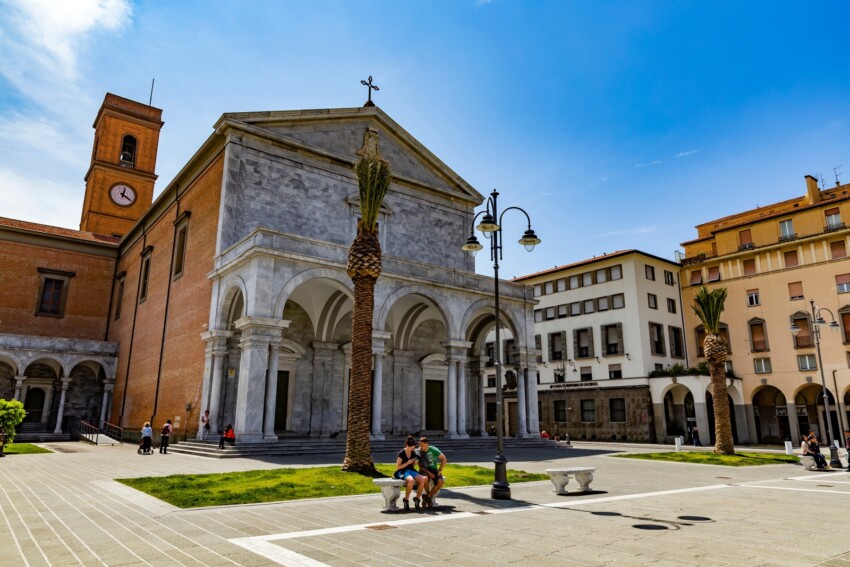
The Livorno Cathedral, or Cattedrale di San Francesco, looks very different externally from typical Tuscan cathedrals.
Unfortunately the church’s facade was completely destroyed during the Second World War and rebuilt with semicircular arches reminiscent of English Renaissance architecture. Inside, however, you’ll find the wealth of artworks you’d expect to encounter in Tuscany.
Nestled between Fortezza Nuova and Fortezza Vecchia lies Livorno’s finest market: the Mercato delle Vettovaglie, a historic covered market that opened in the late nineteenth century.
The magnificent building that still houses it was one of the public works undertaken to revitalise the city’s economy, which had been hit by Italian unification.
Frequented daily by local residents for their shopping, the market also inspired artist Amedeo Modigliani, who had his studio upstairs, and comedians Gino Bramieri and Walter Chiari.
Inside you can buy fruit, vegetables, fish, meat and delicacies of every kind; there are also shops, bars and cafés. For street food lovers and those who enjoy the lively atmosphere of covered markets, it’s an unmissable attraction.
A good reference point for exploring Livorno’s centre is Piazza della Repubblica, where three key city roads converge (Via Grande, Via Garibaldi and Via de Larderel).
Known as “Il Voltone“, it’s one of the city’s largest squares and a popular meeting spot. It was built in the nineteenth century; the Cisternino, a building that supplied water to the city, dates from the same period.
The two statues facing each other across the square represent Grand Dukes Ferdinando III and Leopoldo II.
Housed in Villa Henderson, an elegant historic palazzo, the Museum of Mediterranean Natural History is a highly active research and science education centre focused on environmental and conservation topics.
One section is entirely devoted to human evolution, another to the sea, another to invertebrates, plus there’s a botanical garden.
You can see cetacean skeletons, reproductions of sea beds, specimens of terrestrial and marine invertebrates and a Neanderthal man reconstruction that lets you look face-to-face with a prehistoric human!
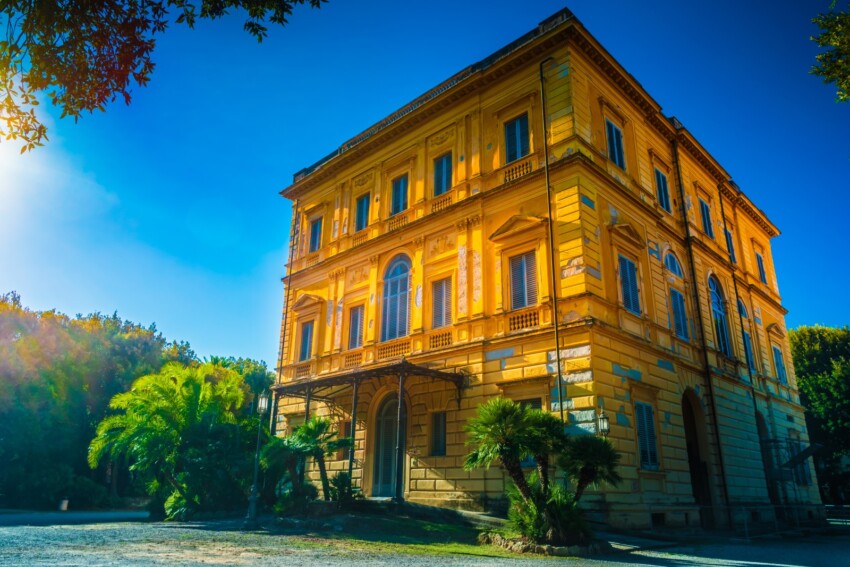
Another splendid historic palazzo, Villa Mimbelli, houses the Giovanni Fattori Civic Museum, an interesting attraction for art enthusiasts and period furniture lovers alike.
The museum collection comprises paintings from the mid-nineteenth century to the 1940s, mostly by Livorno and Tuscan artists. The villa hosting the museum features an elegant garden, perfect for a leisurely stroll.
An exceptional vantage point offering views over Livorno’s centre and port from above is the Sanctuary of Our Lady of Grace. It’s often referred to as the Sanctuary of Montenero after the hilltop on which it stands.
It’s a highly significant place of worship, surrounded by numerous legends; it’s about ten kilometres from the centre and can be reached by car or public transport.
Want to stretch your legs or cool off immersed in nature? Head to the Monti Livornesi Park, a green oasis of around 1,300 hectares spanning the municipalities of Livorno, Collesalvetti and Rosignano Marittimo.
Beautiful forests crossed by numerous streams await you, which you can explore on foot, by mountain bike or on horseback.
To discover Livorno’s most beautiful beaches and the surrounding area, head south from the city centre. Within a radius of less than 10 km, you’ll find three lovely beaches in succession, all easily accessible by car or public transport and all within 10 km of the centre. Each has been awarded the Blue Flag for the quality of its facilities.
Heading south from the city centre, you’ll pass through the districts of Ardenza, Antignano, Calafuria and Quercianella, where locals love to spend their seaside days. The beach selection is extensive and there’s something for everyone. Among the finest, we recommend Tre Ponti Beach, Spiaggia del Sale, a sandy beach bordered by jutting rocks, and the Miramare shoreline.
As you continue along this stretch of coast, you’ll discover magnificent rocky coves, some well-known, others more secluded. The most beautiful are found in the Calafuria Nature Reserve. Don’t miss Cala Leone and Cala Quercianella.
If you have time to spare, take a ferry to the island of Capraia, a natural paradise just a few hours’ boat journey from Livorno.
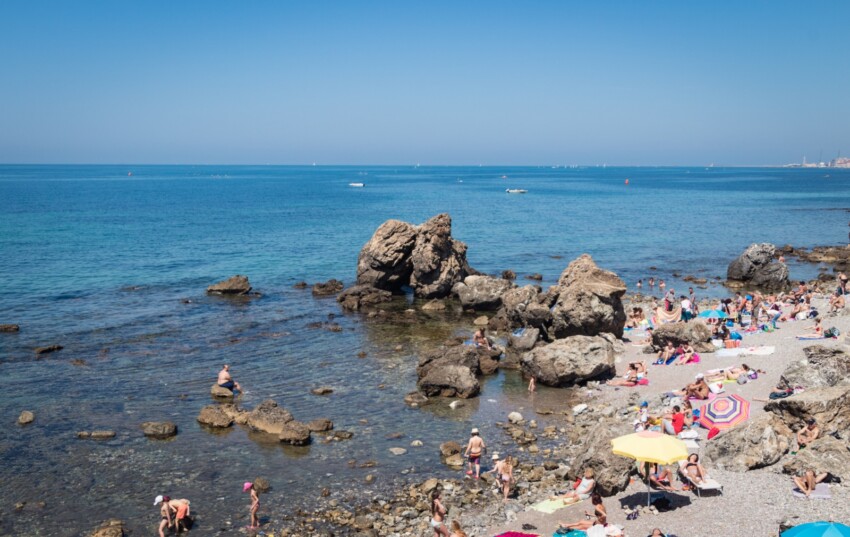
In the district of Antignano, situated south of Livorno just beyond Ardenza, you’ll find charming beaches with shingle beds, not always easily accessible, along a coastline characterised by dark rocks. The first is Tamerice Beach, named after a historic tamarisk tree depicted by important painters such as Fattori, Natali and Lomi. Cabianca Beach (short for casa bianca, white house) lies opposite the street of the same name.
Just to the south is Spiaggia Longa, which as the name suggests is one of Antignano’s longest beaches, also facing the street that bears the same name, Via Longa. You certainly won’t confuse them. A little further down lies one of the most striking beaches in this area: Ballerina Beach, accessed through the park of the same name via a carpet of blooming daisies beneath tamarisk trees. Descending the steps, you’ll reach a small shingle beach surrounded by rocky stacks. One of these, before excessive erosion, apparently resembled a ballerina, hence the name.
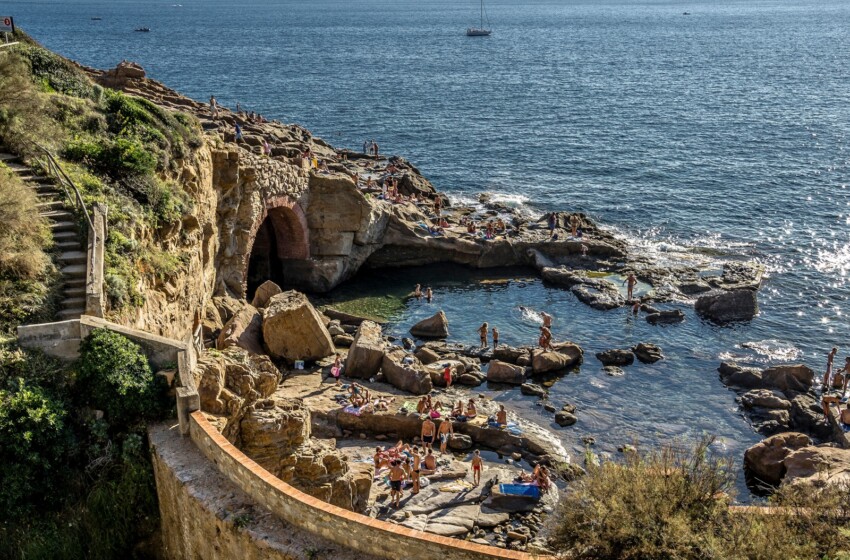
The Calafuria cliff face, several kilometres of rugged coastline battered, as the name suggests, by wind and the sea’s fury, is one of the geologically most interesting stretches of Livorno’s shoreline. It’s an extremely fleeting landscape, as the wind constantly works away and the cliff erodes continuously under its force. Beaches are few, but the cliff is often accessible and there are even some natural brackish pools, the result of past quarrying that fill with seawater with the waves. Next to Calafuria Tower lies the bridge of the same name.
Directly beneath the bridge sits Calafuria Beach, one of the few shingle shores in this area. The coastline ends with Calignaia Beach, made of coarse shingle, also beneath a bridge. Access is from the Romito restaurant car park, a challenging descent, especially the final stretch, unsuitable for young children. The view, however, is quite striking. It appears framed by the Aurelia Bridge, behind which you can see the old railway bridge. The scenery is pleasantly enhanced by this interplay of arches.

The last stretch of coastline in Livorno municipality is represented by Quercianella. Here you’ll find some interesting beaches including Cala del Leone, which is difficult to reach as you must cross Sonnino Park, which is privately owned. On the south side of the promontory is Sonnino pier, with a shingle beach well integrated into the landscape.
Beyond some rocks lies Rogiolo Beach, named after the stream that flows here. It’s well equipped with all facilities, including disabled access. Access is via a convenient concrete walkway along the rocks (descending from La Baracchina restaurant) that connects Rogiolo to Quercianella.
There’s also a road owned by the State Railways, not accessible to cars; however, you’ll need to walk the remaining 200 metres. This beach, with medium shingle mixed with fine shingle, is well sheltered from swell, as Sonnino promontory protects it from westerly winds. Walking along the concrete path heading south, after a few hundred metres you’ll reach the small Quercianella Harbour, which on its north side has a small beach with a saltwater pool created by artificially positioning a barrier of large stones, ideal for letting children play safely.
South of the harbour lies the actual Quercianella Beach, with both free and equipped sections offering all conveniences at hand. The area south of the village, beyond the promontory, has a bed of shingle alternating with rocky veins that form characteristic oblique layers. A well-marked flight of steps allows beach access from that side too. The Chioma stream mouth marks the boundary between Livorno municipality and Rosignano Marittimo. North of the mouth is a final shoreline, attractive but somewhat difficult to find.
A residential area that grew around neoclassical buildings from the 1840s, Ardenza is now completely incorporated into the city of Livorno. This rocky yet flat stretch is home to interesting shingle beaches of recent formation, capable of changing appearance even after a single storm surge.
The first, opposite the Racecourse, is Accademia Beach. Just below the Naval Academy, on either side of the Italian Naval League pier, there are two more beaches, though often occupied by beached boats. These are the Fiume Beaches: it’s not a grammatical error, as it refers to the “Bagni Fiume” (Fiume Baths). The southern one is also called Selciaio Beach.
Rotonda Beach, small but well equipped, faces the park of the same name, south of the Lido Baths. Tre Ponti Beach is a fairly wide tongue of sand with a pleasant appearance, at the mouth of the Rio Ardenza. The seabed here has a structure that favours wave formation, so when the westerly or south-westerly winds blow, this beach is one of the few places where you can surf.
As is common in most transit cities, Livorno’s hotels and B&Bs cluster around the port and cater to those staying just one night.
It’s therefore easy to find both budget hotels, fairly basic, and modern hotels aimed at business travellers offering considerable comfort.
There are also more charming options, such as tastefully furnished apartments in the historic centre and villas just a few kilometres from town; for those seeking luxury, there are a couple of 5-star hotels with swimming pools.
The two simplest ways to reach Livorno are by ferry or taking a low-cost flight to Pisa and then driving or using public transport.
Livorno Port is in the city centre and is directly connected to Sardinia, Corsica, Sicily and the island of Capraia; with a change in Sardinia, you can travel as far as Spain (Barcelona). Arriving at Livorno by ferry is very convenient as ships are fairly frequent and allow you to bring your own vehicle on board.
Pisa Airport is approximately 25 km away and although there are no direct connections, it’s rather easy to reach: simply get to Pisa city centre, which is only 3 km from the passenger terminal, and then take a bus or train. Taxi fares aren’t excessive if you’re travelling in a group and sharing costs.
If you’re already in Tuscany, you can easily reach Livorno from various directions and by different means. For those wishing to drive, the key reference is the Florence-Pisa-Livorno state road, connected to the A1 motorway and other major national routes; the recommended exit is Livorno centre.
Livorno Train Station is conveniently located near the historic centre and port. It lies on the Rome-Genoa line, one of the country’s most important railway routes, served by frequent regional and intercity trains. Trains on this line also stop in Florence, Pisa and at major Maremma coastal resorts.
Bus is a valid alternative: local and regional buses stop at the train station, while long-distance buses to national destinations arrive at a coach station approximately 5 km away.
What's the weather at Livorno? Below are the temperatures and the weather forecast at Livorno for the next few days.
Livorno is a municipality in north-central Tuscany situated along the coast and serves as the provincial capital of the same name. It lies just 25 km from Pisa, approximately 90 km from Florence and 130 km from Siena.
 Hotel
Hotel  Budget accommodations
  Apartments
  Family Hotel
  Luxury Hotel
  Resorts