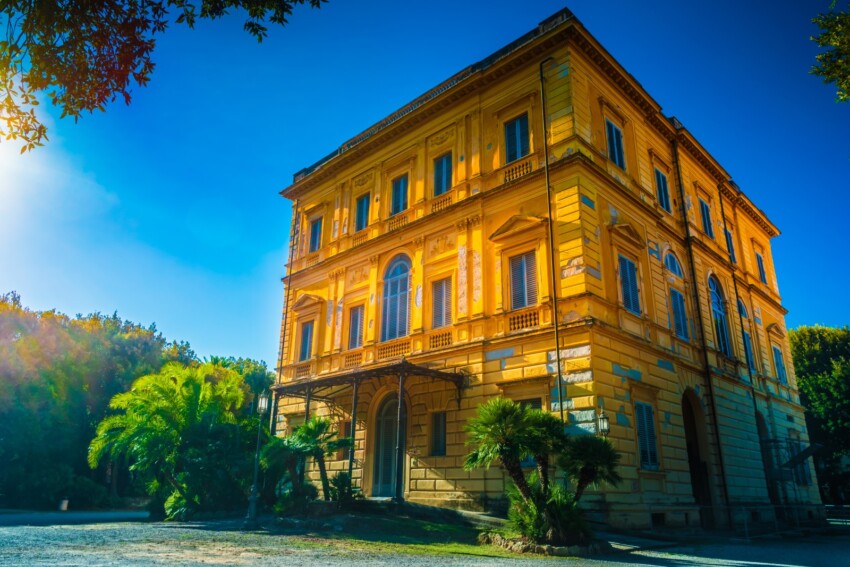
The museum is housed across three floors of the beautiful Villa Mimbelli and contains one hundred and thirty-six works by painters who shaped Italian art between the 19th and 20th centuries. The ground floor displays canvases by Enrico Pollastrini (Livorno 1817-1876) featuring religious and historical subjects. The second floor opens onto the main museum trail. Three large halls showcase major canvases by Giovanni Fattori (Livorno 1825 Florence 1908). In spacious exhibition rooms you’ll find paintings of considerable significance such as “Cavalry Charge at Montebello” (1862), “Assault on Madonna della Scoperta” (1868) and “Maremma Herds” (1893). Equally renowned are the paintings “Portrait of His Third Wife” (1905), “Grey Day” (1893), “Seafront at Antignano” (1894) and “Lady Martelli at Castiglioncello” (1867). The route continues through halls dedicated to Telemaco Signorini, Vincenzo Cabianca, Giovanni Boldini, Serafino De Tivoli, Silvestro Lega, Adolfo Tommasi, Angelo Tommasi and Ludovico Tommasi. The rooms devoted to “naturalistic” painting and portraiture are particularly interesting, featuring works by Cesare Bartolena, Michele Gordigiani, Vittorio Corcos and Leonetto Cappiello.
The first floor houses works by Post-Macchiaioli painters including Plinio Nomellini, Ulivi Liegi, the Micheli school, Mario Puccini, Giovanni Bartolena, Raffaello Gambogi and Leonetto Cappiello. A brief excursion into Divisionism is represented by works by Benvenuto Benvenuti and Vittorio Grubicy De Dragon. The museum’s collection also includes several valuable works not yet on display, awaiting a suitable venue. Among these are: “Head of Christ”, attributed to Beato Angelico and from the church of Santa Maria del Soccorso, “Madonna and Child” by Álvaro Pírez, “Madonna and Child” attributed to Sandro Botticelli, “Madonna” from the Byzantine school of the 15th century, “Madonna and Child” by Cima da Conegliano, “Deposition” by Carlo Cignani, “Crucifixion” by Neri di Bicci, “Dantean Madonna” by the Master of the Nativity of Castello, “Battle of the Burgundian” by Jacques Courtois. The museum organises significant temporary exhibitions: among the shows held so far were those in 1996 on the “Post-Macchiaioli”, in 1997 dedicated to Vittorio Corcos and titled “Cézanne, Fattori and 20th-Century Italy”. In 1998 came a remarkable retrospective of Plinio Nomellini and several others.
Fattori’s work stands as a central figure in 19th-century European art, its epic breadth measured against the rhythms of daily life. Profoundly characterising Fattori’s artistic experience, as highlighted in more in-depth studies of the artist, is the complex interplay of numerous technical approaches—from preliminary sketches to drawings, studies and finished paintings to engravings—in a continuous process of refinement, cross-references and reworkings.
His output is underpinned by prolific graphic activity, largely comprising sketches drawn from life; he himself tells us this, describing himself as a “scrupulous observer of nature who, since my youth, have always carried with me a small pocket notebook for everything that strikes me”. His practice of engraving, which punctuates much of Fattori’s long creative journey, likewise unfolds in the complexity of thematic developments structured on revisits and references to drawings and paintings. This approach of lateral oscillations across a broad technical range presupposes—to properly represent the artist—an examination across different languages, from synthetic, abbreviated panels absolute in their figurative conciseness, to remarkable graphic expressions of a more personal and intimate nature, to vast military canvases firm and powerful in their static scenes or in the fervour of battles, epic in their compositions of cowboys. The human figure is the thread that guides the exhibition trail, structured around three principal moments: portraiture or the figure set within an environment, beginning with portraits composed in traditional formats, half-length, in the early years with tight formal organisation of Purist character, then becoming more powerful and sculptural, such as the remarkable Rifleman or Portrait of His Third Wife, a late work yet marked by high formal tension that opens onto 20th-century Italy, through to remarkable “small panels” including Lady Martelli at Castiglioncello or Portrait of Barrister Valerio Biondi, where conciseness and sculptural sensibility propose extraordinary and novel forms of expression.
“The most aristocratic sense of elegance presides over the organisation of tones, the transition from one to another, their harmonisation”, wrote Soffici of Fattori’s portraiture.

 Hotel
Hotel  Budget accommodations
  Apartments
  Family Hotel
  Luxury Hotel
  Resorts