Calafuria lies within the municipality of Livorno, along the Aurelia state road that connects the Antignano neighbourhood to the Quercianella locality. It sits roughly ten kilometres from Livorno's city centre.
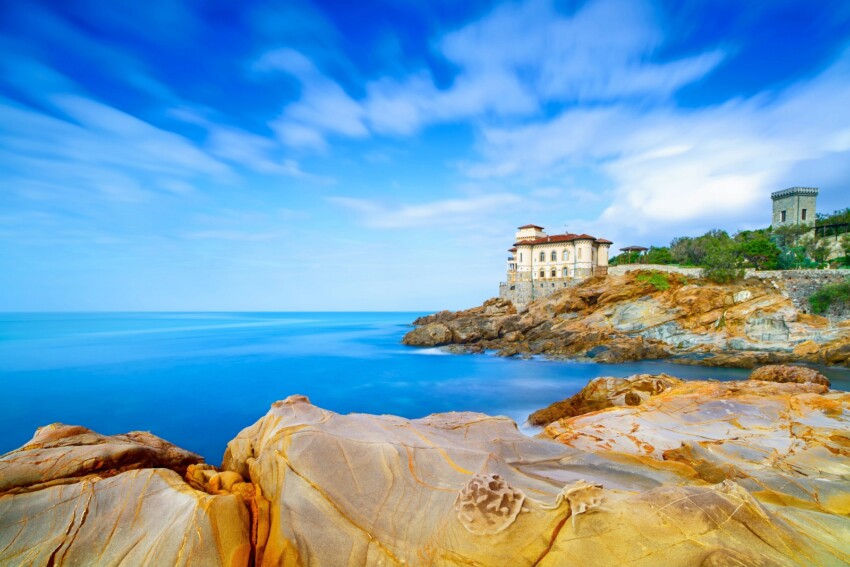
The Calafuria Nature Reserve protects one of Tuscany’s wildest and most captivating coastal stretches. Reddish-hued sandstone rocks plunge into the crystal-clear waters of the Tyrrhenian Sea, creating a landscape that alternates between sheer cliffs, natural pools carved into the stone and secret coves. Just a few kilometres from Livorno, along the famous scenic Romito road, this protected area of approximately 115 hectares offers an experience that blends unspoilt nature with historical significance.
Three castles and sixteenth-century towers dot this promontory: from the Castello del Boccale to the north, through the imposing Torre di Calafuria, to the Castello Sonnino which dominates Cala del Leone. Behind them, the Livorno Hills covered in Mediterranean scrub descend towards the sea, forming crevices where stone martens, porcupines and wild boar find refuge. Underwater, walls carpeted with red coral drop away to seabeds that have fascinated divers and scholars for centuries.
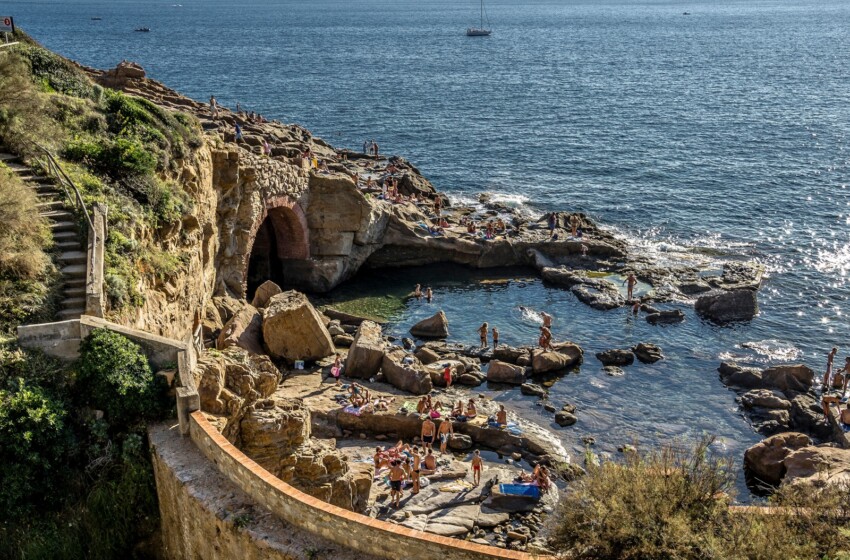
Calafuria doesn’t have beaches in the traditional sense. The coastline is instead made up of a series of rocky access points, coves and natural platforms that require a touch of adventurous spirit but reward you with exceptionally clear water.
The Scogli Piatti (Flat Rocks) represent the most convenient sea access in this area. The rock formation allows you to enter the water gently without any particular difficulty. The area is easily recognised as it’s dominated by the Torre di Calafuria, a Medici construction about twenty metres high that stands on a sloped base. Built in the sixteenth century as part of the Grand Duchy’s defensive system against Barbary raids, the tower has a square footprint with sides of nearly eight metres and an upper balcony supported by small arches on limestone corbels.
Just above the rocks sits a restaurant serving fish dishes with views over the cliffs. The area attracts visitors from early morning when the water takes on particularly brilliant turquoise hues. Diving Torre di Calafuria organises dives, including night dives, to explore seabeds rich in posidonia, where gilt-head bream, barracuda and other fish swim among walls adorned with red coral that descends to depths of forty metres.
Continuing along the Romito scenic road, a sign points to the Vaschette di Calafuria (Little Pools). These extraordinary natural pools are actually ancient open-air sandstone quarries dating back to the Etruscan-Roman era. Stone extraction left pools with squared walls and even small steps carved into the rock, now filled with seawater that wave action continuously refreshes.
Some pools lie below the current sea level, evidence of the rise that occurred over the centuries. This phenomenon has created pools of varying depths perfect for swimming even when the sea is rough: only strong westerly winds make bathing inadvisable. The area is completely free, with no beach clubs or bars. In the afternoon, “Gela” – an ice cream and refreshment seller – passes through, a tradition that has served Calafuria swimmers for generations.
The beautiful and irregular rock formations of Sassoscritto offer numerous points for diving from various heights. The rocks create crevices and small caves that invite exploration with mask and fins. The crystalline water allows you to observe the seabed from above: a mosaic of rare algae, golden sand tongues and rocky pinnacles emerging from the depths.
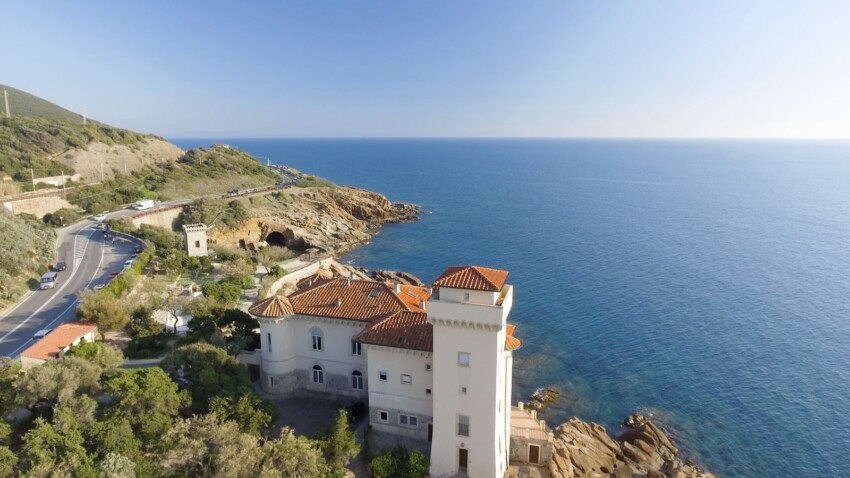
The Castello del Boccale marks the entrance to the Nature Reserve coming from Livorno. This neo-medieval construction stands on a sixteenth-century Medici watchtower, also known as the “Maroccone tower” or “Devil’s tower”. Between the nineteenth and twentieth centuries, Marchesa Eleonora Ugolini had the tower transformed into a residence with crenellations, later modified by the Whitaker-Ingham family who in the early twentieth century replaced the crenellations with sloping roof covers.
Restored by Livorno architect Ivano Falchini after a long period of abandonment, the castle has been divided into eleven apartments and six outbuildings, all privately owned. Visits are therefore limited to the exterior, but its position perched over the sea in Cala dei Pirati (Pirates’ Cove) offers spectacular photo opportunities. The area takes this name from the Saracen raids that threatened the Livorno coast for centuries.
Following a path with steps through the small wood for about ten minutes, you reach Cala del Leone, a spacious hidden beach surrounded by cliffs. A large rock ideal for diving separates the entrance from the actual beach, which consists of pebbles moved by waves with a characteristic rumble. From above, Castello Sonnino appears to keep watch over this wild corner.
The castle, in neo-medieval style, was built by Baron Sidney Sonnino on the remains of a sixteenth-century Medici fortress. Sonnino was a leading figure in Italian politics: Prime Minister, Minister of Finance and Treasury of the Kingdom of Italy, and chose this manor as his residence and mausoleum. This castle is also private and can only be admired from the outside.
The Calafuria Nature Reserve offers marked and easily walkable trails that wind between Aleppo pines, holm oaks, narrow-leafed privet, mastic, strawberry trees, myrtle and laurel. Following these paths leads to viewpoints from which you can admire horizons spanning Livorno and the Tuscan Archipelago. The fauna includes stone martens, porcupines, foxes, hedgehogs, beech martens and wild boar that often venture to the coast.
Calafuria’s seabeds represent an extraordinary marine ecosystem that is the subject of scientific study. From three to ten metres deep, the seabed features Posidonia oceanica meadows interspersed with sand tongues and rocky pinnacles. Below sixteen metres, magnificent walls adorned with red coral descend towards deep blue. Around twenty metres, among sponges and sea fans, a reef dominated by coralline formations drops almost vertically to forty metres towards a sandy seabed.
Crevices, canyons, caves and fissures provide shelter for exceptional biodiversity. The particular turbidity of the waters, which varies with weather, currents and temperatures, has favoured the establishment of red coral that continues to be closely monitored by the scientific community.
Calafuria is a protected natural area with no direct accommodation facilities. Lodging can be found in the neighbouring districts of Antignano and Quercianella, or in central Livorno just a few kilometres away. Hotels and B&Bs in Livorno’s southern districts allow you to reach the cliffs quickly by driving along the Romito scenic road.
Livorno offers a full range of accommodation options, from beachfront hotels on the Terrazza Mascagni to apartments in historic neighbourhoods. The city is well served by public transport and Livorno Antignano station on the Tyrrhenian railway line makes it possible to reach Calafuria without a car, although the walk from the station to the sea access requires at least thirty minutes.
Calafuria lies within the municipality of Livorno, along the Aurelia state road that connects the Antignano neighbourhood to the Quercianella locality. It sits roughly ten kilometres from Livorno's city centre.


 Hotel
Hotel 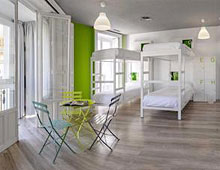 Budget accommodations
  Apartments
  Family Hotel
 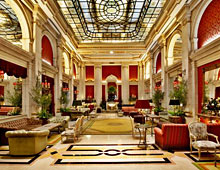 Luxury Hotel
 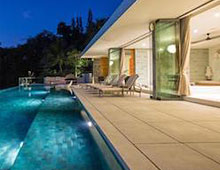 Resorts