La Mandola eco Hostel
Capraia - Via della Mandola
Book now
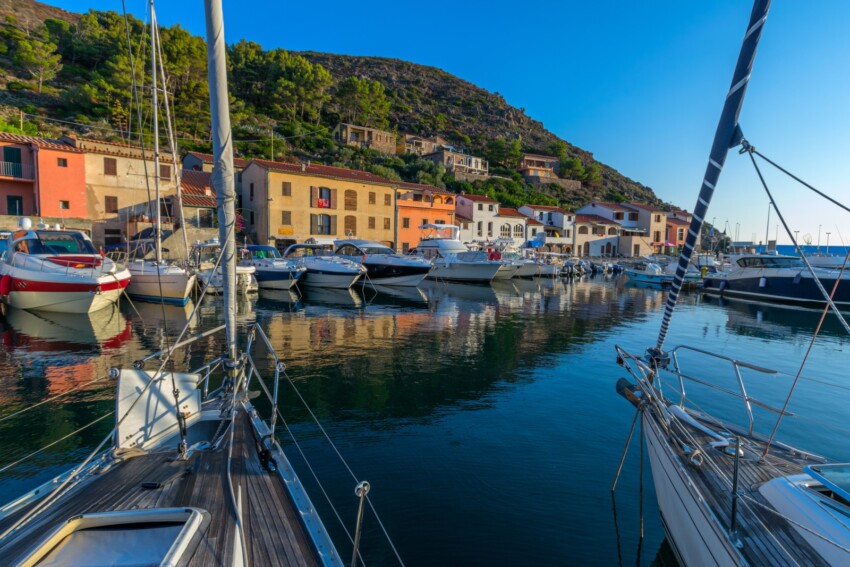
Capraia Island is the wildest in the Tuscan Archipelago and, in many respects, the most authentic. Of volcanic origin, it has been part of the Tuscan Archipelago National Park since 1996 and presents itself as a succession of sheer cliffs overlooking the sea, dense and fragrant Mediterranean scrubland, and coves reachable almost exclusively by boat. It is the third largest island in the archipelago, with a mountainous configuration that has Monte Castello as its highest peak at 447 metres. Mass tourism has never reached here, and this is its greatest asset: those who choose Capraia do so consciously, seeking something that more celebrated destinations can no longer offer.
The name Capraia, from the Latin Capraria, derives from the Etruscan word capra which, contrary to what one might think, means rock: the etymology alludes to the volcanic origin of the island and its rugged, rocky character. The Romans occupied it from the 3rd century BC onwards, making it a naval base to combat Carthaginian piracy. In the 6th century AD it became a refuge for a community of Christian hermits, later followed by monastic monks who founded the monastery of Santo Stefano. In the following centuries, Pisans and Genoese competed for the island, and it is the Genoese who left the most visible marks: the Fortress of San Giorgio and the coastal watchtowers, including the Torre dello Zenobito, built in 1545 to protect the coast towards Corsica.
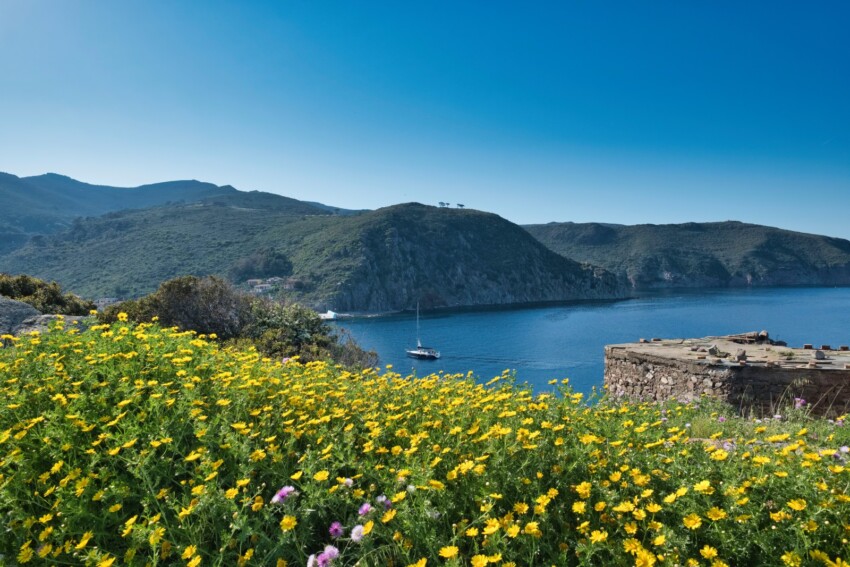
The coastline is particularly jagged: there are as many as 22 inlets around the entire perimeter, but most are reachable only by sea. The most practical option is the taxi boat, available directly at the harbour, which allows you to reach the most remote coves and take a tour around the island with stops at the most scenic points. Alternatively, you can hire a small boat without a licence to explore independently.
The most famous cove is undoubtedly Cala Rossa, an ancient crater of the former volcano easily recognised by the striking red of the lava rocks, which forms a splendid contrast with the blue sea. On the western side you’ll find Cala del Reciso, Cala del Fondo and Cala del Vetriolo, the latter known for its characteristic tafoni, holes carved into the rock by wind action. The only sandy beach is Cala della Mortola, in the northernmost part of the island, reachable almost exclusively by sea. The coves accessible on foot from the village are instead on the eastern side — in full sun in the morning, in shade in the afternoon — including Cala di San Francesco, Cala dello Zurletto and Cala del Ceppo.
For divers, the waters of Capraia are truly legendary: crystal-clear and teeming with fish thanks to the strict protection of the National Park. Rocky seabeds alternate with seagrass meadows, with close encounters guaranteed even at shallow depths. It’s also possible to practise the so-called «blue mile», a swimtrekking route consisting of 22 buoys, 1,100 metres long, in front of the inhabited area of the island.
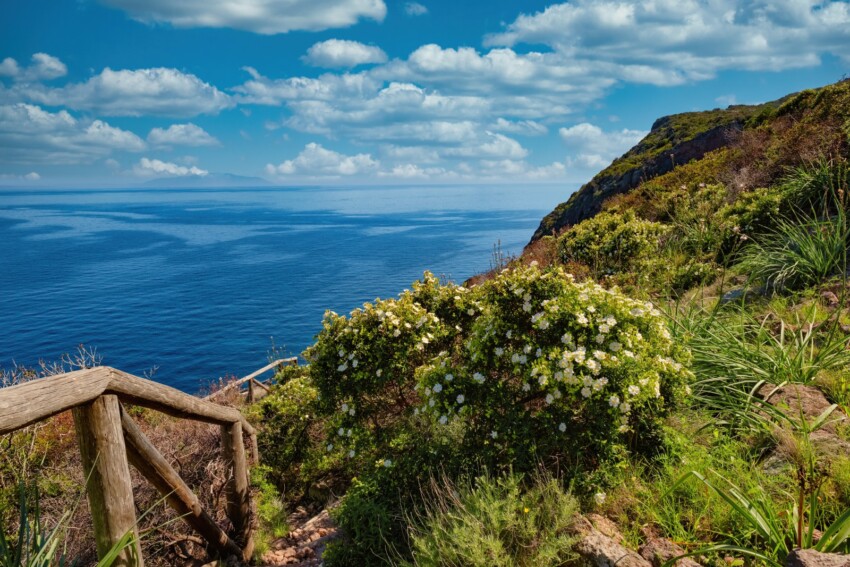
The village of Capraia can be visited entirely on foot in just a few hours: distances are minimal and cars are practically non-existent. The Fortress of San Giorgio, which dominates the village from above, and the Port Tower offer panoramic viewpoints of great charm overlooking the harbour and mountains. Nearby is the former convent with the Church of Sant’Antonio, recently restored on its façade. The entire area of the former Penal Colony — which was active until 1986 — is accessible on foot along dirt paths: the abandoned structures among the vineyards and helichrysum scrubland create an atmosphere suspended in time.
For trekking enthusiasts, one of the most beautiful routes is the one that reaches Punta dello Zenobito in the southernmost part of the island, with a magnificent view of the tower and an extraordinary viewpoint from Punta Bellavista. The paths run through vegetation of myrtle, mastic, rosemary, helichrysum, rock rose, spurge and oleander, with rare endemics such as the Capraia cornflower. In spring and autumn the Walking Festival offers guided excursions to discover the island with specialist guides.
Capraia is renowned for its fresh and aged goat cheeses, for its aromatic wildflower honey and for its stuffed squid, a dish that is emblematic of local cuisine. The wines produced include small quantities of Vermentino, fresh and mineral, and a red dessert wine made from Aleatico grapes, intense and concentrated. The most anticipated gastronomic event is the Squid Festival in November, featuring a fishing competition and food and wine stalls at the harbour. In summer, between August and September, Capraia takes part in the Tuscan Archipelago Maritime Palio.
Capraia’s accommodation offer is deliberately limited, in keeping with the island’s character. The facilities are concentrated almost entirely in the harbour and village areas, about a kilometre apart and connected by a small bus. Those who choose to stay at the harbour find themselves immersed in a maritime atmosphere, with the boat just steps away and the bustle of fishermen beneath the window; those who prefer the village climb among the narrow alleys at the foot of the San Giorgio Fortress, with direct access to the main park trails.
The most important recommendation is: book well in advance, especially during the high season between June and September. The island’s accommodation capacity is structurally limited and places sell out months ahead.
Capraia is accessible from Livorno by ferry, but since it is quite far away you should plan to stay at least one night to see anything: the crossing takes about three hours. The island is 64 km from Livorno and 53 km from Piombino, whilst Corsica is just 31 km away. Ferries run all year round and increase in frequency during the summer months: it is advisable to book well in advance, especially in August. There are no real roads on the island: between the harbour and the village there are just a few hundred metres and you get around exclusively on foot.
Capraia Island lies in the Tyrrhenian Sea, in the province of Livorno, roughly 64 km from the Tuscan coast and just 31 km from Corsica. It forms part of the Tuscan Archipelago National Park.
 Hotel
Hotel 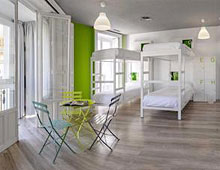 Budget accommodations
  Apartments
  Family Hotel
 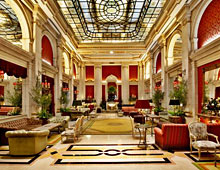 Luxury Hotel
 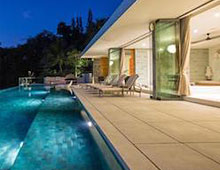 Resorts