Florence: Uffizi Timed Ticket & Masterpieces Audio App
7.148 reviews
Buy now
From 27,20€ per person
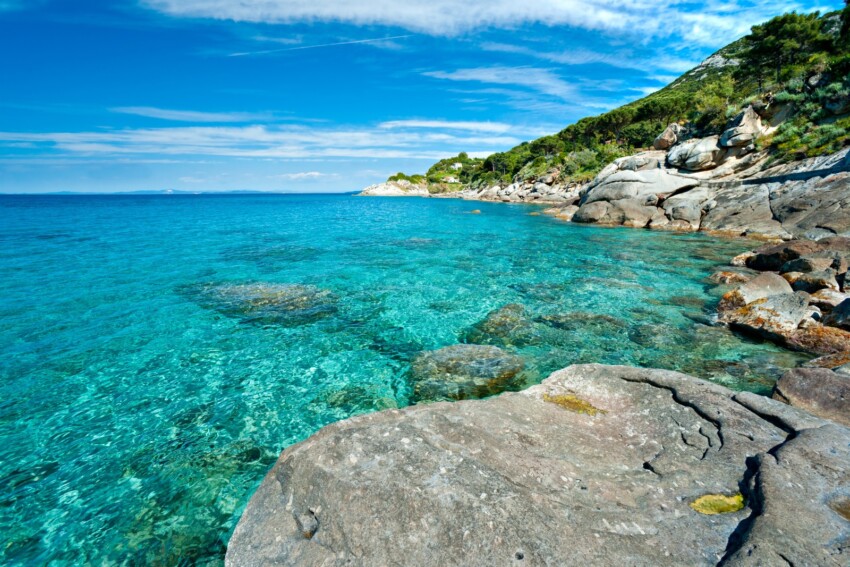
Elba Island is a kaleidoscope of small and wonderful beaches, with breathtaking views, stretching along its 150 kilometres of coastline.
With over 150 beaches, each one unique, during your holiday on Elba you can relax on long stretches of pale sand or on coves of white pebbles, shorelines of black sand or red shingle. Beyond the beaches you’ll also find smooth granite cliffs bathed by crystal-clear sea.
The beaches ideal for families with children are Biodola, Marina di Campo, Lacona, Procchio and Fetovaia, as the sea is shallow for approximately 35 metres from the shoreline.
Among the most sought-after beaches, to mention just a few, we find Capo Bianco, Sansone, Forno, Sant’Andrea, Le Ghiaie, l’Innamorata, Le Tombe, Cala Seregola and Cotoncello.
Beyond the beaches mentioned, you can discover tiny coves reached via long dirt tracks. The effort will reward you with a beach all to yourself!
Remember to choose your beach according to the wind direction.
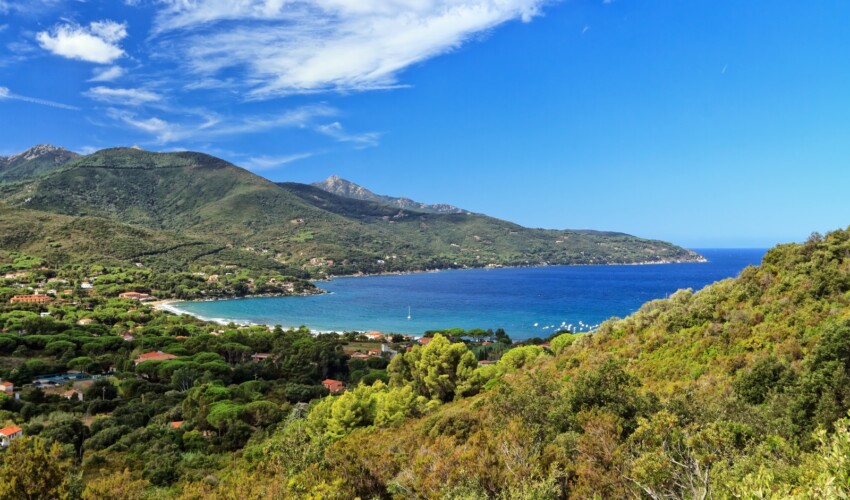
Along the northern coastline of Elba you’ll find the famous tourist resorts of Maricana Marina, Procchio and Biodola as well as Portoferraio, the island’s main town.
In the eastern section you’ll find the beaches of Nisportino and Sassi Rossi, made up of multicoloured pebbles of varying sizes and coarse sand, and towards Portoferraio Bagnaia and Schiopparello.
The beaches closest to the historic centre of Portoferraio are Le Viste, Le Ghiaie, Capo Bianco and Padulella. Just beyond lies Seccione beach, or Prunini, a bit awkward to reach but very beautiful.
Towards Capo d’Enfola, beaches of particular beauty are Sansone and La Sorgente.
In the Biodola Gulf, Forno and Scaglieri are also very popular. Moving towards Marciana, you’ll find the beaches of Procchio, La Paolina, Redinoce and Le Sprizze strung out one after another.
The Sant’Andrea Beach is located on the north-western part of Elba, just a few metres from the village of the same name and roughly 30 minutes’ drive from Portoferraio.
Measuring 200 metres long and narrow, the golden-sand beach is bathed by crystal-clear emerald-coloured sea and sits amid a breathtaking landscape covered in Mediterranean scrub.
A short distance to the left, the white cliffs of Capo Sant’Andrea frame the beach, known as the Cote Piane, striking smooth granite slabs, whilst to the right lies the small and enchanting sandy cove of Cotoncello.
The beach has a bar, restaurants and a metered pay car park approximately 100 metres away.
The La Paolina Beach is situated along the northern coastline of Elba Island, 2 kilometres from Procchio on the provincial road to Marciana Marina, and takes its name from Napoleon’s sister who loved to visit it. Just a few metres from the shore sits the islet of Paolina, easily accessible both by swimming and wading.
Only 5 metres wide and less than a hundred metres long, the beach of mixed sand and small pebbles is reached via a wooden staircase that winds through a small holm-oak wood framing the shoreline. A small beach club allows you to hire umbrellas and loungers, though it’s worth noting the beach only gets sun in the morning.
From La Paolina you can easily reach the adjacent beach of Redinoce.
The beach, not recommended when northerly winds blow, has no car park and cars are usually left in some wider sections of the road verge.
Considered by many the most beautiful beach on Elba, Biodola sits along the northern coast, in one of the most enchanting bays of the island, just 10 kilometres from Portoferraio and shortly before Procchio.
Stretching 600 metres, this beach of fine white sand is well-equipped and offers the chance to try sailing, windsurfing, diving, water-skiing and golf. The Mediterranean scrub framing La Biodola beach borders crystal-clear shallow sea that makes it ideal for families with children and those who enjoy paddling in the water.
Within the Biodola Bay you’ll also find the beaches of Scaglieri and Forno, separated from Biodola by some rocky outcrops. Numerous bars, restaurants and high-quality hotels are located just tens of metres from the beach.
The Forno Beach is the smallest of the three beaches in the Biodola Bay, on the northern part of Elba Island, 10 kilometres from Portoferraio in the direction of Procchio.
Despite being only 100 metres long and very busy, particularly in July and August, the sunsets from Forno Beach are quite literally unforgettable.
The sandy beach of Forno connects to Scaglieri, numerous houses reach right to the water’s edge, and it offers the opportunity to go windsurfing, diving, golfing and take sailing lessons.
To reach Forno, take the turning for Biodola and continue for 4 kilometres. Parking is difficult to find.
The wonderful Sansone Beach is located along the northern coastline of Elba Island, 5 kilometres from Portoferraio and shortly before the Enfola headland.
Sansone is an enchanting beach of bright white shingle and is bathed by emerald-coloured sea.
Ideal for snorkelling given that numerous fish inhabit the caves and crevices around the beach, Sansone has a wild charm whilst still offering the chance to hire umbrellas and sunbeds.
Stretching 270 metres, the beach is dominated by a steep cliff and is accessible on foot along a path starting shortly before the Viticcio turning.
Nearby are the lovely shingle beaches of Cala dei Frati, La Padulella, Capo Bianco, Seccione, Acquaviva and La Sorgente. From this corner of the island you can witness stunning fiery sunsets that paint the bay red.
Small white pebbles mixed with pale sand characterise Capo Bianco beach and this splendid stretch of coast 2 kilometres from Portoferraio town centre, along the northern part of the island.
Not far from the equally beautiful and famous Le Ghiaie, Capo Bianco is considered by many one of the most enchanting beaches on Elba Island. Only 350 metres long and very narrow, the beach is dominated by tall, steep white Eurite cliffs that, together with the turquoise and crystal-clear sea water, create striking plays of light and reflection.
To reach Capo Bianco you can park at Padulella and then continue for a kilometre towards Enfola, or from the town centre follow the road towards Le Ghiaie until you see signs for Capo Bianco. The road ends at a square serving as a pay car park overlooking the beach.
Capo Bianco offers no facilities and is recommended when the Scirocco wind blows.
Very close to Portoferraio town centre, on the opposite side from the harbour, Le Ghiaie Beach is one of the most cherished on Elba Island.
Large white Eurite pebbles worn smooth by the waves make up this enchanting 400-metre shoreline. The beach, equipped with facilities, is set within a biological protection area, which also includes Lo Scoglietto, and is one of the most popular spots for diving and snorkelling enthusiasts.
Particularly lovely when the Scirocco wind blows, the beach is bathed by crystal-clear waters that create beautiful plays of light thanks to the pale seabed. The views of the Medici bastions are also very striking.
Le Ghiaie is easily reached from the harbour, though car parking spaces are very limited.
The eastern coastline of Elba Island faces the Piombino Channel and the Tuscan coast and is famous for its beaches of sand and brilliant mineral-coloured deposits. Protected from easterly and north-easterly winds, this part of the island has been inhabited since Greek times thanks to the iron mines north of Rio Marina.
Within the deep gulf of Porto Azzurro you’ll find Reale, Barbarossa, Terranera—sand mixed with haematite—and Naregno beaches. Just further south lies Istia beach, an oasis of peace and tranquillity that is difficult to access.
In the north-eastern section, around the small tourist harbour of Cavo, you’ll find the beaches of Cala Seregola, with dark mineral-rich sand, Topinetti, with dark iron-rich sand, and Cala dell’Alga.
South of Cavo the coast is dominated by steep slopes right up to the entrance to the Porto Azzurro gulf.
Frequented mainly by locals, Cala dell’Alga is a small and peaceful cove north of Cavo, on the north-eastern tip of Elba.
The narrow crescent-shaped beach, around fifty metres long, is made up of sand and pebbles and is bathed by shallow, calm sea. A small cliff near the entrance creates a second tiny beach.
To reach Cala dell’Alga you must walk down a narrow lane, just a few tens of metres long. A pay car park and a kiosk, from where you can see the Tuscan coast on clear days, are situated just above the path.
The beach has no facilities.
Dominated by old and weathered buildings that bear witness to the mining activity of this part of the island, Cala Seregola beach overlooks the Piombino Channel and offers lovely views of the islets of Cerboli and Palmaiola.
Cala Seregola has rust-red sand mixed with pebbles of different colours and you can hire umbrellas and loungers. The shoreline is quite wide. Despite limited facilities, it’s fairly busy, especially in peak season.
The beach is located about 3 kilometres from Rio Marina on the provincial road to Cavo.
The Topinetti Beach is a truly distinctive and unique shoreline located on the eastern side of Elba Island on the road from Rio Marina to Cavo.
The beach of bright black shingle and sand, its colour due to the enormous quantity of mineral in the area, stretches approximately 200 metres and offers stunning views of the isles of Cerboli and Palmaiola, right through to the Tuscan coast and the Argentario peninsula. On the left side of the beach are large rocks ranging in colour from white to red via yellow.
The waters in front of Topinetti can be choppy as it opens onto the Piombino Channel where numerous ferries pass through.
To reach it you must follow a dirt road for about a kilometre. The beach has a small free car park and a bar.
The Barbarossa Beach is set within a narrow inlet just one kilometre from Porto Azzurro town centre, along the eastern coastline of Elba Island, in the direction of Rio nell’Elba.
The beach takes its name from the pirate Barbarossa who is said to have used it as a landing place. Measuring 130 metres long, the beach of sand and small rounded pebbles is partly equipped with paid loungers and umbrellas and partly free, and hosts a diving centre.
Barbarossa is sheltered from currents and is the ideal spot for snorkelling enthusiasts.
From the beach you also enjoy a lovely view of the bay and of the Spanish fortress of San Giacomo, which cannot be visited as it now houses the island prison, accessible via a path.
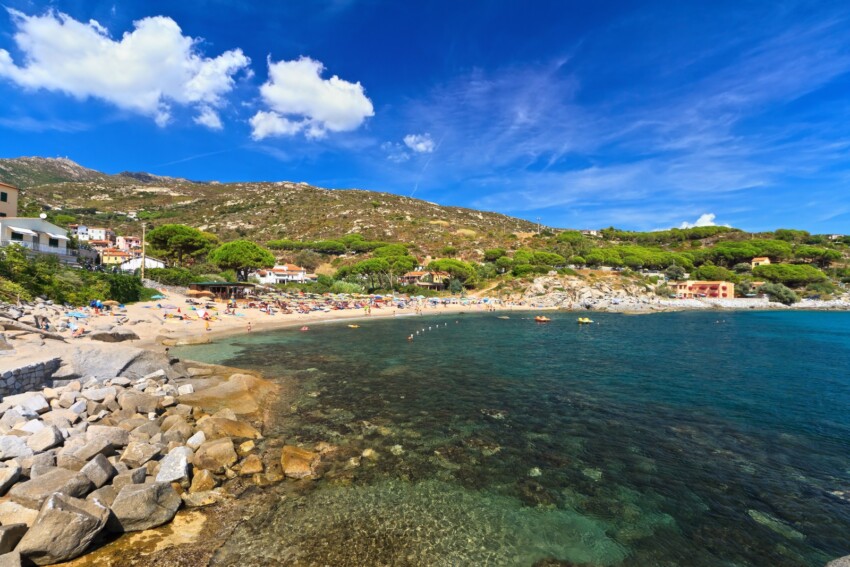
Along the southern coast of Elba, three stunning bays open up—Campo, Lacona and Stella—each harbouring spectacular beaches, particularly when the Grecale wind blows through.
The Remaiolo beach is the most southerly on the island and sits south of Capoliveri, at the foot of Monte Calamita. Just beyond, heading west, you’ll find the beaches of Innamorata, Pareti, nestled in Mediterranean scrubland, Barabarca and Zuccale.
In the more sheltered part of Stella Bay lie the light-sand Lido beach, the tiny Felciaio cove, dark-sand Norsi, and Margidore. Moving along, in the almost identical bay, you can admire Lacona—one of the island’s most beloved beaches—and Laconella.
The Campo shoreline and the charming Galenzana cove are also highly popular. Finally, there’s the sandy Cavoli beach, which is ideal for children and young adults.
Stretching for 300 metres and narrow in width, the Innamorata beach sits just a few hundred metres from Morcone, a hamlet of Capoliveri, on the southern part of Elba.
Crystal-clear waters lap against the coarse-sand shoreline, which glows magnificently at dusk with some of the island’s most captivating sunsets. Behind the beach, which is partly equipped with facilities, a cliff face provides shelter from the wind.
The beach takes its name from a legend dating back to 1534, telling of a young bride who, in an attempt to rescue her beloved after he was kidnapped by the pirate Barbarossa, threw herself into the sea and vanished beneath the waves. The legend is revived each 14 July with a torchlit procession of people dressed in 16th-century costume.
The Gemini islets lie to the left of the beach, a perfect spot for divers.
Nestled among lush greenery, Pareti beach occupies the southern part of the island, tucked inside a small bay that also overlooks the beaches of Innamorata and Morcone, not far from the village of Capoliveri.
Surrounded by Mediterranean scrubland and protected to the south by a small peninsula, this golden-sand beach stretches for 200 metres.
Sheltered from the winds, shallow and well-equipped, Pareti beach is perfect for families with children and those keen on diving. Not far away are two other small beaches accessible by swimming.
The charming Barabarca cove sits on the western side of the Calamita promontory in Stella Bay, along the southern coast of the island, near Zuccale beach and the village of Capoliveri.
Framed by two headlands that form a sheltering bay and embraced by Mediterranean scrubland, this golden-sand beach with small pebbles measures just 100 metres long. The rocky seabed makes it ideal for snorkelling, and Barabarca offers a small bar plus the chance to hire pedal boats and kayaks.
Behind the beach lie two paid car parks from which a narrow, mostly stepped path descends to the shore. The view from above across the sea and the tufa cliff is absolutely stunning!
The lovely Zuccale beach overlooks Stella Bay, on the southern side of Elba near Capoliveri.
This narrow, golden-sand beach stretches just 200 metres and is framed by a cliff topped with Mediterranean scrubland. Sheltered within a small bay, Zuccale is best avoided when southern winds blow.
Two spacious paid car parks with parking meters sit behind the shoreline.
The equally lovely Barabarca beach is just a short distance away.
Among the island’s largest beaches, Lacona stretches along the southern coast within its namesake bay, 5 kilometres from Portoferraio and 8 from Marina di Campo, framed by the green peninsulas of Capo Stella and Capo Fonza.
The expansive shoreline of fine, golden sand extends for over a kilometre and slopes gently into crystal-clear water. The beach is well-equipped and offers plenty of water sports options.
Popular with young people and families with children thanks to its extensive stretches of free beach and proximity to several campsites.
Behind Lacona stands a beautiful pine wood, perfect for a rest and a bite to eat.
Nearby you’ll find Laconella, Margidore and Ghiaieto beaches, plus several smaller coves.
The lovely Laconella beach sits on the right side of Lacona Bay, along the road leading to Marina di Campo.
Just 100 metres long, this beach boasts fine, light-coloured sand. On either side are large, smooth rocks perfect for snorkelling. Beyond Punta della Contessa rocks, to the left, stretches the large Lacona beach.
Parking is available just before a campsite entrance, though spaces are limited. From there, a path of about a hundred metres leads down to the beach.
Among Elba’s most famous and fashionable bays, surrounded by Mediterranean scrubland, Cavoli beach nestles in the dramatic landscape of the southern slopes of Monte Capanne.
The white-sand beach, facing south, lies 4.5 kilometres from Marina di Campo and is easily accessible from anywhere on the island by following signs to Fetovaia. Particularly beloved by young people and those keen on sunbathing rather than tranquillity, Cavoli stretches 300 metres but is divided into two sections by small rocks.
Cavoli offers beach clubs, restaurants, bars, tobacconists and paid car parks.
The spectacular Blue Grotto is nearby and accessible only by sea.
Seccheto beach forms part of the so-called Sunshine Coast and lies along the southern shore of Elba between Cavoli and Fetovaia beaches.
Measuring 130 metres long, this golden-sand beach is ringed by stunning cliffs and washed by crystal-clear waters, making it ideal for snorkelling. On the left side of Seccheto, smooth rocks create small natural saltwater pools perfect for children’s play.
The beach is partly equipped and served by a small bar. A free car park sits on the road leading to the beach.
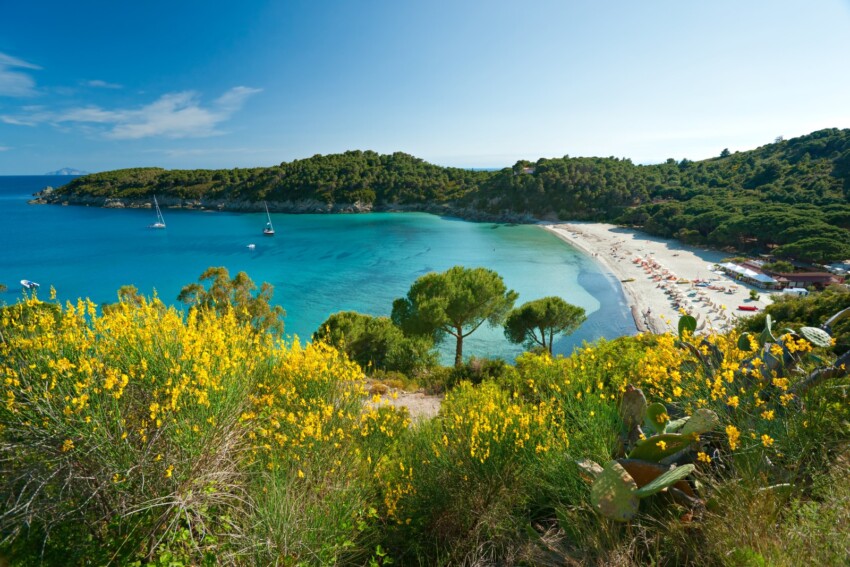
Known as the Sunshine Coast, the western stretch of Elba extends for just over 10 kilometres, running from Seccheto to Colle d’Orano.
Mountainous and dotted with coves, sandy and pebbly beaches and cliffs, the western coast is dominated by Monte Capanne and offers breathtaking views of the islands of Montecristo and Pianosa, Corsica and unforgettable sunsets.
The Sunshine Coast beaches are ideal when the Ponente and Libeccio winds blow. The most famous bays are Le Tombe, scattered with dark pebbles, Fetovaia, among the island’s most beloved, Pomonte, famous for the Elviscot wreck, Patresi, a haven for snorkellers, and Sant’Andrea, a tiny sandy cove nestled between striking, smooth granite rocks.
Among the most striking and photographed beaches on Elba, Fetovaia simply cannot be missed—a white-sand bay stretching about 200 metres, in the southwestern part of the island between Cavoli and Pomonte.
Stunning turquoise seabeds that are not too deep, spectacular views and transparent water make it particularly suitable for families with children.
Fetovaia, partly free access, is sheltered from western winds by a long promontory covered in Mediterranean scrubland and is the perfect spot for diving, whether you’re keen on underwater fishing or scuba diving, and snorkelling.
To the left of Fetovaia, beyond a pine wood, lie the so-called Pools, a series of seawater reservoirs trapped by granite slabs, whilst to the right, beyond the peninsula, stretch the sandy beaches of Le Tombe and Il Giardino.
The village of Pomonte sits along the western coast of Elba, the island’s most dramatic stretch, and, despite its picturesque appeal, still remains largely off the beaten tourist path.
Nestled in a splendid valley at the foot of Monte Capanne, Pomonte is surrounded by terraced slopes, small lakes and cascades. The village is chiefly renowned for the wreck of the Italian cargo ship Elviscott, which sank in 1972 and now lies 12 metres down, not far from the shore.
Just a few hundred metres from the village sit 3 pebbly coves—Ogliera, the largest, Centrale and Quartiere—whilst the surrounding area boasts numerous pebbly beaches and granite cliffs.
On clear days, you can admire the islands south of Elba—Pianosa, Montecristo and Giglio—as well as the Corsican coast.
In the following map you can see the location of the main places of interest mentioned in this article.
 Hotel
Hotel 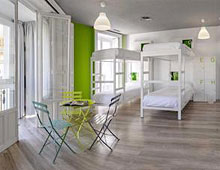 Budget accommodations
  Apartments
  Family Hotel
 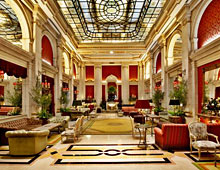 Luxury Hotel
 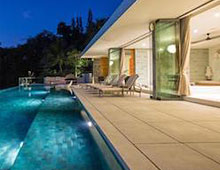 Resorts