Pianosa lies in the Tyrrhenian Sea, south of the Island of Elba and approximately 14 km from Marina di Campo, in the province of Livorno. It forms part of the Tuscan Archipelago National Park.
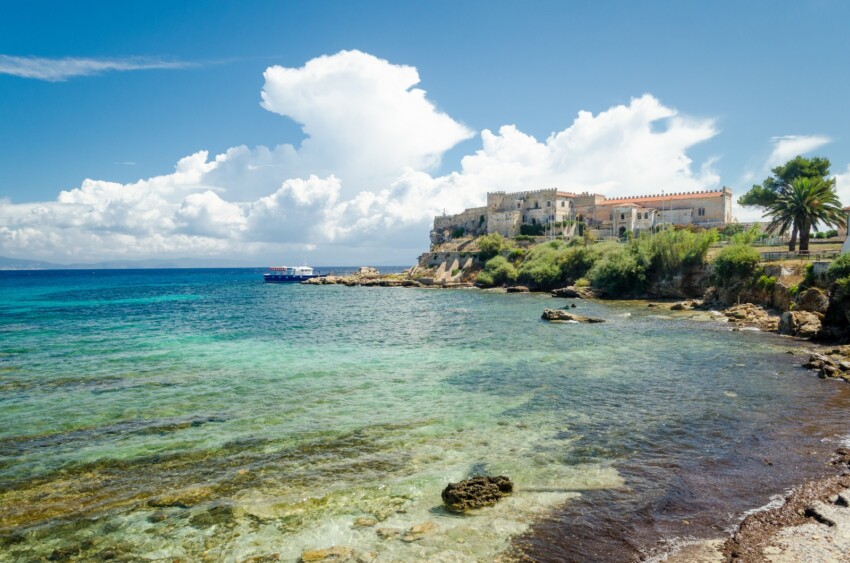
From the sea, Pianosa announces itself as a thin strip of colour, just slightly more vivid than the blue of the sky and sea: flat, almost invisible, with its highest point just 29 metres above sea level. Yet once you land on this small island of just over ten square kilometres, it reveals a unique character within the Tuscan Archipelago. Jagged cliffs, coves carved into the rock, seabeds among the most pristine in the Mediterranean, and a silence that is rare to find anywhere else: Pianosa is an island that its own destiny has preserved.
Pianosa’s history is marked by dramatic turns of fate. In 1553 the island was ransacked by pirates Dragut and Kara Mustafà, who destroyed the Pisan castle, killed much of the population and deported the survivors: Pianosa remained uninhabited for centuries, until it became a penitentiary. From 1858 to 1998 it served as a penal colony, first as an ordinary one, then — from 1977 at the behest of General Carlo Alberto Dalla Chiesa — as a maximum-security prison that held members of Italy’s most dangerous terrorist and mafia organisations. Among its notable inmates was Sandro Pertini, confined here from 1931 to 1935. It is precisely this bitter fate that has protected Pianosa from tourist developments and property speculation, preserving its seabeds and natural landscape, which remain among the most unspoilt in the Mediterranean. Fishing has been forbidden for over forty years. Today around twenty prisoners live permanently on the island under an open-prison regime, working in the vegetable gardens and the island’s only restaurant: the boundary between their area and the village is the so-called Muro dalla Chiesa, which cannot be crossed without an authorised guide.
Since 1996 Pianosa has been part of the Tuscan Archipelago National Park, and access is regulated with a maximum of 250 visitors per day. You cannot wander freely: most of the island can only be visited with authorised guides. Vehicles cannot be transported on the ferry. There are no roads in the conventional sense. These restrictions are not obstacles: they are the guarantee that Pianosa remains what it is.
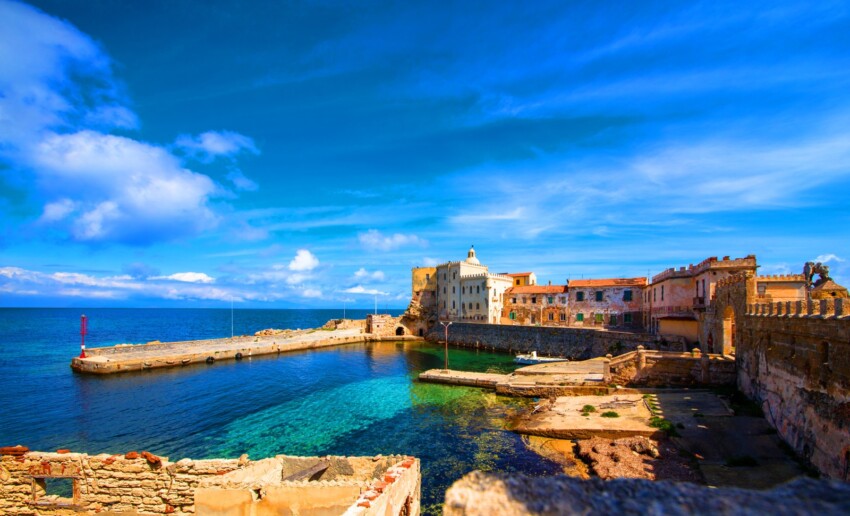
The small harbour, with its architecture designed by director Ponticelli amidst the neo-Gothic buildings of the old village, is the first image that greets arriving visitors. It is also the only area of the island that can be visited freely, without a guide, where you can move among decaying buildings and archaeological remains in an atmosphere of a ghost town that exerts its own peculiar charm. Forte Teglia, dating from the Napoleonic era, overlooks the harbour entrance.
The most historically significant site is Agrippa’s Bath, a maritime villa of Agrippa Postumus identified by archaeologists on the island’s northern coast. In June 2025, restoration, stabilisation and enhancement works financed by the Strategic Plan for Major Cultural Heritage Projects were completed, with an investment of 1.3 million euros: the villa is now visitable with Park Guides in better condition than ever. Nearby, the Early Christian Catacombs — dating to the second half of the 3rd century AD, with use continuing at least until the 5th century — are spread across two distinct areas and can be visited only with a guide.
The Park’s museum system comprises three structures: the Agronomist’s House, opened in 2022 with rich multimedia content on the island’s nature, culture and history, including a virtual immersion in Pianosa’s seas; the Museum of Geological and Archaeological Sciences, which traces Pianosa’s history from rocks dating back approximately 19 million years ago through to the medieval period; and the Catacombs. Museum admission is accessible with tactile panels, braille and audio guides for the visually impaired.
Visits are organised by the National Park and can be booked online on the Park Authority website. You can choose between a walking excursion with a guided tour of the village and three museums — lasting approximately two and a half hours, easy difficulty — and a mountain-bike route along the south-western coast through old prison facilities, for a more physically demanding and panoramic experience of the same duration. Both include approximately six hours on the island.
For those wanting to explore the most remote areas, there are themed excursions dedicated to the southern coast, with a stop at Cala del Bruciato — a cove of rare beauty overlooking Montecristo — and to the northern zone with Porto Romano, accessible only in autumn. Kayaking and snorkelling trips along the wilder coastlines are also available, as well as carriage rides and, on request, special sunrise or sunset excursions. For divers, mooring buoys in the Marine Protected Area allow diving exclusively through diving centres authorised by the Park: Pianosa’s seabeds are considered an absolute reference point in the Mediterranean.
The only beach where free swimming is permitted is Cala Giovanna, just a few steps from the harbour: a long stretch of golden sand with shallow, crystal-clear waters and a colour reminiscent of the Caribbean, with the ruins of Agrippa’s Villa as backdrop. It is advisable to visit in the early morning or after 5pm for a more peaceful experience. For guided snorkelling, Cala dei Turchi is the most sought-after destination: access is only allowed with the Park’s environmental guides.
Geologically, Pianosa is a flat formation of sedimentary rocks and shellfish deposits that contain precious marine fossils dating to approximately 19 million years ago. Vegetation varies sharply between the coastal zone and inland: along the coast, Phoenician juniper, cistus, myrtle and mastic dominate in a low, dense scrubland that wages a hard battle against aridity; inland, instead, splendid dry-stone walls subdivide residual olive cultivations and stretches where wild herbs have replaced cereal crops. Arboreal species are rare: sparse holm oak specimens, tree-lined avenues of eucalyptus, and scattered Aleppo pine plantations from reforestation efforts. An old Elban saying goes “it costs me more than Pianosa’s barley”, remembering the hardship of those who have lived and worked in the fields here.
Pianosa is home to extraordinary biodiversity, partly due to the forced isolation of the prison years. In the seabeds, the presence of red coral is still remarkable, having almost disappeared elsewhere in the Mediterranean. Bird life is exceptionally rich: you’ll encounter hoopoes, red partridges, bee-eaters — a colourful bird that arrives from Africa to nest — peregrine falcons and kestrels; along the coasts, the rare Corsican gull, crested cormorants and Cory’s shearwaters. The island is also home to some endemic lizards found nowhere else. Schools of dolphins regularly swim in the waters of the International Cetacean Sanctuary. In spring the scrubland bursts into yellow, pink and white blooms, transforming the island into a carpet of colours.
Pianosa is almost always visited as a day trip, but it is possible to stay overnight at the island’s only hotel, which has just ten rooms. Spending the night on Pianosa is a rare and much sought-after experience: availability runs out quickly, especially in the summer months, and it is essential to book well in advance. The most convenient alternative is to stay on Elba Island — less than an hour by ferry — and visit Pianosa for the day.
Pianosa is accessible year-round every Tuesday from Piombino with a stopover at Rio Marina, via Toremar ferries. The daily connection is operated by Aquavision, departing from Marina di Campo on Elba Island and, in high season, also from Piombino. The crossing takes approximately 45 minutes from Marina di Campo. The island access ticket — which is mandatory — is paid together with the ferry ticket and must be booked online in advance, especially in summer. It is not possible to take vehicles onto the island: you get around on foot, by bike, or using Park transport.
Pianosa lies in the Tyrrhenian Sea, south of the Island of Elba and approximately 14 km from Marina di Campo, in the province of Livorno. It forms part of the Tuscan Archipelago National Park.
 Hotel
Hotel  Budget accommodations
  Apartments
  Family Hotel
  Luxury Hotel
  Resorts