Agriturismo Podere La Maestà
Rosignano Marittimo - 53 Località Col di Leccio Terra
Featuring city views, Agriturismo Podere La Maestà offers accommodation with patio, around 27 km from Livorno Port.
Book now

Rosignano Marittimo is a municipality in the province of Livorno, with its historic centre perched on a hilltop, about 6 kilometres from the sea. Yet it remains a celebrated seaside resort, particularly among Tuscans, as it encompasses the villages of Chioma, Castiglioncello, Rosignano Solvay, Vada and Mazzanta, all five facing the sea and each possessing considerable appeal.
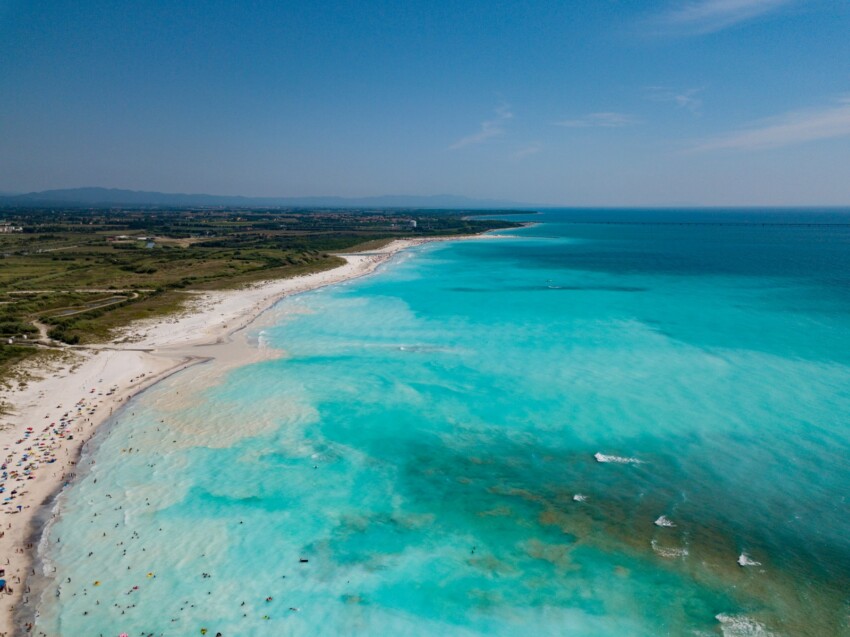
Of these, Chioma is the most northerly and in certain respects the wildest, whilst Castiglioncello and Vada are undoubtedly the two most famous and touristy spots, though Rosignano Solvay boasts the distinctly unusual Spiagge Bianche – a Caribbean-like beach with its striking white sand and turquoise waters, were it not for the fact that this effect is caused by discharges into the sea from the Solvay plant, a well-known producer of bicarbonate located just behind.
But setting aside the much-debated Spiagge Bianche, visitors to Rosignano Marittimo come principally to relax on one of Castiglioncello’s beaches, such as Quercetano bay or Le Forbici beach, or to sunbathe on Vada’s shoreline, or perhaps to stroll through the lovely pine woodland of Mazzanta.
From north to south, the coastline of Rosignano Marittimo municipality comprises the villages of Chioma, Castiglioncello, Rosignano Solvay, Vada and Mazzanta, boasting a variety of beaches in total – here’s what they are.
Lillatro Beach is located in Rosignano Solvay and is fairly extensive. It begins south of the Lillatro sailing club and extends to the northern boundary of the Spiagge Bianche. It’s a long sandy beach with ample car parking. There’s also a restaurant-bar-pizzeria on the beach.
The celebrated Spiagge Bianche are perhaps Rosignano Marittimo’s most famous stretch of coastline. Part of the Rosignano Solvay village, they stretch for roughly 4 kilometres, extending to the boundary with Vada. This long beach is often likened to tropical coasts for its brilliant white sand and intensely azure waters. Unfortunately, these striking colours are a consequence of calcium carbonate discharges from a Solvay plant situated approximately one kilometre from the beach.
The discharges produce various pollutants, with the result that swimming is prohibited at Spiagge Bianche, though this ban is largely ignored in practice. According to the UN United Nations Environment Programme, this stretch of coast ranks among Italy’s 15 most polluted.
Waste from the Solvay factory, plainly visible from the beach when you turn your back to the sea, enters the water via a drainage channel known as the “white ditch”; nevertheless, the white beaches of Rosignano Solvay remain one of Tuscany’s most visited and photographed destinations today.
Beyond Pietrabianca Beach, heading towards the town of Vada, the long town beach begins. This is a shoreline spanning roughly 5 km, largely comprising free beach, though there are opportunities to hire sun loungers and parasols from a handful of beach clubs. The beach also has several bars and restaurants, whilst at the southern end, not far from the Tesorino beach establishment, there’s a kitesurfing school.
Pietrabianca Free Beach begins where the Spiagge Bianche end, separated from Solvay’s pollution by a jetty called San Gaetano Bridge. From there, passing also a curious wartime relic – a Second World War bunker surfacing just metres from the shoreline – you arrive at Pietrabianca Beach, one of Vada’s most significant stretches.
Here, swimming is largely unrestricted, though as you approach the town centre, you encounter beach establishments, bars and amenities. Behind the beach lies a fine pine grove, and the road running through it is where you park to reach the sea.
Pietrabianca Beach is vast, sandy and tranquil, making it ideal for families with children, yet equally appealing to young people seeking entertainment, as its length means you can always find a spot for ball games or to set up a sound system.
The southernmost village of Rosignano Marittimo is Mazzanta, lending its name to the eponymous beach, which is very long and characterised by fine white sand, alongside some pebbly areas; much of it is free, whilst beach establishments are few and modest in size. Behind the beach stands a lovely pinewood, which also encompasses part of the town itself.
Finally, the southernmost beach in Rosignano Marittimo municipality, still part of Mazzanta village, is Le Gorette Beach. We’re near the boundary with Cecina municipality, specifically with Marina di Cecina, and this extensive stretch of free beach has dense pinewood behind it, extending hundreds of metres inland.
Part of the beach is equipped with facilities thanks to several beach clubs offering sun loungers and parasols for hire. There’s also convenient parking directly behind the beach’s southern section.
A section of Le Gorette Beach is dedicated to dogs: it’s the Bau Beach. Here, owners can let their four-legged friends enjoy themselves in complete safety.
In the following map you can see the location of the main places of interest mentioned in this article.
Setting aside its coastal villages, Rosignano Marittimo remains a medieval borough of historical and cultural interest, well worth visiting even just for a break from seaside life. The town boasts several noteworthy churches, including the Church of Saints John the Baptist and Hilary, with its adjoining oratory, and the ruins of the Oratory of Our Lady of the Snow.
Yet the most emblematic monument of Rosignano Marittimo is its castle, beautifully restored, commanding splendid views over the sea, particularly from the clock tower, which is free to access. Adjacent to the castle is a museum tracing Rosignano’s history from the medieval period to the present day.
The historic borough of Rosignano Marittimo is hardly the destination of choice for nightlife enthusiasts: being sparsely populated, it shuts down entirely after dark. Far more engaging is the nightlife in the coastal villages, particularly Castiglioncello, which is the most sprawling and densely populated.
If you’re coming to enjoy the sea, don’t stay in Rosignano Marittimo’s centre: it sits on a hillside, away from the coast. Instead, choose Castiglioncello or Vada, two seaside villages boasting excellent accommodation.
In Castiglioncello, for instance, there are numerous hotels, mainly two or three-star establishments, plus plenty of apartments. Vada is smaller, but features a lovely seafront hotel alongside various apartments throughout the town. The two villages are separated by Rosignano Solvay, which has no lodging facilities.
Along the coast, at the southern edge of Rosignano Marittimo municipality, lies the village of Mazzanta, where there are several hotels, though generally not immediately adjacent to the beach.
If you prefer space, privacy and the ability to prepare your own meals to a hotel holiday, book a holiday home at Rosignano Marittimo. We recommend a few below, but in this case we advise you to book early because houses and apartments for rent at Rosignano Marittimo are in high demand.
Among travellers, Rosignano Marittimo is known as the southern terminus of the A12 motorway starting from Genoa. This is precisely its strong point when discussing accessibility: this major transport artery ensures travel times are never excessive.
For example, from Florence it takes just over one hour and 15 minutes, following the FI-PI-LI expressway to Vicarello then joining the A12, which you follow southbound to its terminus at Rosignano Marittimo.
From Arezzo and Siena it takes roughly two hours; from Arezzo you first reach Florence via the A1, then continue on the same route, whilst from Siena you pass through Colle Val d’Elsa, where you join the SS68 Val Cecina road, which leads directly to the southern edge of Rosignano Marittimo’s coastline.
Reaching Rosignano Marittimo from the Tuscan coast is straightforward: Pisa is roughly 50 minutes away via the SS1 Aurelia road or the A12, whilst from Livorno it’s just over 20 minutes, driving south along the SS1 Aurelia.
The coast is also served by rail: there are railway stations at Rosignano, in Rosignano Solvay village, and Vada, in the village of the same name. Regional trains stop at both stations, running to and from Grosseto, Livorno, Campiglia Marittima, Pisa and Florence Santa Maria Novella. The journey from Florence to Rosignano by train without changes takes just over an hour and a half, while from Pisa it takes roughly 40 minutes.
What's the weather at Rosignano Marittimo? Below are the temperatures and the weather forecast at Rosignano Marittimo for the next few days.
Rosignano Marittimo is located in the municipality of Livorno. Its defining characteristic is that it sits inland, whilst the main seaside resorts – including Rosignano Solvay, Vada and Castiglioncello – lie directly on the coast.

 Hotel
Hotel  Budget accommodations
  Apartments
  Family Hotel
  Luxury Hotel
  Resorts