Borgo al Cielo
Suvereto - Belvedere, Piazza San Tommaso, N. 23
Book now
Suvereto is an enchanting medieval village, still encircled by its original walls, situated not far from other attractions in the area such as the Etruscan city of Populonia. It lies in the south-east of Livorno province, at the heart of the Val di Cornia.
Blessed with a particularly mild climate, Suvereto sits on gentle slopes rising from the Cornia river valley towards the Colline Metallifere (Metalliferous Hills); from these elevated vantage points you can glimpse the Tyrrhenian Sea, the Gulf of Follonica and Elba island, whilst behind the village lie roads and paths leading towards Massa Marittima and Volterra.
Suvereto’s countryside is rich with cork oaks, centuries-old olive groves and vineyards, reflecting the character of the local economy, traditionally built on agriculture, forestry and livestock farming. Today, however, Suvereto also benefits considerably from tourism, thanks to its stunning surrounding landscape, distinguished by one unique feature: cork oak, known locally as suvero, which gave the village its name and even features on the municipal coat of arms.
The picturesque historic village of Suvereto is a pleasure to explore, and within a few hundred metres it contains some fascinating monuments and attractions. Here are the main sights.
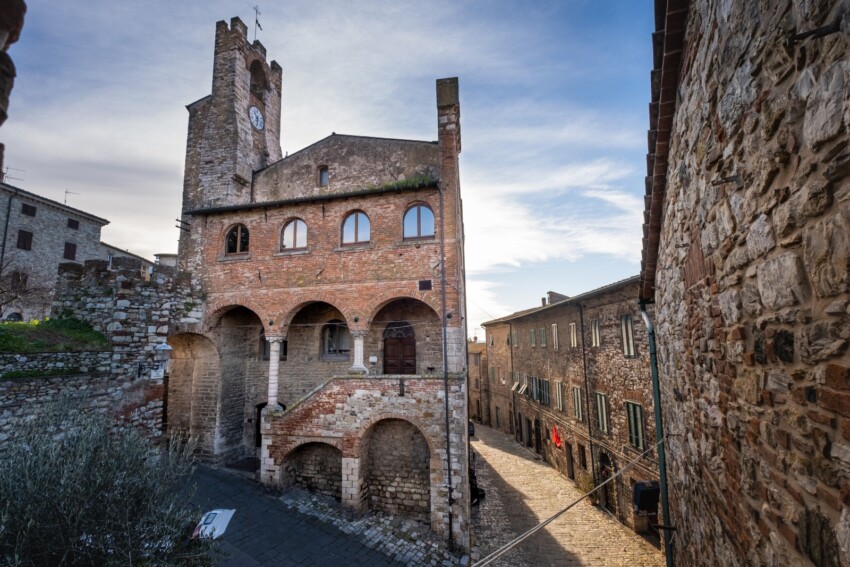
The town hall of Suvereto represents one of the finest examples of medieval civil architecture in the Livorno Maremma. It is crowned by an ancient tower, now housing a clock but once a bell tower that summoned the assembly of Elders and served as one of the village’s observation posts.
The entrance is reached by a short, steep flight of stairs sheltered beneath an open loggia supported by columns: the judges’ loggia, from where verdicts and community decisions were traditionally announced and published. The current structure, which represents centuries of reinterpretation of 13th-century elements, sits atop older residential foundations, likely featuring the wood typical of early 13th-century Pisan-style pillar houses.
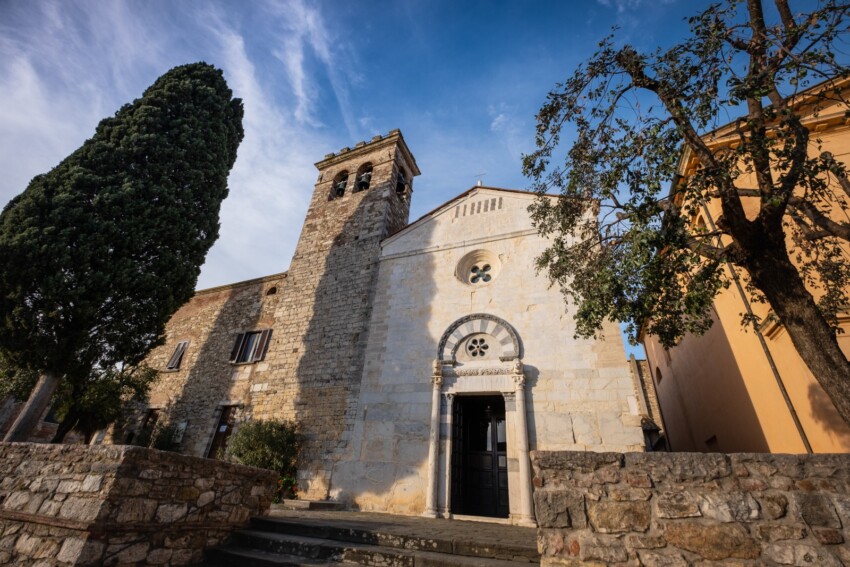
The parish church of Suvereto is dedicated to San Giusto, bishop of Volterra. Dating from very early times, it was completed in 1189. The building features a Latin cross plan with a single nave, and its gabled façade is pierced by a rose window and Romanesque doorway, framed by two pilasters topped with corbels supporting a decorative architrave carved with a vine scroll emerging from a central figure’s mouth.
Inside you can admire an octagonal baptismal font carved from stone dating to the 12th century, and a pipe organ from 1718 crafted by Domenico Francesco Mazzoni.
On the church’s left side, not perfectly aligned with the façade, stands a bell tower with a rectangular base, which was damaged by lightning and restored by local craftsmen in 1884, though this work altered its original appearance and removed several distinctive features of Tuscan Romanesque style.
The Church of San Michele Arcangelo, now home to the Museum of Sacred Art, was built in 1881 by the Misericordia confraternity, which had its headquarters here alongside the parish church on the site of the old cemetery. The church was soon abandoned and by the early 1900s served as a parish hall.
A 1999 restoration returned it to its former appearance and made way for the Museum of Sacred Art, which preserves works from the local parish and artistic heritage. The museum houses a collection of paintings from the 17th and 18th centuries, originally displayed in various community churches. There are also two magnificent wooden statues from the 15th century depicting the angel Gabriel and the Virgin Mary, attributed to Lorenzo di Pietro, known as il Vecchietta.
Perched on the summit of one of two hills on which Suvereto’s castle spreads, stand the remains of the ancient Convent of San Francesco, with its adjoining conventual church. The convent was founded in 1286 on land donated by the Aldobrandeschi counts of S.Fiora, former feudal lords of Suvereto, and was consecrated by Fra Bartolommeo, Bishop of Grosseto, as recorded by Rodolgo, the order’s chronicler.
Inside the convent, now converted into private residences, you can still see decorative elements and inscriptions telling the story of this complex, including a finely carved ancient doorway bearing the Giannetti family crest, the noble arms of the Angelieri family and various funerary and commemorative plaques.
The small historic centre of Suvereto boasts numerous apartments and carefully restored properties let as holiday homes, catering to all requirements. Staying in Suvereto’s centre lets you fully savour the village’s medieval atmosphere, especially in the evening when day-trippers have returned to their coastal hotels.
Alternatively, you might prefer to experience the natural beauty surrounding Suvereto, in which case there’s nothing better than staying at a farmhouse, country estate or country hotel just a few kilometres from the village. You’ll have the chance to sleep surrounded by greenery, in an idyllic landscape and complete tranquillity. There are numerous farmhouses, particularly on the hills north of Suvereto, and whichever you choose, this remains the ideal solution for those seeking relaxation, comfort and peace.
Suvereto lies inland from Livorno, not far from the border with Grosseto province. Its location might seem daunting, but it’s truly worth visiting, and with a couple of intermediate stops you’ll have the perfect day trip planned.
From Florence it takes just over 2 hours, travelling along the FI-PI-LI arterial road to the Vicarello junction, then joining the A12 motorway to Rosignano barrier and finally continuing along the SS1 Aurelia state road heading south towards Venturina. From there, it’s a little over 10 minutes to your destination.
For those coming from other Tuscan inland towns, Suvereto is not particularly quick or convenient to reach: from Siena for example it takes over an hour and a half, from Arezzo almost two and a half hours. It’s easier if you’re already on the coast, as it takes roughly an hour and 10 minutes from either Pisa or Livorno city centres; in both cases you travel south on the Aurelia, exiting at Venturina and then following the SR398 regional road to your destination.
Those wishing to reach Suvereto by public transport should plan for a change at Campiglia Marittima railway station, at Venturina Terme, where regional trains from and to Florence, Pisa, Grosseto and Rome Termini stop. Bus number 3 departs from here and reaches Suvereto’s bus terminal in 20 minutes.
What's the weather at Suvereto? Below are the temperatures and the weather forecast at Suvereto for the next few days.
Suvereto is located in the province of Livorno, inland, not far from Venturina Terme, San Vincenzo and Piombino.

 Hotel
Hotel 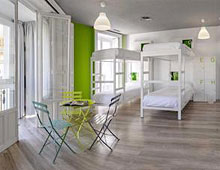 Budget accommodations
  Apartments
  Family Hotel
 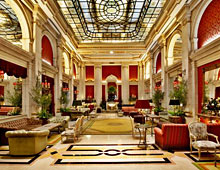 Luxury Hotel
 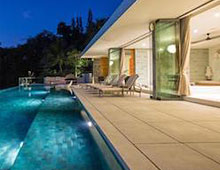 Resorts