Lucca In Villa Elisa & Gentucca
Lucca - Viale Armando Diaz 71
Book now
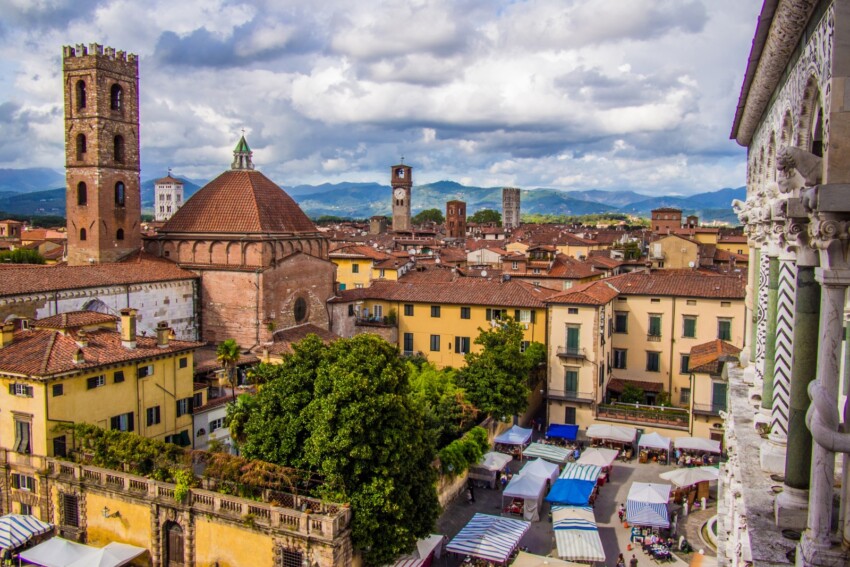
Amongst Tuscany’s art cities, Lucca tends to be rather overlooked by tourists, who are drawn primarily to three more famous destinations: Pisa, Florence and Siena.
But have you ever taken a look at the map of Tuscany? Lucca is very close to Pisa, less expensive and far less crowded: it’s an ideal base for combining the two cities into one unforgettable holiday. In fact, you could easily spend an entire weekend in Lucca alone.
Its historic centre is a gem enclosed within a perfectly preserved Renaissance city wall that you can explore on foot and by bicycle. Walking around the walls is just the beginning of a rewarding exploration: numerous surprises await you, including a plaza with no access roads, a garden perched atop a tower, and the birthplace of one of Italy’s most celebrated composers.
Lucca is a place to see but also to experience. It’s brimming with bars and small venues and hosts a packed annual events programme; the highlights are the Lucca Summer Festival, featuring concerts by Italian and international artists, and Lucca Comics & Games, Italy’s premier comics and gaming fair.
The local cuisine is another excellent reason to visit. Don’t leave Lucca without tasting buccellato, the traditional local sweet… and don’t confuse it with its Sicilian namesake!
Inside and outside Lucca’s walls there’s an abundance of things to see. Take all the time you need – Tuscany is best enjoyed at a leisurely pace!
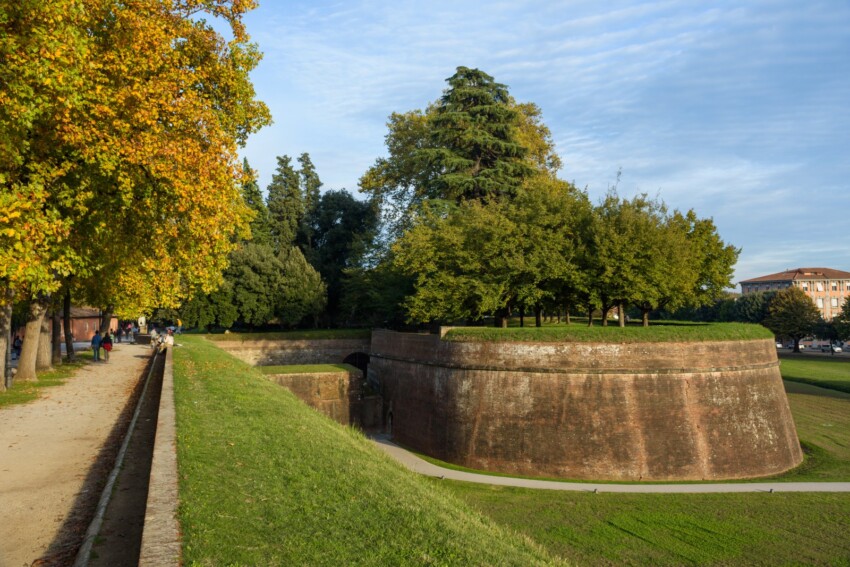
The city walls enclosing Lucca’s historic centre are the city’s top attraction. Though commonly referred to as medieval walls, they’re more accurately described as Renaissance structures, having been built from the early 16th century through the mid-17th century.
These are the only defensive city walls built in the modern era that have survived completely intact to the present day: a masterpiece of architecture and urban planning that continues to inspire admiration.
The numbers are impressive: they stretch for a total of 4 km, stand 12 metres high and are a remarkable 30 metres wide. Throughout their long history, the only threat they defended the city against was flooding from the River Serchio in 1812.
Don’t picture them as the austere walls surrounding a medieval castle. Lucca’s walls are a beautiful tree-lined boulevard that you can walk, run or cycle along, and they frequently serve as a venue for outdoor events.
Along the route you’ll encounter the city’s access gates and gun emplacements.
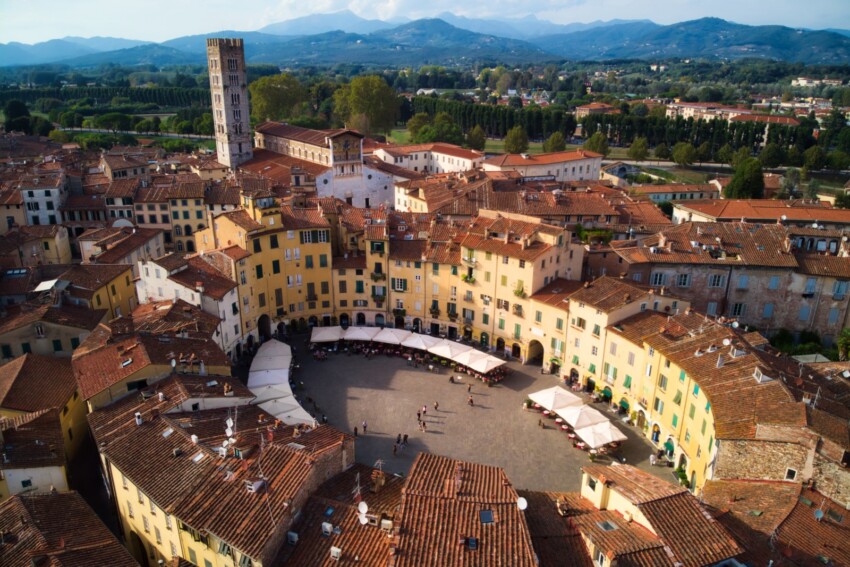
Lucca’s most beautiful square is the centrally located Piazza dell’Anfiteatro, so named because it stands on the site of a Roman amphitheatre and partially echoes its ancient outline – which explains its distinctive elliptical shape.
Another peculiarity is that this is a closed plaza: no streets lead directly into it, and access is gained through four small arched doorways.
The square’s current appearance dates to the 19th century and was designed by Luccan architect Lorenzo Nottolini; stand in the centre of the plaza to fully appreciate its perfect harmony. It’s also worth popping into some of the shops facing the square, as several retain fragments of ancient Roman structures within.
Piazza dell’Anfiteatro is the heart of city life: busy day and night, it regularly hosts concerts and events.
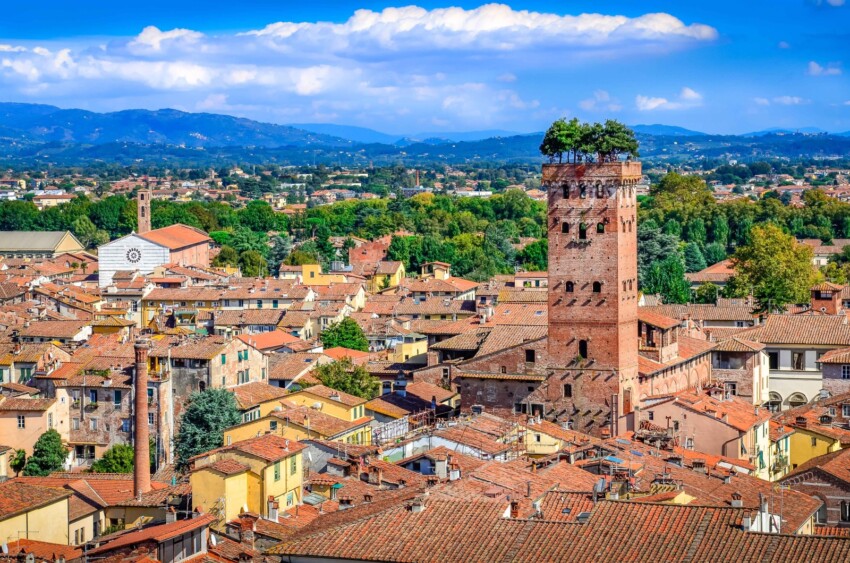
The Guinigi Tower is one of the few surviving towers in Lucca and one of only two that you can visit. It’s a square tower built of red brick, constructed in the 14th century at the behest of a wealthy family of Luccan merchants.
It wouldn’t be particularly different from other medieval towers if not for one remarkable feature: a roof garden created on its summit. Honestly, how often do you see large trees growing on top of a tower?
From the top of the Guinigi Tower, cooled by the shade of centuries-old holm oaks in the roof garden, you can enjoy views extending from the city out to the surrounding hills. The tower stands 44.25 metres high and requires climbing 230 steps to reach the summit.
The other tower you can visit in Lucca is the Clock Tower, which exceeds the Guinigi Tower in height by approximately six metres. It’s a civic tower fitted with a bell and a working clock still operated by a manual winding mechanism.
The original clock dates from 1390; the one we see today was made by Luccan clockmakers and installed in the second half of the 18th century. You can see it by climbing to the top of the tower: in this case there are 207 steps.
The tower stands at the corner of Via dell’Arancio and Via Filungo, the city’s main shopping street. After admiring Lucca from the tower’s heights, you can take a pleasant stroll browsing the shop windows.
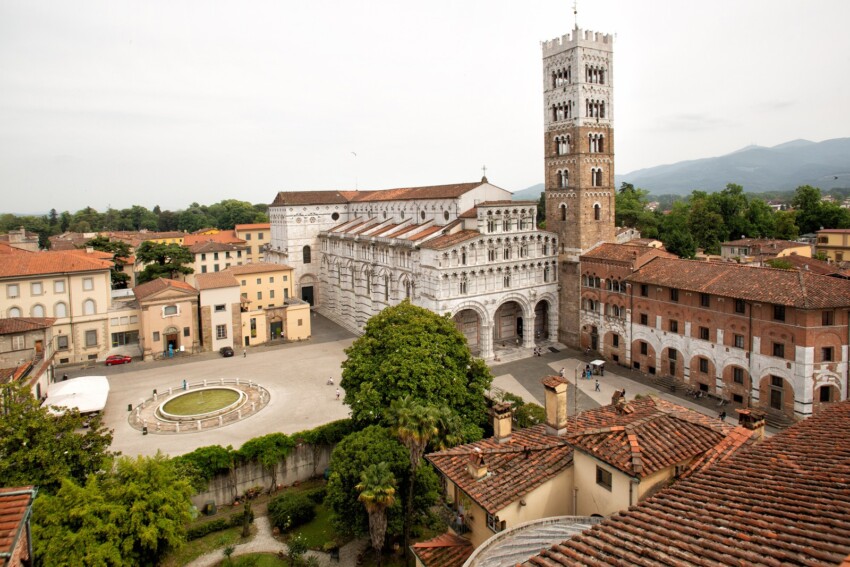
Its placement in a small square and the presence of other buildings pressed against its structure might cause visitors to underestimate the importance of Lucca Cathedral, dedicated to St Martin.
But one need only glance at the architectural details and the impressive array of artworks contained within to understand that this is a building of great historical, artistic and religious significance, comparable to other celebrated cathedrals across Italy.
The cathedral’s original core was built in the 4th century AD at the behest of St Fredian, the city’s bishop. Initial modifications occurred as early as the 11th century, but the appearance we see today results from changes made between the 14th and 17th centuries.
The polychromatic façade is inspired by that of Pisa, but distinguished by elements typical of Luccan style; it’s slightly asymmetrical because it had to accommodate a pre-existing bell tower.
The church’s interior is a profusion of artworks. The most frequently cited in guidebooks are the ancient Holy Face Crucifix, the Tomb Monument of Ilaria del Carretto created by Jacopo della Quercia, and the Last Supper painted by Tintoretto.
You can climb the bell tower to enjoy panoramic views over Lucca; after visiting the church, take a look at the nearby Cathedral Museum dedicated to sacred art.
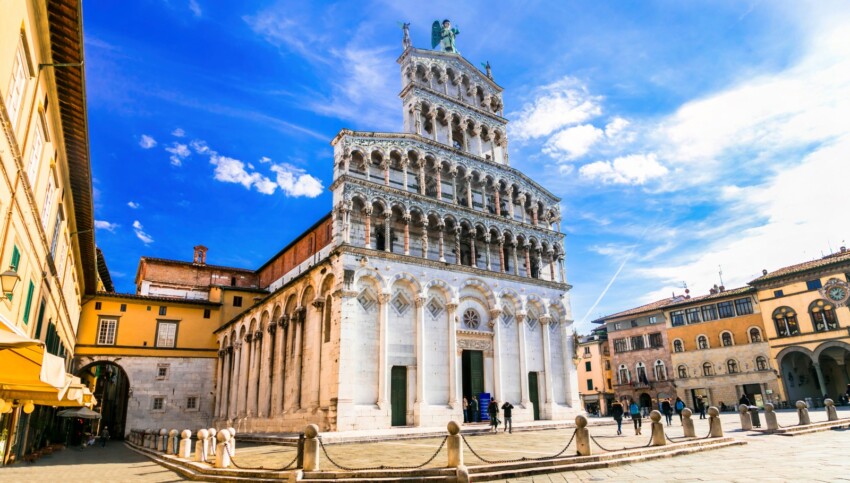
Piazza dell’Anfiteatro isn’t the only beautiful square you’ll discover while exploring Lucca’s historic centre.
Lucca’s largest square is Piazza Napoleone6, named after the sister of the French emperor. While it can’t match the charm of the more famous piazza, it’s equally rich in history and another vital gathering place for locals. This is where the Summer Festival’s main concerts take place.
Also worth noting are Piazza San Michele7 and Piazza San Frediano8, graced by their respective churches.
[/place]
Giacomo Puccini, the celebrated composer of operas that shaped the history of Italian lyric opera such as Turandot and Manon Lescaut, was born in Lucca on 22 December 1858.
The house where the great composer was born and spent his childhood and adolescence is now a museum dedicated entirely to him. The house was sold during a period of financial difficulty and repurchased by Giacomo during his successful years; it remained in his family’s ownership until its transformation into a museum now managed by a foundation.
Inside the Giacomo Puccini House-Museum you can see original furnishings from the period, historical documents and musical scores. The most fascinating pieces, however, are the Maestro’s personal belongings, particularly the piano he used to compose his masterpieces.
In the square facing the house stands a bronze monument to Puccini created by Vito Tongiani.
If you’re passionate about painting or local history, don’t miss the National Museum of Villa Guinigi: a visit is a journey through the city’s history and visual culture.
It’s housed in a magnificent palazzo of red brick in late Gothic style that was the residence of Paolo Guinigi, Lord of Lucca from 1400 to 1430. It’s located just outside the walls.
The collection features artworks by Luccan and international artists who stayed in Lucca, as well as archaeological finds from the area. The display is arranged chronologically.
Another important painting collection and magnificent example of a noble residence is the National Museum of Palazzo Mansi.
The building is an elegant 17th-century palazzo that belonged to a wealthy merchant family, embellished with frescoes, Brussels tapestries and fine furnishings that we can still admire today.
The museum’s collection includes paintings by Italian and international artists from the 16th to 18th centuries; about eighty of these paintings were donated to the city by the Grand Duke Peter Leopold.
There’s also a section dedicated to textile weaving that includes a workshop and an exhibition of 19th-century looms.
A green oasis nestling against Lucca’s Renaissance walls, in the south-eastern part of the city, is the Botanical Garden, an extensive garden created in 1820 that boasts a rich collection of trees, plants and flowers.
The top attractions are the Montagnola, dedicated to flora native to the mountains surrounding Lucca, the Arboretum featuring centuries-old trees and a magnificent collection of camellias and rhododendrons.
Having left behind the medieval and Renaissance atmosphere of central Lucca, just beyond the walls awaits a Baroque jewel: Palazzo Pfanner, a sumptuous 17th-century building constructed – needless to say – by a wealthy merchant family.
The palazzo was enlarged and beautified by successive owners, who, having recently acquired noble titles, wanted to flaunt their wealth and prestige. In the 19th century it was purchased by Felix Pfanner, an Austro-German beer producer.
The palazzo is now owned by his descendants and open to the public for guided tours and events. The visitable areas include the central hall, other interior rooms and the monumental garden.
The countryside around Lucca offers wonderful opportunities for walks or cycling trips in the countryside. The best area for outdoor activities is the Serchio River Park, an area of great natural value extending from Monte San Quirico and the hamlet of Palazzaccio to Sant’Anna.
Within the park you can follow three different thematic routes: a water route, a nature route and a historical route.
In the following map you can see the location of the main places of interest mentioned in this article.
The most charming area to stay in Lucca is certainly the historic centre. Booking a hotel or b&b in the centre puts you within easy reach of all the main attractions and with plenty of restaurants and venues on your doorstep for a night out.
However, be mindful if travelling by car: the centre is a limited traffic zone and parking spaces are scarce. Be sure to ask your chosen accommodation whether you’re authorised to enter with your vehicle and if they have parking available. If not, leave your car outside the walls or book a hotel in the surrounding area.
Another important consideration concerns the timing of your visit. If you’re planning to visit Lucca during the comics fair or Summer Festival periods, book well in advance, ideally several months ahead. It may sound excessive, but bear in mind that during these two hugely popular events accommodation is consistently fully booked.
Staying in the countryside around Lucca rather than in the centre expands your choice of accommodation. Beyond hotels, apartments and bed and breakfasts, you’ll also find beautiful country houses, farm stays and luxury hotels with spa facilities set in the countryside. The best properties have a swimming pool.
Lucca enjoys a strategic location for road connections across Tuscany, which means you can easily reach it from several directions.
To drive to Lucca, the main motorways are the A11 Florence-Seaside and the A12 Genoa-Pisa, from which you can take a slip road to your destination. The Lucca East and Lucca West toll booths are just a few kilometres from the city centre.
Getting to Lucca by public transport is possible but requires a bit of planning and patience – you’ll almost certainly need to make at least one change.
Lucca’s railway station sits right next to the historic centre and is served mainly by regional trains to Pisa, where you can then connect to Florence or other destinations.
The bus is arguably a better option, with direct coach services to Florence and other major towns across Tuscany; there are also some long-distance coaches that can get you to Lucca from cities in other regions. Lucca’s bus station is located in the town centre.
The nearest airport to Lucca is Pisa, about twenty kilometres away and easily accessible. It’s an important hub for budget airlines, so you’ll often find cheap flights.
What's the weather at Lucca? Below are the temperatures and the weather forecast at Lucca for the next few days.
Lucca is a municipality in Tuscany and the capital of its province. Located in north-western Tuscany, it sits just 20 km from Pisa, approximately 75 km from Florence, and 150 km from Siena.
 Hotel
Hotel  Budget accommodations
  Apartments
  Family Hotel
 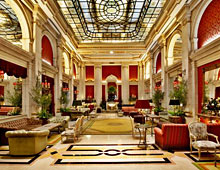 Luxury Hotel
 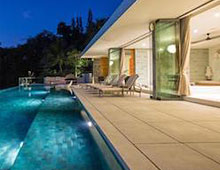 Resorts