Park Hotel Regina
Bagni di Lucca - 157 Viale Umberto I'
Book now
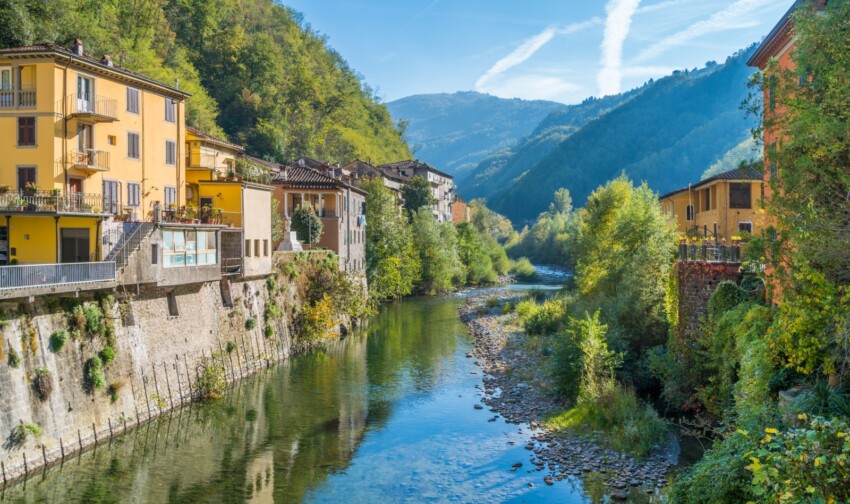
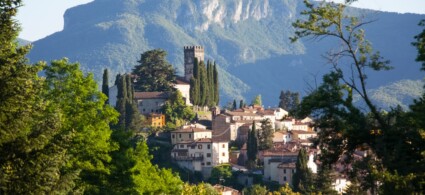
In the province of Lucca, the charming Bagni di Lucca is a gem well worth discovering. Nestled along the route to the Pistoian Mountains, beside the Lima stream, not far from San Marcello Pistoiese, it sits in the heart of a region where nature truly reigns supreme.
Yet alongside this pristine landscape, Bagni di Lucca is perhaps best known for its thermal springs, whose history stretches back to ancient times – they were already renowned during the Roman era. In more recent centuries, the thermal baths of Bagni di Lucca became a favourite stop for pilgrims on the Via Francigena. However, it was when Napoleon’s sister, Maria Anna Bonaparte, decided to transform the town into an international tourist destination that Bagni di Lucca truly flourished, leading to the modernisation and reconstruction of the spa facilities by the finest architects of the age.
Discover this hidden corner of Tuscany, relatively unknown to most visitors, where you can unwind amidst breathtaking scenery and wander through a town steeped in history. You won’t regret it, and you’ll be eager to return.
The thermal waters of Bagni di Lucca are renowned for their curative properties, particularly beneficial for respiratory and rheumatic conditions. The water flows from several springs at high temperatures, ranging between 45 and 55 degrees Celsius. Some of these springs feed spa centres offering wellness and relaxation programmes.
Among all the facilities, the most important is located within the Hotel & Terme Bagni di Lucca, comprising the Jean Varaud thermal baths and Casa Boccella, along with a splendid thermal pool. Adjoining this is a dedicated wellness area, featuring mud treatments and spa therapies, as well as massage treatments using essential oils.
The Jean Varaud complex also includes two magnificent grottos, the Grotta Paolina and the Grotta Grande, which maintain a constant internal temperature between 40 and 45 degrees, making them ideal for steam baths.
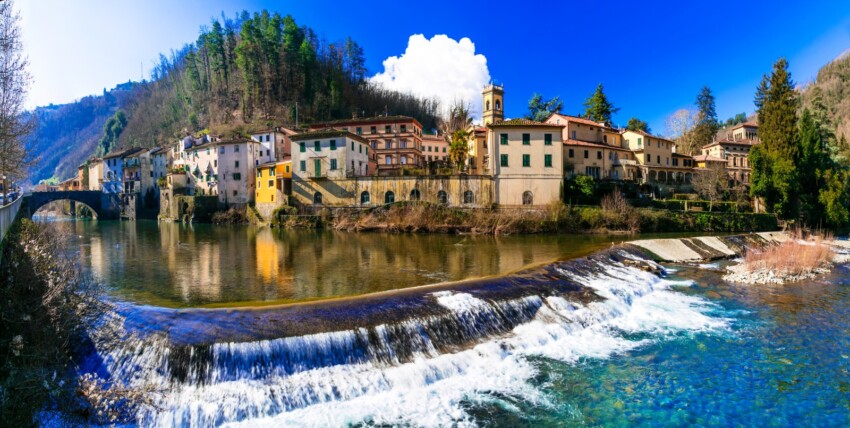
Bagni di Lucca may be a small town, but it’s certainly worth staying here to explore a number of genuinely interesting landmarks and monuments. Here’s a rundown so you won’t miss a single one.
Located in Fornoli, the Ponte delle Catene is a suspended bridge of stone and iron, designed by architect Lorenzo Nottolini around the mid-19th century.
For its time, it was a pioneering feat of engineering, though in style and period it bears strong similarities to the Chain Bridge in Budapest, an icon of the Hungarian capital that spans the Danube through the city centre. In this case, the bridge crosses the small Lima river, and whilst far less imposing, it remains well worth a visit and a closer look.
It’s worth noting that the Fornoli Chain Bridge, like its larger counterpart in Budapest, was damaged by German armed forces during the Second World War; the structure wasn’t fully restored until after the war.
When Russian prince Nikolai Demidoff settled in Tuscany and made his way to Bagni di Lucca, he decided to build a hospital for those unable to afford thermal treatments. Alongside it, he commissioned a chapel, today known as the Cappella Demidoff, which on a smaller scale bears a striking resemblance to the Pantheon in Rome, thanks to its cylindrical design and columns framing the main entrance.
The chapel is connected to the hospital by a bridge, originally built of wood, which eventually collapsed during a flood of the river below. It was subsequently rebuilt in masonry, an elegant structure with iron railings and an archway of brick and marble.
One of Bagni di Lucca’s most intriguing attractions is the Museum of the Impossible. Set within Villa Buonvisi Webb, where Lord Byron once stayed among other guests, the exhibitions rotate periodically, making it an excellent reason to revisit the town.
Inside, the themes range from esotericism to various folk beliefs, from mysterious artefacts to horror-inspired displays. Expert guides will accompany you through your visit, sharing insights into what you’re viewing.
The Museum of the Impossible is located in Piazza Webb; visits are guided, exclusively in Italian, and last approximately one hour and thirty minutes. Given the nature of the content, visits by those under 16 years old are not recommended.
Along via Evangelina Wipple stands the impressive Villa Ada, an ancient Renaissance structure completely renovated during the 1800s by the British consul in Livorno, Sir Mac Bean. Today, the villa is surrounded by a lovely English-style garden, featuring artificial limestone grottos and various decorative elements dating from its construction period.
Purchased by the municipality of Bagni di Lucca and converted into a thermal spa, Villa Ada unfortunately now sits abandoned and has lost some of its appeal, though from the outside it still radiates considerable charm. Behind it, however, stands the lovely Villa Ada swimming pool, which remains well-used, especially during summer.
Among all the attractions in Bagni di Lucca, the casino stands out prominently. It boasts the title of Europe’s oldest casino, even older than the renowned casinos of Monte Carlo or Venice. Opened in 1308 at the behest of Countess Matilda and closed in 1953 along with all other casinos in Italy, it reopened only in 2009 in entirely automated form – no croupiers work at the gaming tables, only screens where players can try their hand at slots and video poker.
Even those with no interest in gambling can explore the luxurious rooms of Bagni di Lucca’s casino, as it houses a museum dedicated to gambling.
The history of the Bagni di Lucca casino in 1981 makes for interesting reading. The local administration provocatively decided to reopen it; however, the opening lasted only a few hours before the Guardia di Finanza arrived in town and resealed it on the Prefect of Lucca’s orders, as the necessary state licence was lacking.
Small Bagni di Lucca winds along the meandering curves of the Lima stream; its banks are home to various accommodation options, ranging from traditional hotels to simple apartments and bed-and-breakfasts. There’s no shortage of hotels near the thermal baths: choose to stay here if your trip’s purpose is to experience the healing waters or simply enjoy a day of relaxation.
Bagni di Lucca is roughly 30 kilometres from the provincial capital, reachable in about 35 minutes by car heading north along the SS12 state road. The same route works when driving from Florence: take the A11 motorway to Lucca first, then continue along the SS12; the journey takes approximately one hour and thirty minutes.
From the Tuscan coast, it takes about an hour to reach Bagni di Lucca from either Pisa or Livorno; the journey from the Versilia is slightly shorter, roughly 45 minutes from Viareggio and Lido di Camaiore.
For those using public transport, the E10 bus line, run by CTT Lucca, connects central Lucca to Bagni di Lucca in approximately 50 minutes.
What's the weather at Bagni di Lucca? Below are the temperatures and the weather forecast at Bagni di Lucca for the next few days.
The name gives away which province Bagni di Lucca sits in, though the provincial capital is quite a distance away. You'll find it in Garfagnana, along the road leading to San Marcello Pistoiese, just a short distance from the Pistoia province border.
 Hotel
Hotel  Budget accommodations
  Apartments
  Family Hotel
  Luxury Hotel
  Resorts