Hotel Ristorante La Lanterna
Castelnuovo di Garfagnana - Località Alle Monache 300/B Piano Pieve
Book now
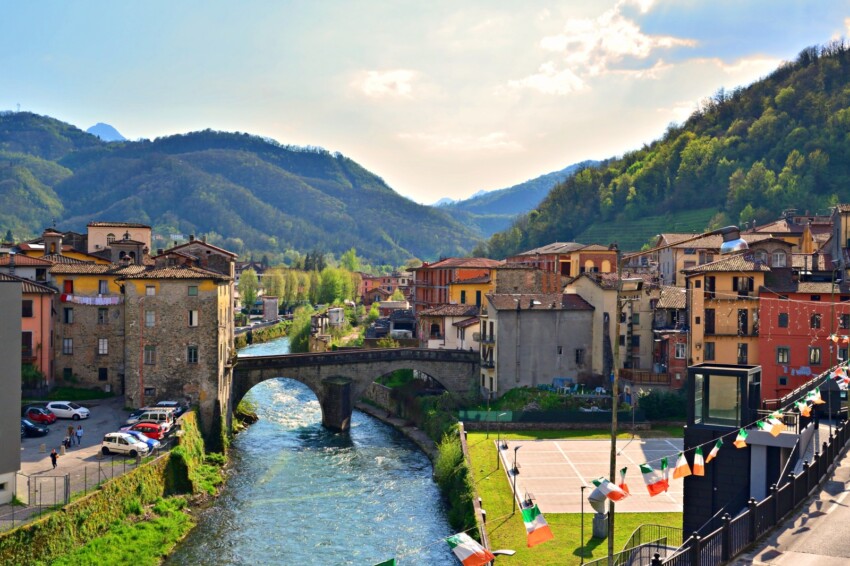
The beating heart of the Garfagnana region, Castelnuovo is one of the most interesting villages to visit if you’re in the area. Located in the province of Lucca, this pleasant town with almost 6,000 residents represents one of Garfagnana’s principal attractions and, at the same time, a convenient base for exploring this often-overlooked region, which deserves far greater recognition.
Castelnuovo di Garfagnana combines a charming medieval village with modern amenities, good hotel facilities, and easy accessibility thanks to its railway station. It would be a grave mistake to arrive and leave straight away, so pair your visit to the historic centre with a few days exploring its beautiful surroundings.
Garfagnana is indeed full of surprises. Medieval villages, ancient fortresses, stunning views, mountain trails, interesting museums and much more besides. To explore it thoroughly, stay in Castelnuovo, and you won’t regret it.
Begin exploring Castelnuovo di Garfagnana from its historic centre. Small yet beautifully preserved, you’ll enjoy wandering through its narrow medieval streets—perfect for photography—and you can also shop or sample local specialities. After exploring aimlessly and connecting with local life, dedicate yourself to the main monuments and most important sights, whether in the centre or surrounding areas.
The Castelnuovo di Garfagnana Cathedral, officially the Church of Saints Peter and Paul, is the town’s most important church. Erected in the 15th century in Renaissance style, its interior was completely redesigned during the Baroque period, with the addition of altars and period decorations.
The exterior façade is austere, built in grey stone, and features three portals with a relatively simple pediment. It’s the interior that impresses, with the apse completely restructured in the 19th century and a collection of religious artworks dating from the 15th and 16th centuries, along with several fine paintings by renowned artists, including the Madonna and Child with Saints by Salviatino.
Mont’Alfonso Fortress sits a short distance west of Castelnuovo di Garfagnana village, in a panoramic location. It’s an ancient fortress now restored, with gardens and accessible pathways for all. From here you can enjoy splendid views of the surrounding countryside, the Apuan Alps and the Apennines.
Mont’Alfonso Fortress covers an area of 60,000 square metres, and its name derives from Alfonso II d’Este, who decided to build it at the end of the 16th century. Its defensive walls are impressive, comprising 7 bastions and 2 gates, stretching for a total length of 1,150 metres.
The beautiful Rocca Ariostesca is one of Castelnuovo di Garfagnana’s symbols, located at the start of the town centre on Piazza Umberto I. Its name comes from Ludovico Ariosto, the famous poet who lived here for 3 years whilst serving as governor of the Garfagnana province.
Originally built as a military fortification, the Rocca Ariostesca soon became a museum dedicated to Ludovico Ariosto and 16th-century Garfagnana.
The Ariosto Trail is a hiking path nearly 6 kilometres long, dedicated to the great poet. It takes roughly an hour and a half to complete and is a circular route with no difficulty: the total elevation gain is only 350 metres. It starts from the Rocca Ariostesca, crosses the bridge over the Turrite Secca and continues, well-marked, to the village of Torrite.
Here you can observe archaeological excavations that have uncovered ancient thermal baths, but continuing on you reach Mont’Alfonso, where you’ll find an access point to the fortress, the southern gate, usually closed. You can detour to visit the fortress or return to Castelnuovo via Via Debbia.
The Ariosto Trail can be walked in either direction.
A short distance north of Castelnuovo di Garfagnana lies the artificial Lake Pontecosi, created along the course of the Serchio river. On the northern shore sits the village of Pontecosi, which is worth a visit, and there’s a pleasant walking path and public park; on the right bank are several picnic areas, whilst on the left bank you’ll find a well-equipped leisure area.
Its waters are shallow, though sport fishing is possible. The lake isn’t suitable for swimming, although the entire area was reclaimed in 2000. However, you can walk along the so-called health trail, which starts at the Church of San Magno near Pontecosi village.
In the following map you can see the location of the main places of interest mentioned in this article.
In central Castelnuovo di Garfagnana there are three accommodation options: a 3-star hotel and two apartments. Staying in the centre gives you access to all the town’s facilities; however, if you want to make the most of the surroundings, alternatives certainly abound.
With charming apartments, country cottages with pools, hotels, farm stays and farmhouses, by moving just 3-4 kilometres from the centre you’ll find plenty of options to make your Garfagnana holiday as relaxing and peaceful as possible.
Castelnuovo di Garfagnana is located in an area—Garfagnana, in fact—that’s not particularly straightforward to reach. As a historically isolated region, major roads were never built here, and whilst the route is straightforward, it can be quite lengthy.
From Florence take the A11 motorway towards Pisa north until the Capannori junction, then follow signs for Garfagnana. You’ll reach the start of the SS12 Abetone and Brenner road, which you follow parallel to the Serchio river, exiting onto the SP20 and passing through the towns of Borgo a Mozzano, Fornaci di Barga and Gallicano. The entire journey is nearly 120 kilometres, taking approximately 1 hour 45 minutes.
From Tuscany’s coastal towns the journey is shorter: from Pisa around an hour, from Livorno just over an hour and a quarter. In both cases you’ll first reach Lucca via the A11 motorway, then take the SS12 to the SP20 junction, continuing along Garfagnana roads.
If you’re coming from inland Tuscan towns, you should expect a much longer drive: from Arezzo it takes almost 3 hours, from Siena 2 hours 20 minutes, from Grosseto 2 hours 40 minutes. It’s quicker from Massa, which is just an hour away, but the SP13 road you need to take to reach Castelnuovo di Garfagnana is extremely winding, as it crosses the entire Apuan Alps range.
Despite its location, Castelnuovo di Garfagnana is easily accessible by public transport: the town has a railway station served by regional trains from Lucca. The train journey from Florence Santa Maria Novella takes between 2 and 3 hours. You can also travel by train to Lucca and complete your journey by bus.
What's the weather at Castelnuovo di Garfagnana? Below are the temperatures and the weather forecast at Castelnuovo di Garfagnana for the next few days.
Castelnuovo di Garfagnana lies in the province of Lucca, north of the main town. It serves as the most significant settlement in the Garfagnana region.
 Hotel
Hotel  Budget accommodations
  Apartments
  Family Hotel
  Luxury Hotel
  Resorts