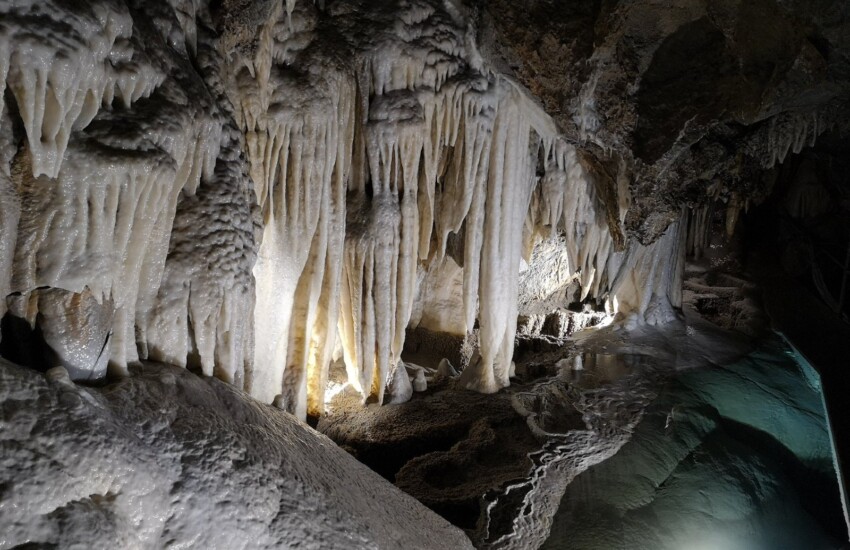
The name “Grotta del Vento” (Wind Cave) derives from the violent air current that flows through it, caused by two entrances situated at different altitudes. The lower entrance (tourist entrance) sits at 627 metres above sea level, whilst the upper entrance, which is impassable, is located eight hundred metres higher, at over 1,400 metres altitude. The internal temperature remains constantly at +10.7 degrees Celsius.
This creates a column of air which, in summer, being colder than the external air and therefore heavier, causes the well-known outgoing wind at the lower entrance (incoming at the upper one). In winter, the situation reverses; since outside temperatures are almost always lower, the internal air, being warmer and therefore lighter than the external air, rises, causing an incoming wind at the lower entrance (outgoing at the upper one). The wind’s velocity is directly proportional to the difference between external and internal temperatures. During visits, the air current is almost completely blocked by closing a reinforced door.
Located in one of the most picturesque areas of the Alpi Apuane, it ranks amongst Europe’s most scientifically significant cave systems. Its remarkable variety of features and vast array of phenomena make this cave a true natural encyclopaedia of speleology and deep karst morphology, expertly and knowledgeably explained by the guides.
Along comfortable pathways, you can observe all the cave’s evolutionary features, from the tiny fissures at its origin to vast vertical chasms, from newly water-carved conduits to ancient fossil galleries, all adorned with splendid multicoloured stalactites, delicate translucent draperies, pristine flowstone and stalagmite spires. Water, absent on the surface, abounds throughout the cave, where you’ll encounter underground rivers, waterfalls, sumps, small lakes and overflow pools. All the concretions are active, meaning they’re still growing, constantly moistened by a thin film of water that revives their colours and enhances their beauty.
Approximately 200 million years ago, on the seabed of what we might correspond to today’s Tyrrhenian Sea, enormous quantities of seashell fragments, coral formations, fish skeletons, sand, silt and chemically precipitated calcium carbonate began to accumulate through water evaporation.
These deposits, though varying in quantity and composition, continued to build up, layer upon layer, for at least 170 million years, forming a mass thousands of metres thick. The immense weight of this accumulation caused the compression and cementation of the various elements, slowly transforming it into limestone rock.
Around twenty million years ago, powerful tectonic forces linked to continental drift caused this rock mass to rise. Intensely fractured by the immense pressure it experienced, it emerged from the sea and gradually formed the mountains we see today.
Rainwater, falling on the mountain’s fractured surface, was immediately swallowed into the ground, where various streams joined to form those brooks, torrents and underground rivers that, flowing through the fissures for millions of years, progressively widened them, transforming them into the dense network of tunnels, galleries, shafts and chambers that constitute the underground complex of the “Grotta del Vento”.
The cave’s tourist route is divided into three completely distinct sections.
In the first section, the most level, you can see an abundance of limestone concretions, such as stalactites and stalagmites, almost all active, meaning they’re still growing.
In the second section, you descend into a cave area still undergoing expansion, with no limestone concretions but featuring erosion formations on the walls, a small stream on the floor and curious mud formations in the return gallery.
In the third section, you visit a perfectly vertical 90-metre shaft, which is ascended from the bottom to reach a final chamber, followed by a short underground canyon.
Visiting all three sections, the third itinerary, takes approximately three hours, but you can also visit just the first section with the first itinerary, lasting about one hour, or the first two with the Second Itinerary, lasting about two hours.
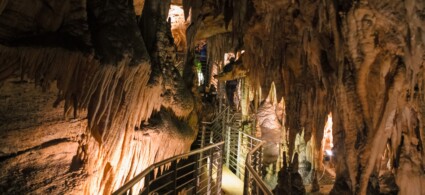
All routes have concrete floors, metal railings and artificial lighting, making them easily accessible for most visitors. When choosing your itinerary, we do recommend considering whether the duration, number of steps and total elevation change are compatible with your fitness level.
Grotta del Vento is open every day of the year (Christmas excluded). From 1 April to 30 September and on all public holidays during the remainder of the year, the following hours apply:
On busy days, to avoid overcrowding and long waits, groups will enter as soon as they are complete. For organised groups of at least 20 people (schools, company associations, parishes, organisations, etc.), visits are possible any day of the year, provided they are booked several days in advance.

 Hotel
Hotel  Budget accommodations
  Apartments
  Family Hotel
  Luxury Hotel
  Resorts