Florence: Uffizi Timed Ticket & Masterpieces Audio App
7.148 reviews
Buy now
From 27,20€ per person
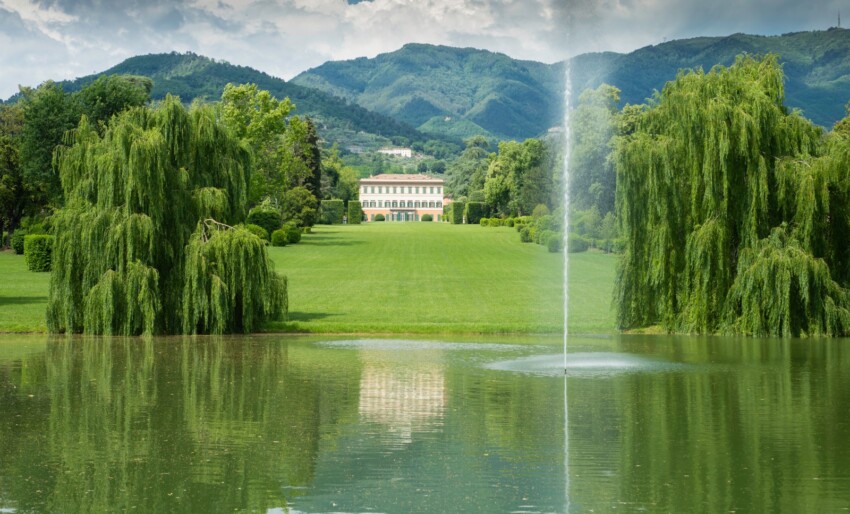
Villa Reale di Marlia is regarded as one of Italy’s most important historic residences. In the 19th century, it served as the home of Elisa Bonaparte Baciocchi, sister of Napoleon and Princess of Lucca. Just 8 km from Lucca’s historic centre, the estate extends across 16 hectares and boasts numerous refined gardens, rare botanical specimens and impressive palaces, offering a wealth of surprising points of interest throughout the grounds.
Major restoration work commenced in 2015 under the new owners, who fell in love with the complex and embraced the challenge of restoring Villa Reale di Marlia to its former splendour. A visit to the park rewards you with the chance to immerse yourself in a myriad of pathways, avenues and gardens in an enchanting blend of past and present: make sure you allow at least one or two hours to discover every corner of the property within its centuries-old walls.
The complex includes various structures from different periods scattered throughout the estate: the magnificent Villa Reale and the adjacent Clock Tower (Palazzina dell’Orologio) dominate the upper part of the park, whilst in the centre stands the Chapel of S. Francesco Saverio, patron saint of travellers. Moving further south, you can admire the nymphaeum known as Grotta di Pan and the oldest of the architectural features, Villa del Vescovo.
A distinctive feature of the park is the variety of its refined gardens: following the route, you can admire the Italian-style garden of Villa del Vescovo, the Hispano-Moorish Giardino Spagnolo, the renowned Lemon Garden with over 200 citrus pots, before finishing beautifully with the celebrated Topiary Theatre, where Paganini once entertained Elisa Baciocchi on summer evenings.
Another unique aspect of the park is the striking and prominent presence of water: the Camelia Avenue is enlivened by an artificial stream that flows to the lake, and just beyond, the 1920s Swimming Pool displays its colours. The Lemon Garden overlooks the ancient Fish Pond, from which you can glimpse the fountain of the Topiary Theatre. These water features are completed by the architectural splashing of the Water Theatre behind the Villa Reale.
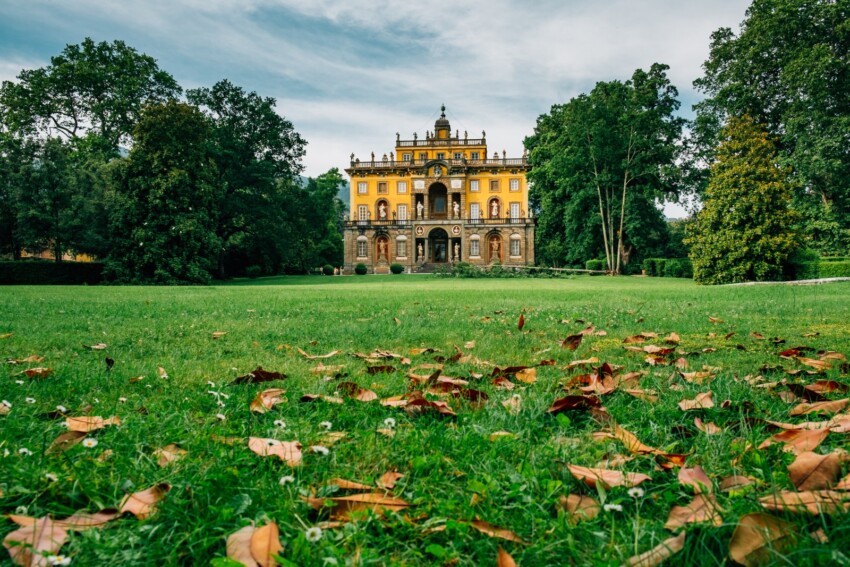
Two majestic avenues of cypress trees, stretching almost a kilometre long, announce the theatrical façade of Villa Torrigiani, the finest example of Baroque architecture in Tuscany. The villa and park date back to the early 1500s, when they were owned by the then-powerful Buonvisi family. It was the scene of meetings between Marchesa Lucrezia, wife of Lelio Buonvisi, and her lover (Arnolfini), who is said to have been captured right in front of the gates of Camigliano, accused of the assassination of Marquis Lelio, which took place in the city.
In the first half of the 1600s, Villa di Camigliano was purchased by Marquis Nicolao Santini, ambassador of the Republic of Lucca at the court of Louis XIV (the Sun King), who wanted to transform it into a sumptuous residence, complete with a garden featuring flowered parterres and large basins in front where the façade is reflected, executed according to designs by Le Nôtre for the Palace of Versailles. He created the Flora Garden-Theatre with grottoes and functioning water features still visible in the Cave of the Winds. This is a remarkable example of a circular grotto with mosaic stonework surrounded by niches containing important statues of winds with fountains at their base, topped by a cupola from which emerges a great cascade of water.
The garden “enters” the villa as decoration in the frescoes by Pietro Scorzini, perfectly preserved (depicting the seasons in the bedrooms, mythological scenes in the lounges and Emperor Aurelian in the main hall), which frame the original furnishings still present. The villa is indeed still inhabited by the family descended from Marquis Nicolao through the marriage of the last heiress Vittoria Santini, who married Marquis Pietro Guadagni Torrigiani in 1816. Their busts adorn the façade and the chapel (open to visitors), where Marquis Carlo Luca and his daughter Marchesa Simonetta Torrigiani are also buried—she married (1937) the Prince of Stigliano Don Carlo Colonna, from whom the current family line descends.
From the 19th century onwards, the park acquired a more romantic character in the areas in front of and behind the villa, with the introduction of plant species from various parts of the world, fine examples of which remain today: Liriodendron Tulipifera, Taxodium districtum, Osmanthus fragrans, Cedar of Atlas and many varieties of Camellia.
Lodovico Buonvisi had the villa, now known as Oliva, built around 1500, and commissioned Matteo Civitali with the design. The villa features two superimposed halls in the central section, running north to south, and has the characteristic loggia open on two levels, whose columns in single blocks are made of Matraia stone.
After the Buonvisi, a family that died out in the early 19th century, the villa had several owners: the Montecatini, the Poniatowski (Prince Carlo is buried in the chapel), the Rosselmini Gualandi, Cardinal Maffi (from whom it passed to the Piccolo Cottolengo), and the Paolozzi. Finally, the Oliva family purchased the property and carried out important restoration work.
In 1600, the villa hosted a Consistory promoted by Cardinal Francesco Buonvisi, in the presence of Pope Alexander VII Chigi della Rovere and numerous cardinals. The grounds of the villa, entirely enclosed, covering approximately 5 hectares, are characterised in the northern section by a holm oak amphitheatre and a “grotto” with water features and marble statues. To the south, the park develops on three levels: at the central level, a cypress avenue leads directly to the gate of the main entrance, artistically decorated with mouldings and rustic mascherons.
The basin called “the little cascades” with bas-reliefs and terracotta statues interrupts the perspective of this avenue halfway along. At the highest level of the park are basins with fountains, a holm oak copse, the lemon house, and spacious lawns framed by trees. The lower level of the park now features a plantation of eucalyptus with a gallery of hornbeams parallel to the main avenue.
The park is rich in many rare plant species such as Ginkgo Biloba, camphor, Osmanthus fragrans, felloia and many others. In addition to the fountain already mentioned, notable ones include the “Mermaid Fountain” and the “Fountain of Abundance”. A “grotto” with new water features faces the villa’s loggia, and behind it is a fir plantation. Two entrance gates, besides the main one, are distinguished by statues of dogs. Of notable architectural interest is the complex of the Buonvisi stables.
Among the many villas in the Lucca area, Villa Mansi is certainly one of the most representative of the culture and society of the ancient Aristocratic Republic. The Mansi family belonged to one of Europe’s most well-known merchant families in the silk trade from before the 16th century, when they worked closely with other Luccan patrician families such as the Buonvisi, Antelminelli and Cenami. From the latter family, the Mansi purchased Villa di Segromigno in the 17th century.
The original building, constructed in the second half of the 16th century, was largely transformed in 1634-1635 by the Urbino-born architect Muzio Oddi. Under the Mansi, the façade underwent restoration by Luccan architect Giusti, and the garden was transformed following designs by Filippo Juvarra, who was responsible for the water management works, hydraulic systems and the tripartite layout of the garden itself. Juvarra’s trapezoidal cutting of the east garden and the stables area served to establish the other two sectors of the water management system: the large lawn area around and in front of the palace and the garden area to the west.
The whole was thus distributed into four main adjoining sectors, each with independent perspective, alternately reversed and roughly trapezoid in shape. Among the numerous frescoes decorating the interior of the villa, those in the central hall are certainly the most interesting, thanks to the work of the neoclassical painter Stefano Tofanelli, highly appreciated by Elisa Baciocchi, Princess of Lucca and sister of Napoleon Bonaparte. These paintings consist of the two large side canvases depicting the deeds of Apollo (Judgment of Midas and Death of Marsyas) and the ceiling fresco representing “The Triumph of the Sun God”.
Villa Mansi, famous for the beauty of its gardens and the elegance of its architectural lines, frequently hosted sovereigns and ambassadors from various European states, invited here by the Republic of Lucca for a pleasant sojourn.
Villa Grabau in S.Pancrazio was built in the 16th century, on the ruins of a medieval village, by the powerful Luccan merchant family the Diodati. In subsequent centuries the villa passed to the Counts Orsetti and, following a marriage, to the Marquises Cittadella. Various owners transformed its original Gothic character into Renaissance features and finally into its current neoclassical appearance.
In 1868, the villa was ceded by the Cittadella to Rodolfo Schwartze, a wealthy German banker living in Livorno, married to Carolina Grabau, of German noble origins.
The nine-hectare park, among the most interesting in the Lucca area, both for its layout and for the richness and rarity of plant species, comprises various architectural gardens.
The “English Garden” was certainly already formed in the 16th century by native species that still form extensive copses today, where you can admire impressive examples of sessile oaks, holm oaks, hornbeams, lime trees, field maples and honeysuckle, plants typical of spontaneous woodland. Among the various species worth mentioning is Michelia figo, known as the banana shrub, and Quercus x Andleyensis, a sterile hybrid created by man and found in the Lucca area only in this park.
The “Italian Garden”, with its beautiful hillside landscape in the background, presents itself as a semi-oval terraced garden, enlivened by the perspective flow of tall hedges, which form a sort of screen with convex waves interrupted by female marble statues representing Ceres, Venus, Pomona, and so on. It contains over a hundred terracotta lemon pots, with the coats of arms of former patrons impressed upon them, which are sheltered during winter in the magnificent lemon house, a structure of considerable architectural merit dating from the 1600s-1700s, certainly among the most important and beautiful in the Lucca area.
The “Topiary Theatre”, a graceful and elegant boxwood stage for summer concerts and performances. On the two central fountains in the Italian Garden, two magnificent bronze masks in the form of satyr heads preside, dating from the Florentine late mannerist period and attributed to Pietro Tacca (1577-1640).
From the same period, a large grotesque stone statue depicting a tortoise supporting a dragon with a human head and a rustic mascaron at the back, from whose mouth emerges a tail.
Villa Bernardini, a fine example of late Renaissance architecture built by Bernardino Bernardini, was completed in 1615, as evidenced by the inscription on the stone frieze adorning the architrave of the entrance portal: “BERNARDINUS BERNARDINIUS A.D. MDCXV”.
Positioned in the centre of the park, it is of the cubic block type with a front portico of three archways, two storeys plus attic and basement. Having always remained in family ownership, it has undergone only minor modifications, exclusively interior, in the first half of the 1700s on the occasion of Francesco Bernardini’s marriage to Marianna Parensi.
The various rooms (halls, drawing rooms, lounges, bedrooms) are completely furnished with furnishings and household items accumulated over the centuries (1600s-1700s-1800s), many of them commissioned by the Bernardini family (armchairs, high-backed chairs, console tables) bearing the family crest carved or painted upon them, which makes them particularly interesting for scholars and enthusiasts.
The spacious front lawn, shaped like a heart and gently sloping towards the gate, still features two giant sequoias dating from the mid-1800s that dominate and frame it. In the rest of the front garden and near the villa are groups of unusual and interesting plants and shrubs.
Laterally, on the right, you access the spacious garden, a former enclosed vegetable garden that was transformed into a secret garden in the mid-1700s. From here you access the large lemon house, whose interior is embellished with centuries-old Ficus repens plants covering its walls and a large Carrara marble basin in Empire style located opposite the entrance.
The most important part of the park is the rear section, consisting of a remarkable topiary theatre in Buxus sempervirens planted in the mid-1700s by levelling the ground. The project, of uncertain attribution, is evidenced by a model of the theatre in the villa on which is written “T. e Petri (…) fecit”. The cavea with its mystilean profile can accommodate over 650 seats: the structure consists of two double rows of boxwood walls, which delimit a wide terrace and are punctuated by sculptural spherical figures created through topiary work that mark points of acoustic and visual reference.
 Hotel
Hotel  Budget accommodations
  Apartments
  Family Hotel
  Luxury Hotel
  Resorts