B&B RIO GRANDE
Massarosa - 894 Via degli Sterpeti
Book now
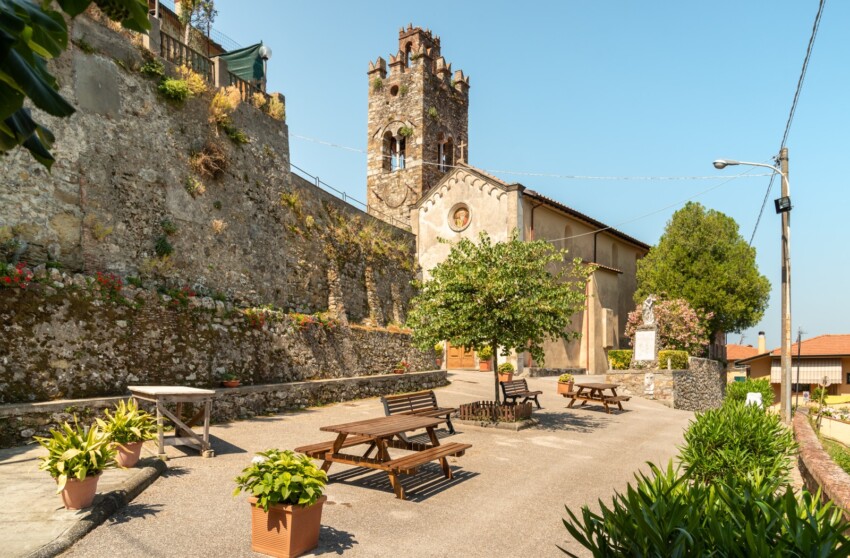
Stretching between the extreme slopes of the Apuan Alps and the Versilia coastline lies the territory of the Municipality of Massarosa. Crossed by State Road 439 Sarzanese-Valdera and the Lucca-Viareggio slip road of the A11 Motorway, at the lower edge of the hills where industry and new residential centres now flourish near the old villages, it preserves exceptional panoramic areas amid silvery olive groves, such as Mommio Castello, Corsanico, Bargecchia, the passes of Quiesa, via Balbano, Pieve a Elici and the heights of Gualdo and Montigiano.
Equally rare and exquisite in beauty are the waterways and marshy islets of Lake Massaciuccoli, bound to memories of Puccini’s music. This is a natural environment that enjoys adequate protection, as its area is part of the Migliarino, San Rossore and Massaciuccoli Natural Park – a wetland zone rich in flora, with some genuinely rare, if not unique, species that can be admired by navigating the so-called “clearings” aboard characteristic rowing boats. With a concession from the Natural Park Consortium, a delegation of the L.I.P.U. (Italian League for Bird Protection) has created a bird-watching reserve. In this extraordinary setting, the most remote evidence of human presence is testified by archaeological finds discovered at San Rocchino from the excavation of silica sands, dating back to the Middle Palaeolithic; the area is not exposed or accessible for cultural visits.
Another zone of prehistoric finds consists of the Mommio Caves, whilst material discovered at Campo Casali and Montramito provides valid evidence of Ligurian settlements from the 7th century and Etruscan occupation in subsequent centuries. The jewel in the crown of historical remains is the Massaciuccoli hamlet, where the Roman era left imposing traces still visible today; you can find the ruins of the Baths and Villa, along with ceramic materials spanning from the 2nd century BC to the 3rd century AD, which are preserved in the local Civic Museum situated between the remains of the Roman Villa and the Baths. It’s worth noting that illustrious figures such as D’Annunzio, D’Azeglio, Giusti, Manzoni, Pea and Rosmini, as well as maestro Giacomo Puccini, stayed in this Massarosa territory, often singing its harmonious beauty.
The romanesque church of S. Martino di Bargecchia was built in the early 1200s. The first confirmed records date from 1234, and it is mentioned in official catalogues only from 1260. Built in exposed stone, the western side is perfectly preserved, as are the walls enclosing the apse which was demolished long ago. The church floor lies two and a half metres below the present ground level. The church measures 5.90 metres in width and 17.70 metres in length. It is in the romanesque style with the altar and apse facing east; the ceiling was made of exposed timber set upon a framework of terracotta. The main door faced west and was surmounted by a small circular window. The church was covered in roof tiles according to the custom of the time. The four bells, of various sizes, were delivered to the parish in 1885. It is said that maestro Giacomo Puccini would often come to Bargecchia to listen to the marvellous melody of the bells, which he faithfully reproduced at the end of the first act of Tosca. For centuries the bells served as the fastest means of communication for past generations. Certainly linked to faith, but always at the service of the people. The bells announced great events, the beginning of a war, its end, dangers, invasions; they marked the hours and raised the alarm for storms. Nowadays, the sound of the bells has been recorded and broadcast through loudspeakers that do not reproduce the original sound.
In a 1690 document, there is mention of building a new church because the old one needed repairs. There are no plans, minutes, registers or archive records that precisely demonstrate when construction of the new church began, but an 1840 letter from the governor of the Royal Navy and Commissioner of Viareggio invites heads of family to assemble to discuss enlarging the church, and a 1842 sheet showing income and expenses for church construction suggests that work began during that decade. Inside you can admire polyptychs from the 14th and 15th centuries, large paintings, marbles and silverware from the 1500s, interesting wooden works and fine processional lamps from the 1700s.
Of the ancient 1270 construction, only the bell tower remains, considered a national monument, whilst the church itself is modern, having been rebuilt in 1848. The importance the Church of Corsanico held in past centuries is evidenced by the existence of an ancient baptismal font. There are no documents prior to the 16th century, as many were removed or lost at the time of Charles VIII’s invasion (1494), and the few that remained were destroyed in a fire that broke out in the Parish Archive when lightning struck. From the registers that still survive, relating to subsequent centuries, it appears that Viareggio used it continuously until 1661, Stiava until 1823, Pedona until 1841, Bargecchia until 1905 and Mommio until 1939. The elevation of this distinguished church to the title and honour of Pieve is of recent date, specifically 1946, a worthy recognition of its ancient spiritual authority. A beneficial institution also of very ancient origin and deserving special mention is the Confraternity of San Michele Arcangelo, which arose in Corsanico in the 15th century.
In 1807 all the moveable and immoveable property of the Confraternity was seized by the state in virtue of the Napoleonic decree ordering the suppression of religious institutes and associations, and the confiscation of their assets. The organ of the Pieve was not originally built for the Church of Corsanico, but was constructed between 1602 and 1606 for the Church of San Francesco in Lucca. The work of Venetian organ builder Vincenzo Colonna, it cost the considerable sum of 380 gold scudi. Historical accounts inform us of the numerous interventions and relocations the instrument underwent over the centuries, until its final installation in the Church of Corsanico (1886). Today the organ comprises 829 pipes (timpani excluded) that make up the sounding part of the organ: 225 are from the 1700s, 82 from the 1600s, 556 from the 1800s and 29 from 1881, the year of the last restoration. The technical and acoustic characteristics of this instrument are catalogued among the works of art of the Ministry for Cultural Heritage. The first concerts were held in 1982, and from 1984 onwards, internationally renowned organists have regularly performed at the keyboard each summer, such as: Mariella Mochi, Yuko Hayashi (Japan), William Porter (USA), etc.
The origins of this Pieve, which was one of the first centres of evangelisation in the Lucchesia region, are shrouded in the darkness of the early Middle Ages; according to tradition it would be one of the Pieves founded between the 5th and 6th centuries by San Frediano, Bishop of Lucca, during his extensive work reforming the Lucchese church.
As time passed, the importance of the Pieve continued to grow.
The church of the 10th, 11th and 12th centuries was not yet the architectural jewel we admire today.
At that time the Pieve consisted of four bare walls, without aisles, with the apse facing east, and a roof of timber trusses covered with slate. Of this primitive construction, destroyed once by military raids more than by human neglect, and rebuilt at the will of Countess Matilda of Tuscany, nothing remains but a small section of the wall that closed the church on the northern side.
The enlargement took place later, probably in the second half of the 13th century, when the Pieve grew in importance and the oratory could no longer meet the needs of the growing population.
The renewed Pieve assumed a decent and austere appearance, befitting a temple of God, and remained so until the early 18th century.
Restorations carried out at the beginning of our century freed the church from the disfigurements that bad taste and ignorance had caused it, so that today we can admire the ancient work restored in all its original beauty and austerity.
The visitor who crosses its threshold cannot resist the arcane fascination that emanates from the aisles of this Temple.
Although there is no precise information about the architect who designed the renewed Pieve, the absence of ornamental friezes on the architraves, capitals and corbels is a characteristic feature of the Lombard school.
Proof of this pure stylistic simplicity, this deliberate restraint, is also the Baptismal Font for immersion, reconstructed with the old material according to its original layout: in the rectangular basin, not only the inhabitants of the place and surrounding areas were baptised, but also those from the plain below, including Viareggio, when that city was still a small, squalid village of humble and poor fishermen.
A magnificent marble Triptych stands out at the far end of the central aisle, above the high altar.
The figures of the Triptych represent the Madonna and Child at the centre, San Pantaleone to the right and San Giovanni Battista to the left. The side altars are topped by two magnificent frescoes: a Madonna and Child and a Crucifixion, dating respectively to the 13th and 17th centuries.
The first, a work of clear romanesque execution, is one of the very few frescoes still in existence from the end of the 13th century; the other is an authentic masterpiece, attributed to Guido Reni.
Also important is the bell tower with its Ghibelline crenellations; it was erected in the 9th century as a watch and observation tower.
To see all the facilities and book accommodation in Massarosa use the form below, entering the dates of your stay.
 Hotel
Hotel 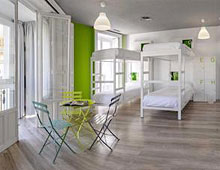 Budget accommodations
  Apartments
  Family Hotel
 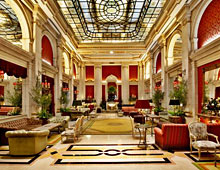 Luxury Hotel
 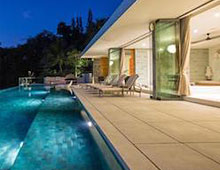 Resorts