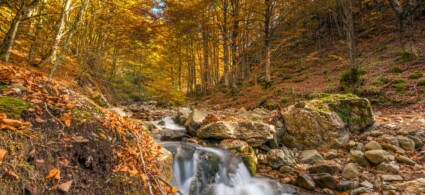
Orecchiella Park
Distance: 10 km
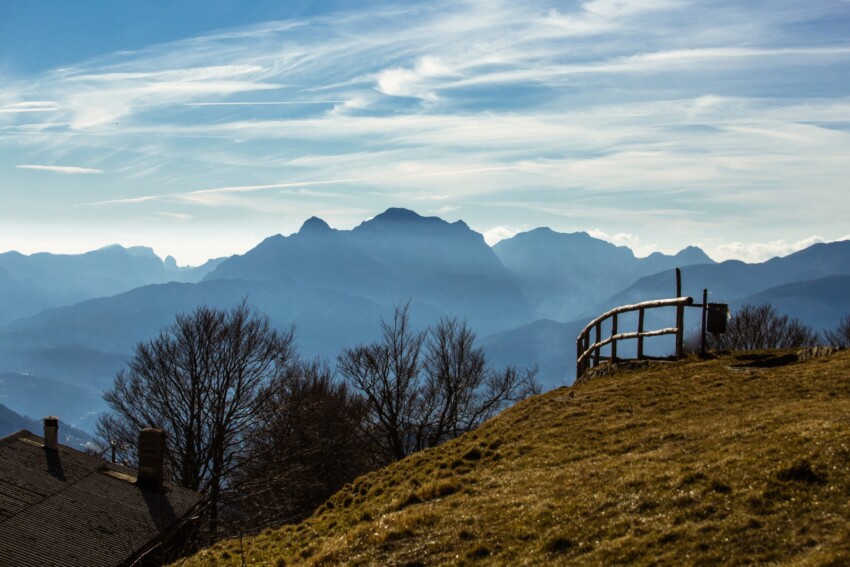
San Pellegrino in Alpe, an ancient hamlet situated at 1,525 metres above sea level, was founded on the burial site of San Pellegrino, who died in 643 AD.
Legend tells of the young San Pellegrino, son of Romano, King of Scotland, who renounced the crown, abandoned his homeland and embarked on a long pilgrimage across Europe. Following a “divine” calling, he reached the wilderness of the Alpe, nestled between the beech forests of Garfagnana and the bare peaks of Cusna, Rondinaio and Cimone.
Here, alongside Bianco, a hermit, San Pellegrino offered hospitality to travellers using the ancient Bibulca and Vandelli routes.
Today, as in centuries past, San Pellegrino in Alpe attracts pilgrims and devotees from across the world.
The boundary between Emilia and Tuscany bisects the sanctuary equally, so the saint’s remains, housed in an urn within the small shrine designed by Matteo Civitali and positioned behind the high altar, rest with his head and torso in Emilia and the rest of his body in Tuscany.
The old Osteria del Duca d’Este, now the Albergo L’Appennino (run by Pacetto), which once guarded the border between the Duchies of Modena and Lucca and dates back to 1221, has always been managed by the Lunardi family. It straddles the municipalities of Frassinoro (MO) and Castiglione Garfagnana (LU).
The hamlet is also home to a remarkable Ethnographic Museum of Rural Civilisation, housed in the old hospice and dedicated to its founder, Don Luigi Pellegrini. The collection contains over 4,000 objects on display, among the largest and most admired of their kind in Italy.
Today, as in centuries past, San Pellegrino in Alpe attracts pilgrims and devotees from across the world. The boundary between Emilia and Tuscany bisects the sanctuary equally, so the saint’s remains, housed in an urn within the small shrine designed by Matteo Civitali and positioned behind the high altar, rest with his head and torso in Emilia and the rest of his body in Tuscany. The old Osteria del Duca d’Este, now the Albergo L’Appennino (run by Pacetto), which once guarded the border between the Duchies of Modena and Lucca and dates back to 1221, has always been managed by the Lunardi family. It straddles the municipalities of Frassinoro (MO) and Castiglione Garfagnana (LU). The hamlet is also home to a remarkable Ethnographic Museum of Rural Civilisation, housed in the old hospice and dedicated to its founder, Don Luigi Pellegrini. The collection contains over 4,000 objects on display, among the largest and most admired of their kind in Italy.
Why was a hospice built at this Apennine pass? In ancient times, a road ran from Lucca up the Serchio valley to Castelnuovo di Garfagnana and Pieve Fosciana. Climbing Mount Chiozza, it crossed the Apennines and descended into Emilia via San Pellegrino and Frassinoro. This was a crucial trade route, difficult as it is to imagine today, and was heavily travelled by wayfarers of the period.
Travellers were motivated not merely by commercial interests, substantial though they were, but also by a distinctly medieval phenomenon: pilgrimage. Due to the length of journeys, almost always undertaken on foot, and for countless other reasons, pilgrims and wayfarers often found themselves in difficulty and in need of assistance. This led to the establishment of numerous medieval hospices offering support in many locations. At San Pellegrino, at 1,525 metres above sea level, the need for help was particularly acute during the harsh winters. At the beginning of the 12th century, a group of devout Christians gathered here with charitable intentions. These men, and women too, lived communally, calling each other “fratelli” (brothers) in the Gospel spirit. Their habits bore an embroidered insignia made up of the pilgrim’s most distinctive objects: the “bordone”, a long staff shaped like a “T”, and the “scarsella”, a travelling pouch. Through labour, the keeping of flocks, and alms collected across much of Tuscany and the Po Valley, the community provided assistance to poor travellers passing through the pass in every season. A church, much smaller than the one that stands today, was built, along with a hostel. The two buildings were connected by a vault beneath which ran the road linking Tuscany to Emilia and northern Europe. The charitable work was hugely popular among the local people. Many offered donations and gifts of property to the brothers of San Pellegrino. The hospice’s reputation, spread by pilgrims and travellers, reached distant regions.
To see all the facilities and book accommodation in San Pellegrino in Alpe use the form below, entering the dates of your stay.
 Hotel
Hotel  Budget accommodations
  Apartments
  Family Hotel
  Luxury Hotel
  Resorts