Antico Uliveto
Seravezza - Via Martiri di Sant'Anna 76
Book now
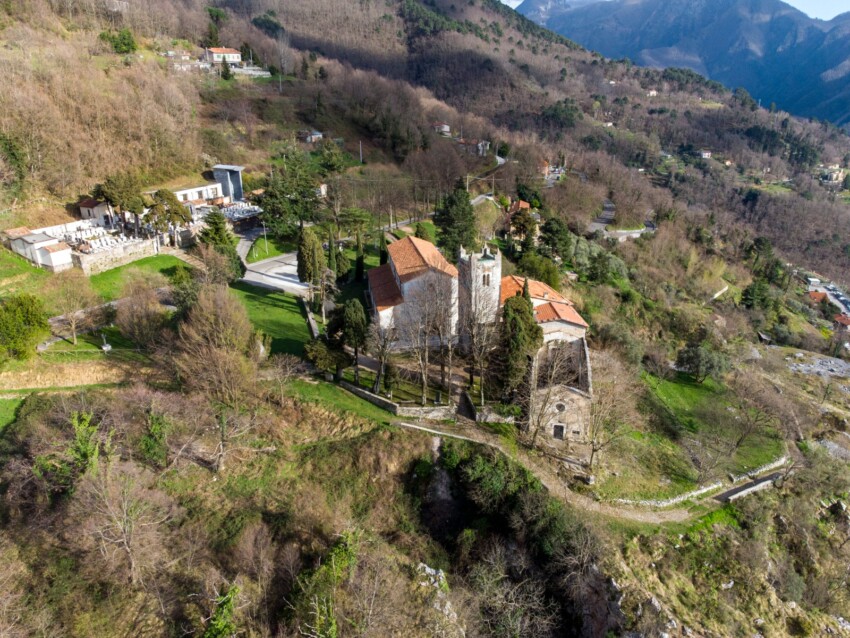
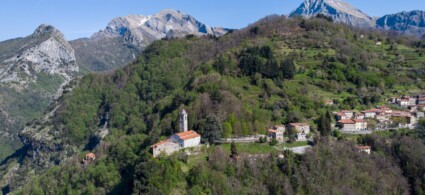
The territory of the municipality of Seravezza (population 12,362 – 39.37 km²) comprises a flat area where the towns of Ripa, Pozzi and Querceta are located, a valley floor with the villages of Riomagno, Malbacco, Corvaia and Ruosina, and a mountainous zone made up of the hamlets of Cerreta San Nicola, Fabbiano, Giustagnana, Minazzana, Basati, Cerreta Sant’Antonio and Azzano. Seravezza, the main town, is a charming and exclusive settlement positioned at the confluence of the Vezza stream and the Serra, framed by the Alpi Apuane mountains, renowned for their dramatic marble cliffs, cool chestnut forests and crystal-clear streams.
Despite the exceptional environmental diversity that characterizes Seravezza‘s landscape, the entire area is defined by the imposing presence of marble; the marble quarries of Ceragiola, Cappella, Trambiserra and Monte Altissimo produce a marble whose unique characteristics have made it world-famous. Today Seravezza is easily accessible via the “A12” motorway (Versilia exit), the Pisa-Genoa railway line (Forte dei Marmi-Seravezza-Querceta station) and excellent road links connecting it with important centres.
The earliest documented historical records of Seravezza date back to 1040, although human settlements certainly existed here as far back as pre-Roman times. The name “Seravezza” appears to derive from a Lombard-era place name (Sala Vetitia: a centre for commercial trade). During the medieval period, Seravezza‘s history was marked by the affairs of the nobles of Corvaia and Vallecchia and the persecution they suffered at the hands of Lucca. As a true frontier land, it was destroyed and occupied countless times, first by Luccan troops, then Florentine forces, and finally the French. The first authentic document of the municipality of Seravezza dates from 1515, when the town ceded Monte Ceragiola and Monte Altissimo to Florence.
Alongside numerous iron foundries or “magone” that worked the veins of materials abundant in the territory, intensive exploitation of the marble quarries began, attracting famous sculptors searching for precious statuary marble. From the 16th century onwards, Seravezza‘s history has been inextricably linked to marble extraction and processing, with its periodic phases of boom and decline. Two sharp interruptions occurred during the World Wars. Seravezza‘s strategic position was tragically reasserted during the Second World War, when the town saw the Gothic Line front remain on its territory for nine months, causing loss of life and devastation, destroying entire villages, public works and industrial facilities. Reconstruction, thanks to the dedication and resourcefulness of the local people, was swift and thorough.
Construction of the Cathedral began in 1422 on a site where an older church probably once stood (as evidenced by an inscription in semi-Gothic characters near the bell tower). After some interruptions and alterations, the Cathedral was consecrated in 1569.
Over the centuries it underwent various embellishments until the Second World War, when it was severely damaged by aerial bombardment.
Many remarkable artworks can be admired inside:
Located in an area of exceptional panoramic interest, the church dedicated to San Martino is entirely built in marble; it is believed to have been constructed around the year 1000 and enlarged in the 13th century.
Between 1518 and 1536 it was embellished with an Ionic portico, probably designed by Michelangelo (unfortunately destroyed during the Second World War), a frame around the roof and a rose window called the “Eye of Michelangelo”, also attributed to the Florentine master.
Inside the church you can admire a bas-relief (on the floor, at the centre), a holy water basin decorated with four figures representing the ages of life, and a small tabernacle shrine.
Beside the church are other buildings, including the oratory of the Santissima Annunziata, located at the beginning of the old mule track, a building probably constructed in the 1700s; its missing roof, plain walls and large marble altar give this church a striking and mysterious appearance.
Inside the Church of Mercy – a voluntary aid and assistance organisation founded and operating since 1859 – are housed a splendid canvas by Pietro da Cortona, the “Marys at the Sepulchre”, and a bas-relief by Donato Benti depicting the Virgin and Child. Beneath the loggia, on the wall, a plaque recalls that Michelangelo, yielding to the wishes of Leo X, opened the quarries of Monte Altissimo and “in three years spent taming the harshness of the places and the inexperience of the people” lived in that location.
It was built between 1561 and 1565 at the behest of Cosimo I de’ Medici, Duke of Florence, to protect the iron foundry. With its simple, almost austere architecture of a fortified villa, it was the summer residence of the Medici family, the House of Habsburg-Lorraine and other Tuscan nobility for many years. Following Italian unification, the palace became the seat of the Town Hall and retained this function until 1967. In the centre of the splendid internal courtyard stands a well with a rim carved from a single block of white marble, with columns and architrave topped by a trophy depicting a trout. Local legend has it that this trout is a copy of one caught in 1603 by Grand Duchess Maria Cristina of Lorraine in the Vezza stream, near the Church of S. Paolo in Ruosina. Today, the first-floor rooms of the palace host numerous contemporary exhibitions, whilst the second floor houses the Museum of Work and Popular Traditions of Historic Versilia, which documents activities related to marble extraction and processing, mining work, traditional crafts and the customs and ways of Versilia.
The municipality of Seravezza, rich in marble deposits, bases its economy essentially on marble extraction, processing and trade. The territory hosts numerous related industries, chief among them those producing machinery for marble processing. Marble extraction and processing activities boast an ancient tradition in the Seravezza area. From the quarries of Monte Altissimo, Cappella, Ceragiola and Trambiserra, the renowned white marble has been extracted and continues to be extracted, as well as notable bardiglio and arabesque varieties.
Near Seravezza you will encounter the Ceragiola quarries, dating back to the Etruscan era, from which Ceragiola white marble is extracted. A visit to the Museum of Work and Popular Traditions of Upper Versilia, housed within the renowned Palazzo Mediceo, is certainly worthwhile. A substantial section of the museum is dedicated to documentation on marble extraction and processing. A footpath starting near Palazzo Mediceo leads to the Costa quarries, where white marble and the so-called Costa bardigletto are extracted. Continuing through the Vezza Valley, along the Arni road, after the hamlet of Pontestazzemese, you reach Le Mulina, a small village whose quarries yielded Medici breccia. Also along the Arni road, but towards Castelnuovo Garfagnana, are small Rosso Rubino quarries. Near Retignano, Monte Corchia is visible with its quarries of Arabescato and Fior di Pesco breccia. Past the Cipollaio Tunnel you reach the Tre Fiumi location, an ideal place to see the quarry landscape up close. Here, white Tre Fiumi, Arabescato Faniello and Fantastico are extracted from the higher quarries.
The Tagliate quarry is easily accessible, though certainly not the most spectacular. Access to other more fascinating quarries is more challenging, such as the striking Cervaiole quarry on Monte Altissimo, from which the famous Arabescato that bears its name is extracted. The quarry is reached by taking the marble road that opens to the left of the Cipollaio Tunnel entrance and continuing on a winding path. The itinerary can be concluded by descending the Massa side.
The Alpi Apuane originated 200 million years ago from the slow accumulation of sediments in a marine basin. Their emergence occurred 26 million years ago and was followed by compressive geological movements; the increase in pressure caused metamorphism, producing a complete change in the primary structure. Marble is the rock in which the effects of metamorphism are most evident. Originally a calcareous sedimentary rock formed by builders like those of modern coral reefs, metamorphism caused it to recrystallise. Various types of marble are found in the Alpi Apuane, and these differences derive from the purity of the original rock. On Monte Altissimo we find “statuary white”, a pure white limestone free of impurities; coloured marbles contain other minerals: bardiglio is grey, cipollino is green, and Seravezza varieties are breccia.
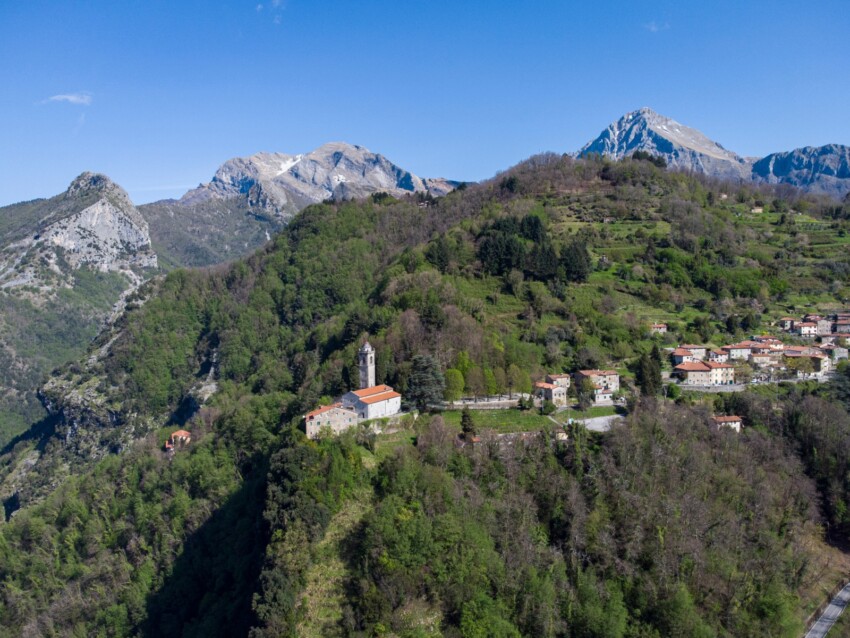
The earliest documentation relating to Stazzema dates back to the 9th century. Matilda of Tuscany fortified the mountain passes, stimulating the civilisation of the area.
From the 15th century, the economy began to develop around quarrying, which became the dominant element of the zone’s culture and economy.
Not to be forgotten is what happened in Sant’Anna di Stazzema on 12 August 1944, when Nazi troops swept through the village and massacred over 500 people, particularly women, children and the elderly. This tragic event is commemorated by a monument with an ossuary and a small museum.
Stazzema municipality is distinguished from other Versilia municipalities by being composed of a series of small, widely separated settlements, most of them situated on higher ground.
The main activity is marble extraction; there are numerous quarries of statuary marble, colossal monuments that cut through the mountains and reflect their brilliant whiteness into the valley.
A visit is recommended to admire them even from a distance by travelling the numerous mountain roads.
In the village of Stazzema, with its stone buildings, noteworthy are the Clock Tower (Torre Medicea) from 1739 and the Carraia Fountain from the 16th century.
Nearby stands the Sanctuary of the Madonna del Piastraio or Madonna del Bell’Amore, an evocative building erected in the 17th century where an image of the Madonna was discovered.
It is reached by a footpath of about 5 minutes from the church. The building was restored in 2002-2003 and is in excellent condition. Just a short walk from Stazzema is the Church of Santa Maria Assunta (9th century), declared a national monument. Given its location, a visit is highly recommended. Its facade is simple, with a 16th-century marble rose window. The interior is much richer, divided into three naves by a series of columns topped with Gothic-Roman capitals. In the presbytery is a painting of the Assumption of the Madonna attributed to Rosselli. The 17th-century altar is finely worked, but the building’s most important piece is an 18th-century organ.
At the foot of Monte Corchia are the villages of Retignano, Terrinca and Levigliani, all worth visiting.
Of note in the latter is a pre-Roman necropolis.
In the village of Ruosina is an unusual monument: an enormous trout commemorating one caught by Maria Cristina of Lorraine in 1603.
Pomezzana, with its Church of San Rocco, preserves important works of Luccan goldsmithy.
In Volegno, there is a 16th-century oratory; in nearby Pruno, a village better known for its Living Nativity, the Church of San Niccolò houses a Museum of Trades.
Isolasanta, a small village at the foot of Monte Sumbra, is famous for the Giants’ Potholes, enormous cavities eroded by water in the hard rock over millennia.
Also worth visiting in Sant’Anna village are the Ossuary Monument and the Museum of the Resistance.
Azure with a silver fess charged with a gold fleur-de-lis placed in bend, flanked by two rings of the same; the fess surmounted by a turreted castle of two, proper, accompanied in base by a gold sun. The ancient coat of arms of the Stazzema vicariate was an armoured arm, striking a hammer on an anvil.
The symbols recalled the remote iron manufacturing active in the territory and represented also in one of the coat of arms colours, black. The other colours, red and blue, belonged to the community. Over time, the coat of arms was completely modified. Until the early 20th century, the ancient work was recalled by two black pestles, placed beside the Florentine fleur-de-lis, topped by a castle and illuminated by a gold sun. The pestles have transformed, in modern times, into two small circles, while the other symbols remain, albeit placed differently on the shield, recalling the tower of Stazzema and Florentine rule, and the sun, which is an auspicious symbol.
To see all the facilities and book accommodation in Seravezza use the form below, entering the dates of your stay.
 Hotel
Hotel  Budget accommodations
  Apartments
  Family Hotel
  Luxury Hotel
 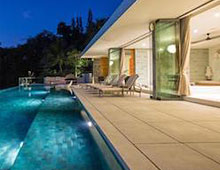 Resorts