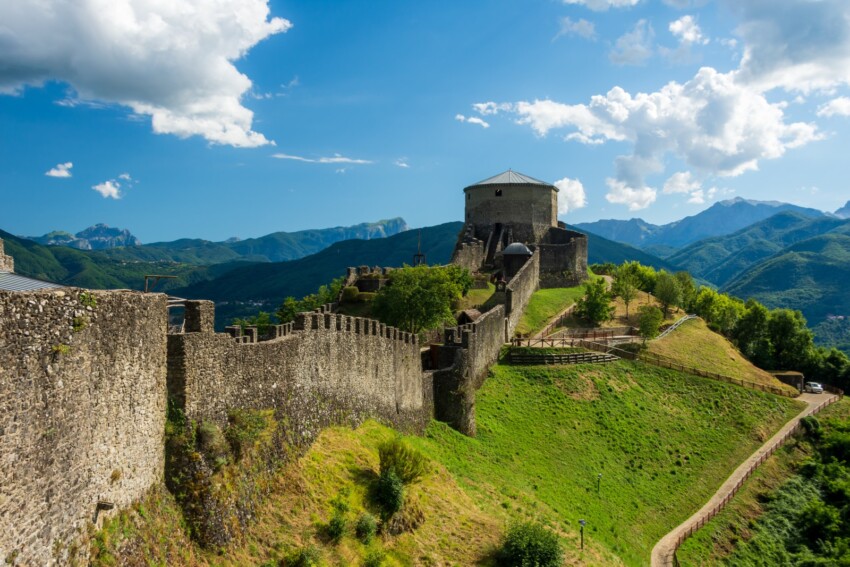
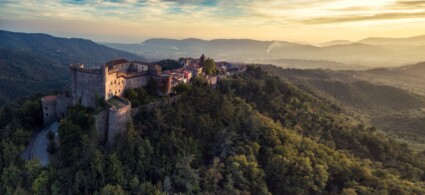
The Fortezza delle Verrucole stretches impressively across the hillside in a north-east to south-west direction, overlooking the village of San Romano Garfagnana at the entrance to the Orecchiella natural park. When visiting the fortress, you can admire the remains of the polygonal tower, a defensive wall enclosure, the remains of various structures, a gallery leading to the underground casemate, the formidable perimeter wall and two bastions—one with an acute point, the other with a rounded tip.
At the morphologically lower sections of the curtain wall are situated two semicircular towers and two gates, of which the one on the eastern side has been blocked. The State Archive in Modena preserves beautiful depictions of the fortress and its various sections, along with the project drawn up by architect M.A. Pasi for the Este family and Captain Costa’s plan from 1796.
State of conservation: The municipality of San Romano Garfagnana purchased the fortress in 1986 from Eredi Bresciani for 15 million lire. The remaining structures are in good condition thanks to consolidation work initiated by the council at the beginning of the 1990s. Archaeological excavations continue to this day, aiming to gather information about the building structures.
A project for repurposing the fortress was commissioned to architect Gianclaudio Papasogli Tacca, who presented it in 1998. The project is still under review by the relevant heritage authorities. Opening hours: The fortress is publicly owned and can be visited. Getting there: From Castelnuovo Garfagnana, follow signs for San Romano Garfagnana. From there, once you’ve passed through the village, turn right up towards the Verrucole hamlet. Park your car in the square next to the church and continue on foot.
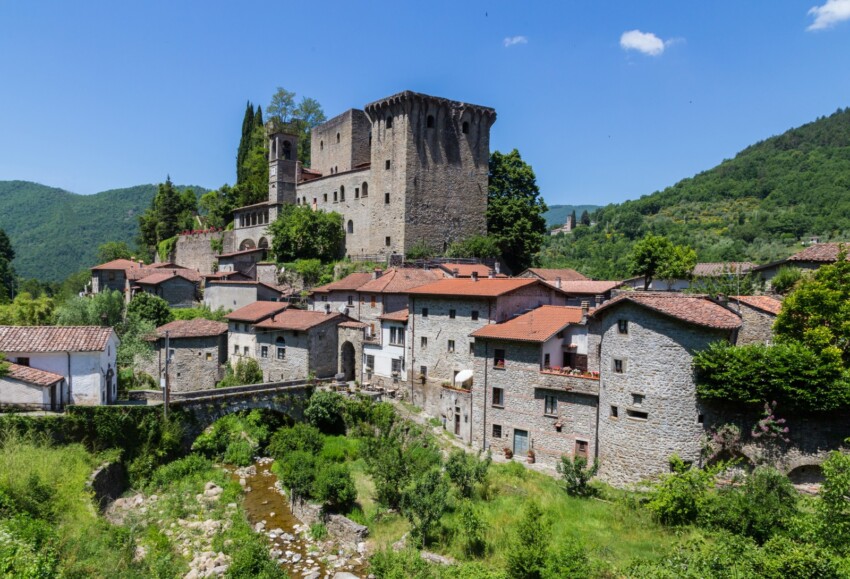
The Fortezza delle Verrucole captures the eye with its beauty and the natural landscape in which it sits, enchanting visitors in every season and inviting exploration. It is certainly one of the most representative monuments of Garfagnana and the system of military fortifications in the surrounding territory, thanks in part to its twenty-year conservation and reconstruction restoration, completed with excellent results.
However, without the help of knowledgeable interpreters, the Fortezza risks remaining silent—a lamentable fate that has befallen too many well-restored historical buildings that remain essentially mute to potential visitors. For this reason, we created the Archeopark Fortezza di Verrucole project.
The Archeopark Fortezza di Verrucole project aims to reconstruct life within the Fortezza as it existed in the past, in the form of an archeopark—in other words, a living museum. Period interiors dating from the 13th century onwards, the placement of gardens and animals where they once were (chosen philologically and respecting the territory’s specific characteristics), the presence of guide-animators who illustrate the fortress’s history and life, demonstrations of traditional crafts, educational workshops and performances suited to the setting—this is essentially what “Archeopark Fortezza di Verrucole” is: added value to the structure brought about by the irreplaceable richness of human presence and passion.
Archeopark Fortezza di Verrucole was born as a thematic park and living museum, and as such aims to be in continuous adaptation to public needs whilst respecting historical accuracy and the protection of heritage. Our perspective is one of constant evolution—a starting point for a journey based on fundamental principles: tradition, history, nature, culture, innovation, passion, pragmatism and quality.
Visitors will experience a unique and personal journey within the fortress walls of the Fortezza delle Verrucole, interacting with guides and the surrounding environment—a complete departure from traditional tours. The approach we’ve chosen for engaging with visitors, which we call “interactive visits”, perfectly aligns with the direction taken by leading museum systems—in other words, transmitting cultural content through concrete, engaging experiences. No matter what time of day visitors arrive at the Fortezza, they will find a guide in period dress to accompany them. Beyond providing the necessary historical introduction, we present the displays we’ve created, which have restored these spaces to their historical completeness. The real added value, however, lies in our constant breaking of the so-called “fourth wall”: no barriers between the furnishings and visitors, no display cases.
During the visit (adapted each time according to the group’s age and background), we make it our priority to engage visitors by inviting them to ask questions and test themselves with historical tools.
The future lies not only in the hands of touchscreens, but also—and above all—in real, concrete experiences. Our model has proven genuinely suited to satisfying both occasional tourists and organised groups.
Visitors can participate hands-on in educational workshops on medieval life, designed for both young people and adults, to explore aspects of our ancestors’ daily lives and transform a visit into an experience.
The creation of an archeopark within the Fortezza delle Verrucole makes it an ideal educational venue for school-age children, where they can experience local history and traditional rural activities firsthand. The Fortezza qualifies as an excellent destination for school trips or as a starting point for an in-depth educational programme to be developed in stages. Our project is tailored on request for schools of all levels and is also suitable for summer schools or sports groups and camps.

 Hotel
Hotel  Budget accommodations
  Apartments
  Family Hotel
  Luxury Hotel
  Resorts