Cavour33
Massa - Via Cavour 33
Book now
The most overlooked of Tuscany’s provincial capitals sits at the far north-west, on the border with Liguria. It’s Massa, which together with its nearby rival Carrara forms the Province of Massa Carrara. Here the typical Tuscan dialect gives way to Ligurian influences, the gastronomy takes on the aromas of the mountainous hinterland, and there’s barely a trace of the gentle rolling hills that characterise our beloved region.
A city that, at the same time, is very often overlooked by tourists. For many, it might merely represent a lunch or afternoon break stop during a day trip from Florence to the Cinque Terre, but if you decide to give it a chance, Massa will captivate and amaze you with its abundance of things to see, its beautifully preserved historic centre, and the warmth and helpfulness of its inhabitants, always ready to assist you and show you the secrets of their city and their land.
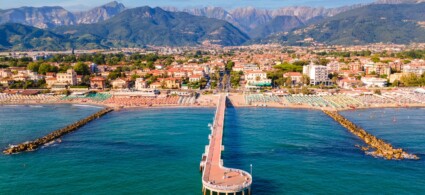
Massa, finally, is an excellent place to stay: despite being an inland city, it’s still very close to the sea; its coastal stretch is encompassed within the resort of Marina di Massa, which ideally marks, together with nearby Marina di Carrara, the northern boundary of the Versilia: from here onwards, the long strip of sand that begins almost at the border with Livorno province abruptly ends, giving way to the Ligurian coast, typically characterised by sheer cliffs dropping into the sea with only tiny pebble beaches visible in between.
Massa is a fairly small city, with just over 60,000 inhabitants spread throughout the municipal area. But in its compact historic centre there are several monuments and places of interest worth visiting.
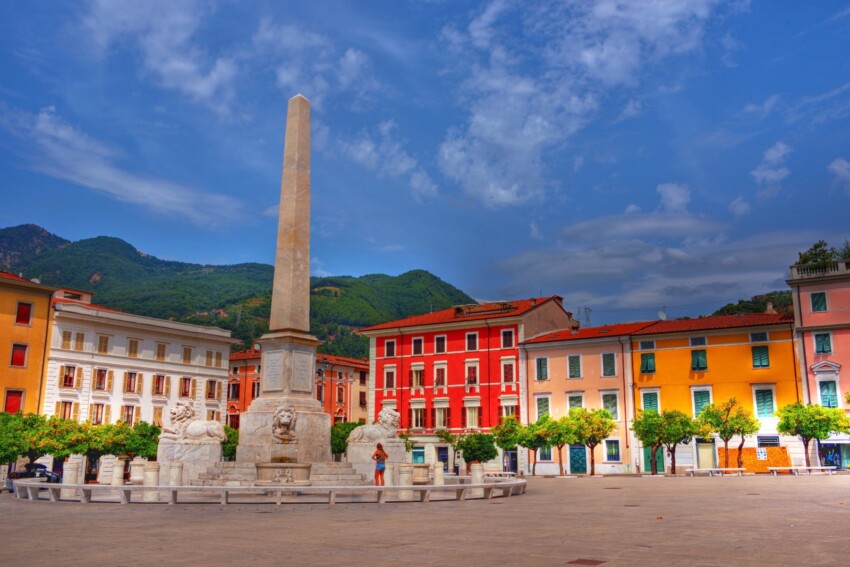
Start your visit of Massa’s centre from its main square, its beating heart. This is Piazza Aranci, named after the double row of orange trees that borders it on three sides. The beautiful Palazzo Ducale overlooks it, whilst in the centre stands a large obelisk, surrounded by four sculptures of lions, from whose mouths water flows into the fountain below.
Piazza Aranci is the perfect gathering place for locals, for a stroll by day or evening. From the square, the pedestrianised streets of the historic centre branch off; shops, bars and restaurants also face onto it.
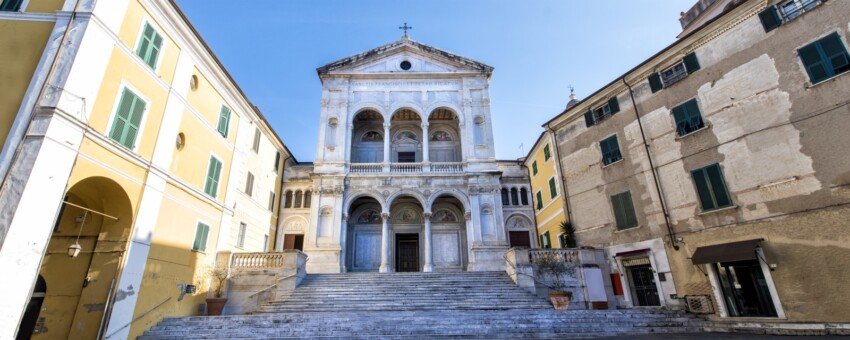
The Duomo of Massa, officially the Cathedral of Saints Peter and Francis, is the city’s most important church. Construction began in the 15th century, and it was consecrated in 1470. However, completion only occurred several centuries later, in 1936, when it assumed the appearance we can admire today.
The main highlight of the Duomo of Massa is undoubtedly its impressive façade, reached by climbing a beautiful staircase. It’s highly interesting as it consists of six arches arranged on two levels divided by a balustrade. The top of each one features a painted fresco depicting religious scenes. The entrance is also very beautiful, and it’s worth visiting the sumptuous altar of the Cybo Malaspina chapel and some paintings from the late 17th century, including Luigi Garzi’s Immaculate Conception and Saints, dating from 1684.
In Piazza Aranci, the most imposing and significant building is undoubtedly the Palazzo Ducale, which occupies the entire eastern side of the square. The building, also known by the nicknames Palazzo Rosso or Palazzo della Prefettura, dates back to 1563, when it was built by Alberico I Cybo-Malaspina in Renaissance style.
In subsequent centuries it took on Baroque features, particularly on the exterior, while inside, beyond the entrance, there’s a beautiful courtyard with columns and staircases, at the far end of which lies the nymphaeum, with the statue of Neptune riding the waves.
Today, part of the Palazzo Ducale serves as a museum and is therefore open to visitors, both externally and internally; one section houses the offices of the Prefect of Massa.
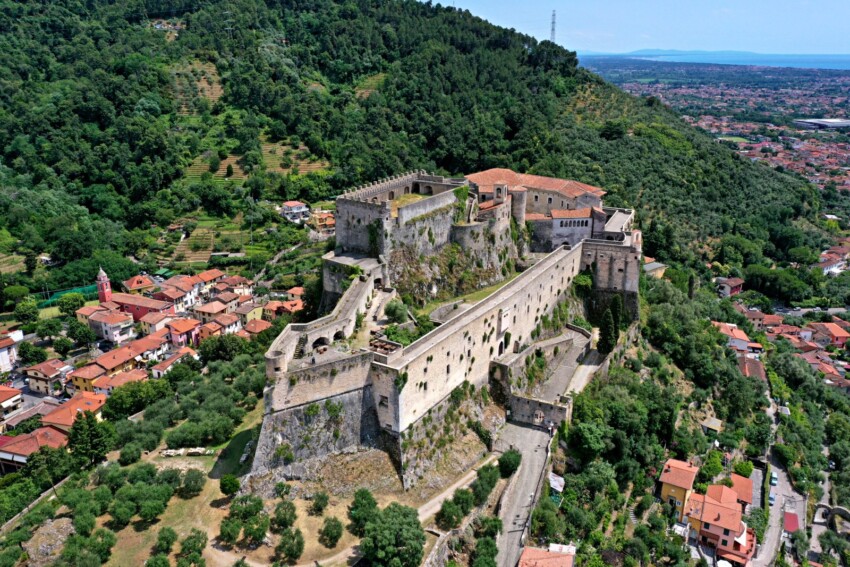
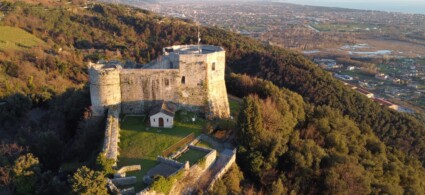
The Rocca Malaspina, also known as the Castello Malaspina, is a fortress situated on the hill behind Massa’s centre. From here the entire city is commanded, and you can observe the Tuscan coast from a privileged viewpoint, with views spanning from Liguria to Livorno.
The rocca owes its name to the Malaspina family, who ruled Massa from the mid-15th century onwards. During their reign the building was substantially transformed, so much so that today the most ancient masonry structures have virtually disappeared. It’s interesting to visit the castle to enter the residential palace and the underground chambers, carved directly out of the rock.
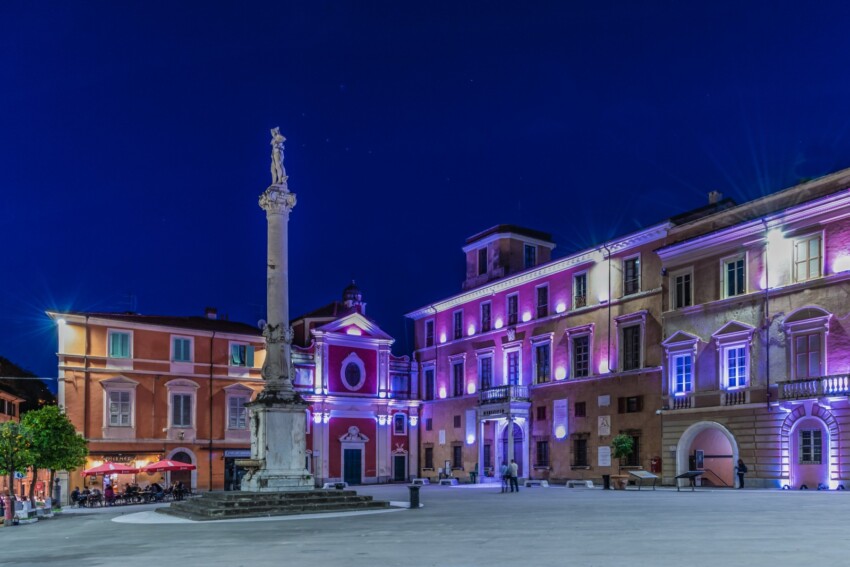
Piazza Mercurio, named after the statue of the god Mercury located in its centre, is one of Massa’s historic squares: it’s in the historic centre and a must-visit destination, as it’s very lively and busy, especially on Tuesday mornings when the city market takes place.
Unsurprisingly, the square’s focal point is the statue of Mercury, positioned on top of a column. At its base there’s a beautiful fountain, built as far back as 1566, which is why the square was originally called Piazza del Pozzo.
A keen lover of gardens and fishing, Alberico I had a small fishing lodge built along the waters of the Frigido, which at that time were crystal-clear and full of trout, called “la Cuncia“, now heavily deteriorated, enriching it with a garden where he combined spontaneous vegetation with a sought-after citrus grove, a precious feature of local production.
His successor Carlo I, for his part, purchased another villa from the Genoese nobleman Giulio Pacero, situated “above the Rocca”, which Carlo II brought to great splendour, adorning it with numerous statues, an elegant loggia and a splendid park. Despite the decline resulting from sales and the loss of the most precious decorations, the villa, now called Villa Massoni6, retains unchanged the charm of effective scenographic architecture and an evocative setting, also due to the work of Alessandro Bergamini.
The last in chronological order is the construction of Villa della Rinchiostra7, the work of Princess Teresa Pamphilj, wife of Carlo II. Coming from the rich and magnificent Roman milieu, she wished to create a “countryside” setting in which to enjoy the modest splendours of a small court. Entrusting Alessandro Bergamini with the realisation of her projects, she created from scratch a building that echoes the styles of Cybea architecture, played on the contrast between the red of the façades and the whiteness of the marble.
The splendid loggia and austere architectural composition give an imposing yet light appearance to a building that is not particularly large in itself, yet made even more prestigious by the splendid park surrounding it, which has been reworked several times and brought to its present form by Ludovico of Bourbon, who owned it for a period in the second half of the 19th century.
In the following map you can see the location of the main places of interest mentioned in this article.
For lovers of nightlife, Massa’s historic centre doesn’t offer much. Naturally there are bars for excellent aperitifs, restaurants for dinner and pubs for the evening, but for those seeking wild nights at a nightclub the city is not ideal. Far better to head a few kilometres south and reach Marina di Massa, where you’ll find nightclubs, beach clubs and discotheques.
If you want to enjoy Massa as a city and stroll through the historic centre, opt for accommodation near Piazza Aranci. There are hotels for all budgets, several apartments and bed and breakfasts, and in the evening, when the city lights go down, peace reigns supreme.
If instead you prefer combining cultural visits with beach days, choose Marina di Massa and you won’t regret it: the atmosphere here is far more holiday-like, with no shortage of ice-cream parlours, children’s play areas and venues of every kind. Be aware that Marina di Massa gets very crowded on summer weekends: avoid staying here if you’re seeking peace and quiet!
Reaching Massa is very straightforward, as the city is just a few kilometres from the junction of the same name on the A12 Genoa-Livorno motorway. From central Florence it takes approximately one hour and 20 minutes, covering just over 110 kilometres via the A11 motorway to Lucca, cutting onto the link road to Viareggio, and joining the A12 to the Massa junction.
The city is also conveniently accessible from the Tuscan coast: Pisa is less than 40 minutes away, Livorno approximately 50 minutes. The distances are short thanks to the A12 motorway, which starts from Rosignano Marittimo, a town in Livorno province.
Those wishing to reach Massa by public transport will be pleased to know that the city has a railway station, called Massa Centro, where regional and intercity trains stop on the Florence-Pisa-La Spezia-Genoa line. Once you leave the train, the city centre is about a 20-minute walk away, reached by following Viale Stazione in its entirety.
Alternatively, you can travel by bus in just a few minutes.
From the early 1200s Massa was often the subject of bitter disputes over control of the city between Pisans, Florentines and Lucchese. In 1442, Alberico I Malaspina, Marquis of Fosdinovo, began the dynasty that ruled the Marquisate for about a century. He was succeeded by Giacomo Malaspina, who was responsible for the reconstruction of the Church of S. Francesco which would later become a cathedral.
In 1519 Alberico was succeeded by his daughter Ricciarda, who married the Genoese nobleman Lorenzo Cybo, uniting the Malaspina house with the illustrious Ligurian family – well-known at the Roman Curia – which had among other things given birth to Pope Innocent VIII (the patron of Christopher Columbus).
Centuries passed, and in 1806 the district of Massa and Carrara was incorporated into the Principality of Lucca where Napoleon installed his sister Elisa Baciocchi, who made the Palazzo Ducale her holiday residence and substantially transformed the urban layout, creating the present-day Piazza Aranci, obtained by demolishing the ancient Church of S. Pietro.
The birth and development of seaside tourism in the late 19th century drew yet another new layout for the city, with rapid growth of a new urban area along the coast, in what is now Marina di Massa, where traces of upper-class settlements are still clearly visible in the Art Nouveau villas that embellish the seafront promenade and subsequently the massive establishment of marine colonies, built during the Fascist period, some of which (Torre Fiat and Colonia Torino) stand out also for their interesting architectural design.
What's the weather at Massa? Below are the temperatures and the weather forecast at Massa for the next few days.
Massa lies at the north-western edge of Tuscany. It is the capital of the province of Massa Carrara. The city is situated inland, whilst its coastal extension is represented by the seaside resort of Marina di Massa.
 Hotel
Hotel  Budget accommodations
  Apartments
  Family Hotel
  Luxury Hotel
  Resorts