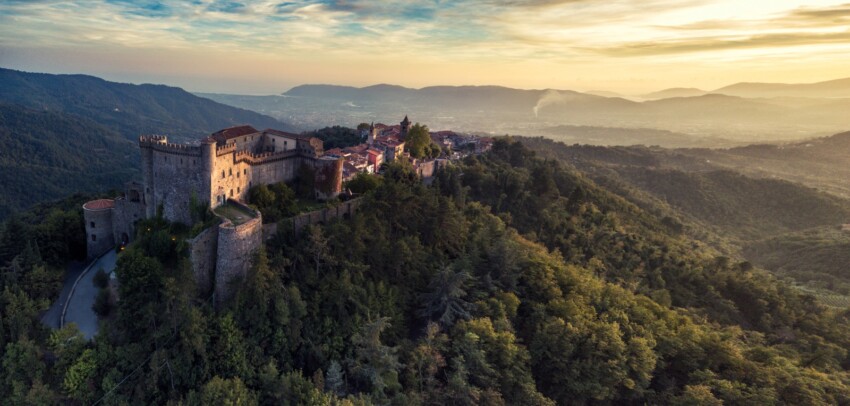
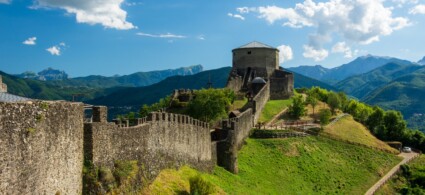
The Castello di Massa dominates the surrounding plains from atop a rocky hill, commanding sweeping views across the entire coastline. It was precisely these strategic qualities that likely led to the occupation of this hilltop, where a fortified settlement was presumably established during the early medieval period.
Written records first mention the place name Massa in 882; according to historians, the settlement would have been located on the castle hill.
The castle, seat of the Marquises of Massa, maintained close ties with the coast and the sea. These marquises, through their battles against pirates, became feudal lords of Corsica as well, adopting the title Marquises of Massa-Corsica. The first written documentation of the castle dates to 1164, when Emperor Frederick Barbarossa assigned part of the castle to Obizzo Malaspina. Some chroniclers note that Massa, roughly a century later in 1268, suffered occupation by the troops of Conradino of Swabia, who devastated the surrounding territory. The following year, the castle was destroyed by Lucchese forces, who could not tolerate the support offered by the people of Massa to the emperor’s troops.
The historical and architectural developments of the castle during the early centuries of the late medieval period remain largely undocumented; after the Marquises of Massa were ousted, the Malaspina family took complete control and ceded the castle in the early 1300s to Castruccio Castracani degli Antelminelli. From the 14th century until the mid-16th century, Massa and its castle passed under the control of Lucca, Pisa and Florence, eventually becoming the property of the Malaspina Marquises of Fosdinovo. It was under this rule that the castle assumed the role of a residence and underwent its most profound transformations, during the period between 1400 and 1600.
After the mid-17th century, the castle’s primary function became military, and when the pre-unification states eventually came to an end, its sole purpose became that of a prison, a role that lasted until 1946. Restoration works carried out by the Superintendency of Monuments in Pisa during the 1950s returned the castle to the city.
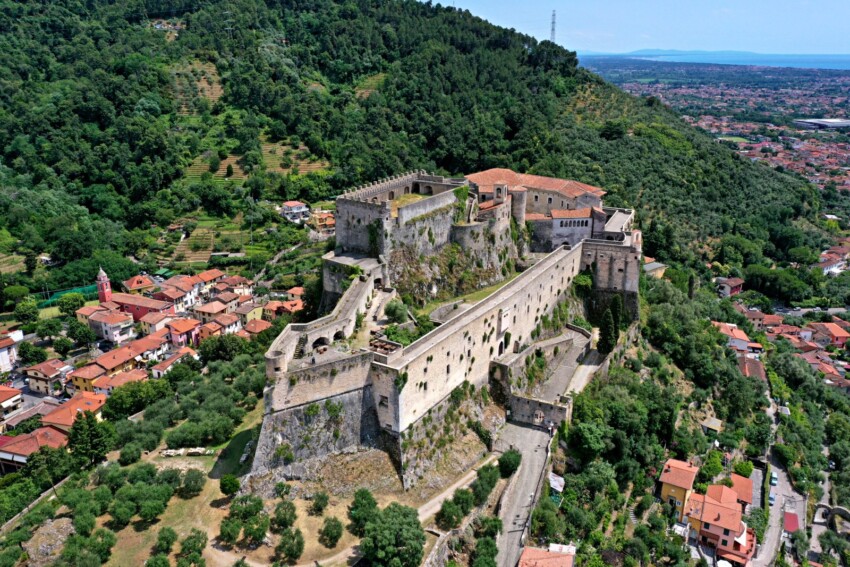
At the top of a steep cobbled path called Via del Forte, you arrive at the castle’s main entrance, protected by a sturdy iron gate set within a powerful stone wall. This is equipped with two tiers of loopholes distributed across two levels—one at ground level and another on the upper section, originally served by a wooden walkway (now long gone). This entrance replaced several earlier structures, one of which, visible in a drawing from the 17th or 18th century, consisted of a drawbridge. Passing through the metal gate, you enter an enclosed space, referred to in historical records as the first courtyard or foreground. Converging on the entrance are a series of gun emplacements of various types and sizes. Directly ahead, within a bastion built specifically to defend the entrance, large artillery pieces were positioned on multiple levels, while to the left, along the ramp leading to the second courtyard, several gunports are oriented towards the main gate.
Access to the castle walls is via a ramp interrupted by a ditch, where a second drawbridge and gate once stood. At this point, examining the castle walls reveals clear stone stratification: at a height of around 5 metres, you can see battlements corresponding to the top of the 15th-century walls. The walls were subsequently raised to accommodate cannon ports. A Gothic arch in white marble, crowned with an erased Malaspina coat of arms, frames the entrance to the second courtyard, which was defended by a machicolation and is now protected by an iron-reinforced wooden gate. The access passage, covered by a barrel vault, was further defended by a portcullis, whose housing remains visible.
A ramp leads up to the second courtyard, characterised on the inland side by an extensive worked rock face and on the seaward side by a robust wall built to house cannon ports, arranged on two floors and topped by a wide covered walkway. The walkway is accessed via a stepped ramp, from which you can reach the parapets of the northern bastion.
At the end of a recently built ramp, on the right, stands a large vaulted chamber that housed artillery pieces aimed towards the mountains and the Rocca settlement. The bastion, with an accentuated point, terminates in a circular guardhouse. To the left, a few steps lead to the walkway, from which you can observe the roads leading to the castle and the city. The structure dates from the 17th century, though the exact year of construction remains uncertain. Giovanni Battista Bergamini’s Historical Memoirs record that: “Prince Don Carlo I, on 20 October 1654, with an impressive ceremony and great public attendance, laid the first stone for the enlargement of the Massa Fortress, according to plans drawn by the renowned engineer Leni, with the express intention of not ceasing work until its actual completion”.
Proceeding along the walkway southwards, after crossing a small metal footbridge, you arrive above the bastion facing the main entrance. Examining the structure from within, you can see that the original installation ended horizontally at a lower level than today, marked by an angular guardhouse, presumably dating from the very beginning of the 17th century, later heightened and incorporated into a late bell-gable.
To continue your tour of the castle, it’s best to head back to the small bell-tower, near which a flight of stairs leads directly to the wall separating the Renaissance residence from the second courtyard, where the cannon ports are located.
Access to the third Renaissance courtyard was protected by a series of defences, now gone, though their traces remain visible. A ditch, cut directly into the rock, separated the wall with its small loggia from the cannon ports; the entire area was protected by a half-tower. Adjoining the rock face, a building, possibly residential, has left its marks on the wall surface. The beam sockets and roofline traces are clearly distinguishable. The other end of the wall was protected by a large circular half-tower with a sloped base and moulding, of which the foundations are still traceable, buried under several metres of earth. This structure likely dates from between the 15th and 16th centuries.
The short access tunnel opens onto the Renaissance courtyard; on the right, the extensive base of the palazzo contains an entrance to older underground rooms, and a marble plaque dated 1652 commemorates 16th-century visits to the castle by Emperor Charles V and Pope Paul III.
The courtyard has an irregular trapezoidal plan, with all four sides presenting different facades. To the north, a large shaped and polished rock overhang dominates, avoiding any projections; a crenellated wall rises from it, embellished with an original 16th-century marble portal. The west side features the frontage of the building wing, pierced by an elegant three-light loggia with raised arches and robust carved marble columns with angular leaf motifs at the base. To the right, access to the loggia consists of a flight of stairs, a modest balcony and an assembled portal, possibly reused, featuring a carved architrave with symmetrical putti-held coat of arms similar to those in the north portal, though with more dynamic and varied design. Almost all the noble coats of arms in the courtyard were chiselled away during the Napoleonic era. The western side also boasts a fine well of perfect 15th-century rigour, with slender columns and a cylindrical stone ring with a broad square border. It resembles the somewhat more elaborate well on the eastern side, which has an octagonal stone ring and angular leaf motifs at the column bases.
The southern facade is occupied by the 15th-century frontage of the Malaspina palazzo, entirely covered with an ornamental geometric pattern composed of interlocking eight-pointed stars and Greek crosses. Though restored, this pattern represents a rare survival of decorative work. The facade features, from bottom to top, a strong marble string course with rope moulding and five windows with powerful stone frames—the fourth from left is a restoration—with carved architraves featuring vegetal themes, and on the fifth, heraldic motifs as well, in the purest 15th-century style. The architraves are all differently carved and feature: foliage scrolls, rosettes, garlands, coats of arms, busts, winged protomes and more. Note on the third window the small armillary sphere bearing the Alberician motto DIE.TIT.DIE. Above the architraves are neoplatonic inscriptions with temporal themes, in the vernacular: SEQUITA EL TEMPO-ASPETA EL TEMPO-VA COL TEMPO-COL TEMPO (Follow Time—Wait for Time—Go with Time—With Time). Above the windows are ten large circular painted medallions, now empty, originally perhaps filled with images of the months and astrological signs. Below, five more windows with classical frames; a decorative band frescoed on a red ground between marble roundels carved with diamond or rope patterns. Finally, a broad cornice spreads across the front, resting on brackets and carved beneath with classical rosettes.
The eastern side of the courtyard is occupied by the 16th-century palazzo facade, characterised by the robust ground-floor portico and the powerful frames of doors and windows, all in finest Apuan marble. Within the portico is also the entrance to the 15th-century wing, with the portal featuring rich moulding bearing the inscription IN DEO TANTUM. The first floor offers four excellent window displays with arched lights and the repetition of the same sacred motto. Above stretches an elegant loggia with slender paired columns, whilst the facade is closed by the same cornice as the adjacent wing, enriched with more varied iconographic themes beneath.
The palazzo’s main entrances face the Renaissance courtyard. The north wing’s facade shows, at its left extremity, a small door; this is one of the accesses to the underground rooms where the oven was located, still in existence today. On the same wing, at ground level, are several small rooms. The central door, beneath the colonnade, gives access to a small room distinguished by an umbrella vault and a fireplace with marble frame, where a Malaspina coat of arms is placed; the small room connects to an adjacent hall with an irregular floor plan. This too is covered with an umbrella vault and features, on the east wall, the inscription: CHI LORDERA’ I MURI SARA’ TOSTO PUNITO (Whoever harms the walls shall be swiftly punished). This inscription dates from the early 20th century, when the castle housed prisons, a purpose that remained in use until 1946. From this hall, you can descend into three underground chambers via a steep flight of stairs or access the bastion, dating from 1570, which once contained a large tower demolished in 1780. Recent restoration work has revealed the foundation of this circular tower with sloped base and moulding.
The underground rooms are entirely carved from solid rock; the walls bear the finishing marks left by the stonemasons who worked on the building. Beneath the colonnade lies the entrance to the main hall, raised by three steps and dominated by an imposing portal bearing the inscription IN DEO TANTUM. The large hall is covered by a barrel vault dating from the mid-17th century, whilst the far wall is distinguished by a large fireplace, beside which lies the entrance to the frescoed rooms. On the wall opposite the fireplace is a two-light window offering a view into the hall from the last room of the noble floor.
Within the 15th-century wing of the castle are three frescoed rooms, already documented in 16th-century records, in less than perfect condition but of considerable interest. They are probably datable to the last two decades of the 15th century; contiguous to one another, they are historically known as: the “Chapel”, the “Picta Chamber” and the “Sala della Spina”.
The first room we encounter, the most cramped and irregularly shaped, served as the castle’s chapel during the Renaissance. Among the fresco fragments, a large painting of the “Birth of Christ” is now legible only in fragments. Five figures of Prophets, however, are clearly recognisable, placed in painted lunettes high along the other walls. They are surrounded by broad decorative bands filled with floral rosettes. Among the figures are a singing David, above the entrance door, and an Isaiah, on the opposite wall. The artist of this pictorial composition is probably Bernardino del Castelletto, a Malaspina court artist and the foremost Apuan Renaissance painter.
A simple marble portal leads into the adjacent “Picta Chamber”, where we find significant remains of refined “grotesque” decoration. We can observe the frames simulating wall cladding, fragments of a frieze on red ground with monstrous opposing figures, cornucopiae, floral stylemes, anthropomorphic figurines. Within broad lunettes, outlined by flower-filled bands, lies perhaps the most precious theme: rich candelabra with dancing putti or musicians balancing on the edges. The vault is filled with the decorative theme of “fish scales”.
The third room, the largest, is separated from the chapel by a broad carved marble arch, put in place during the early post-war restoration work. The “Sala della Spina” takes its name from representations of Malaspina emblems—flowering and withered shrubs—along the ceiling, where a large armillary sphere is painted at the centre. Lower down, still on the ceiling, busts appear within roundels of authoritative figures and of the signory. The walls, meanwhile, offer grand views of external landscapes with trees, where the profiles of two cities are recognisable: one almost certainly Florence, the other perhaps Genoa or another city in that direction. Note above the window a depiction of the castle itself, probably later in date than the other frescoes.
Access to the noble floor is via a marble staircase accessible directly from the courtyard through the colonnade. After climbing the first flight of stairs, you reach a landing and, proceeding to the left, a small stone staircase leads to a door with marble jambs and portals. On the portal are the initials “I A” and traces of a Malaspina coat of arms, which was defaced during the Napoleonic era. The portal, bearing the same initials as the bell dating to 1454, represents one of the earliest attestations of the Malaspina family of Fosdinovo’s presence within the castle. The noble floor consists of a series of spacious halls arranged along a longitudinal axis and interconnecting with one another. The marble staircase leads to a corridor with two doors on its left side, decorated with fine marble jambs and portals. At the northern end of the wing is a small room, probably used as a wardrobe, which had three openings. One opening connected the small room to the stone staircase described earlier, another provided access to the adjacent hall, and the third, identifiable as an emergency exit, led directly outside the palazzo through a small space equipped with toilet facilities for the guard corps.
Adjacent to this strategically positioned room is a spacious hall, covered with an umbrella vault, equipped with toilet facilities and probably used as a bedroom. Two further halls with umbrella vaults follow in sequence; the last, with a biforate window overlooking the ground floor hall, provided access to the Pinello tower, demolished in the eighteenth century.
At the end of the first-floor corridor, a modest marble staircase leads to the second-floor hall, covered with a timber ceiling with coffers installed during post-war restoration work. At the end of the second-floor hall are entrances to three rooms at a lower level, entirely decorated with vertical stripes. Two of these rooms are connected by a narrow passage with a fascinating polychrome decoration of vertical stripes. These spaces were used as a prison from the mid-sixteenth century onwards, as evidenced by inscriptions left by prisoners. Notable among these is that of Priest Romeo, imprisoned in 1564.
From the second-floor hall, you can reach a small loggia overlooking the courtyard, where a series of small paired columns support vaults with painted soffits depicting cherubs and other floral motifs.
An opening on the north wall of the hall leads into a corridor that opens onto a room with a barrel vault. This is the first of four adjoining small rooms with openings onto a vaulted corridor, from which you have a complete view of the settlement at the Rocca. Crossing the last room, you exit the palazzo to access the military section of the castle.
The military section of the castle, the keep, is separated from the Renaissance section by a stone bridge that replaced an earlier drawbridge. In the portal, you can see the housing for the drawbridge and the chains that operated it. Once inside the courtyard, you can see on the left some buildings probably dating from the fifteenth century, a dating suggested by the presence of several loopholes in the perimeter wall.
A space on the right allows entry to a large barrel-vaulted room, protected by two vertical structures forming a pincer formation. This space, which housed an ammunition store, communicated with the courtyard above, where the gun emplacements were located, via two circular openings that allowed ammunition to be passed from one level to the other. The room contains two cisterns, one highlighted by a circular well and the other, open to the sky, distinguished by a channel system for collecting rainwater.
Adjacent to the storage room is a large space, covered with metal beams that support the courtyard floor. The great hall had been completely filled with earth in previous centuries, and its recovery in the 1980s revealed carefully worked rock face. On the wall opposite the rock face, you can make out the trace of a staircase that, running along the masonry, led to the corner guardhouse.
Once you enter the properly military spaces of the castle, you can ascend to the upper sections via a paved path between the rock face of the hill and some buildings. Of these structures, the one furthest north is distinguished by a bell tower supporting a fifteenth-century bell. Dated by an inscription to 1454, it bears several Malaspina coats of arms and the initials of Iacopo Malaspina, who held the fief and castle of Massa in the mid-fifteenth century. This is evidence of the Malaspina family’s earliest interventions on the castle. Continuing on, you arrive at a terrace near the summit area.
From this point, you can see a distinctive feature of the castle: the keep’s fortified platform, created through work to regularise the rock in situ. An imposing vertical rock face was artificially created by skilled stonemasons from the quarries, who removed irregular formations using quarrying techniques, whose traces are still clearly visible today. At the top of a flight of stone steps stands the base of a medieval tower, one of the few structures surviving from the early medieval period, built using typically medieval construction techniques. The tower, still intact in its vertical development, is depicted in representations dating to the sixteenth century.
The summit area consists of a large courtyard with a rampart walk on the side facing the hills. In past centuries, the courtyard held artillery pieces. Chronologically, we can assume that the fortified platform and the modification of the rocky hillside occurred in the first half of the sixteenth century, at the initiative of Alberico and Ricciarda Malaspina, whose names are recorded on a plaque on the keep’s rock face, in a niche originally occupied by a small votive shrine. The corner guardhouses, also apparently from the sixteenth century and recovered during recent restoration work, have a form similar to that found in the lower bastioned defences and to the guardhouses depicted in views of the urban walls.

 Hotel
Hotel  Budget accommodations
  Apartments
  Family Hotel
  Luxury Hotel
  Resorts