Merlo d'Oro
Carrara - 24 Via Carlo Cassola
Book now
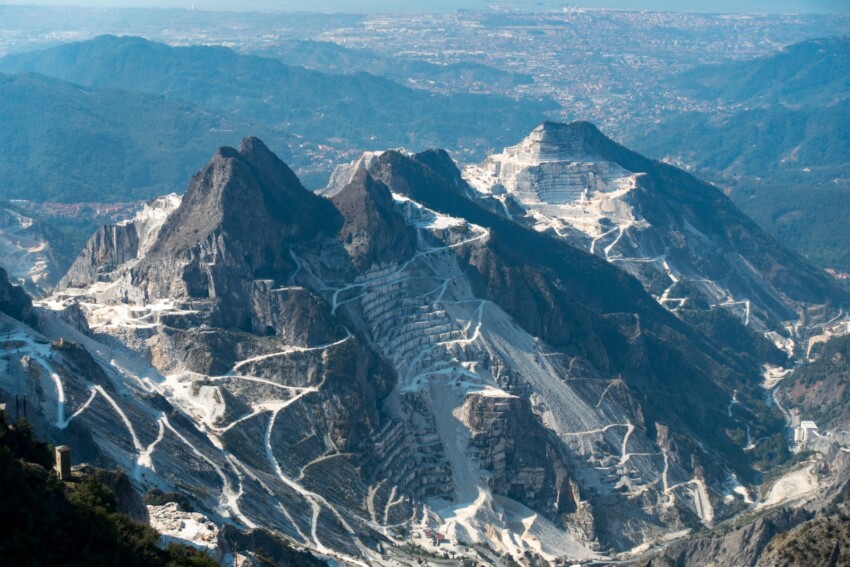
Poised between the sea and the mountains, Carrara is a city that has earned worldwide recognition thanks to its marble. Yet it doesn’t attract as many visitors as it deserves; but if you dedicate a weekend to it, you’ll discover an authentic, forthright town that still thrives on the legacy of its past, when marble extraction drew workers from across Italy to the city.
Visiting Carrara means stepping into an industrial and mining heritage that has partly faded but remains vibrant in other respects. Wandering through the historic centre is genuinely pleasant, thanks to the wealth of things to see packed into a relatively compact area. Yet Carrara is synonymous with marble, and today you can visit some of the region’s most important quarries, either on guided tours or completely independently.
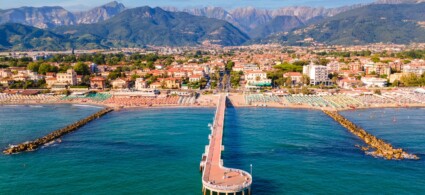
It’s also worth noting that Carrara sits just a few kilometres from the sea. Its coastal area corresponds to the locality of Marina di Carrara, lively and youthful especially in summer, when the streets fill up and its lovely beach becomes crowded. For this and countless other reasons, give Carrara a chance – you won’t regret it.
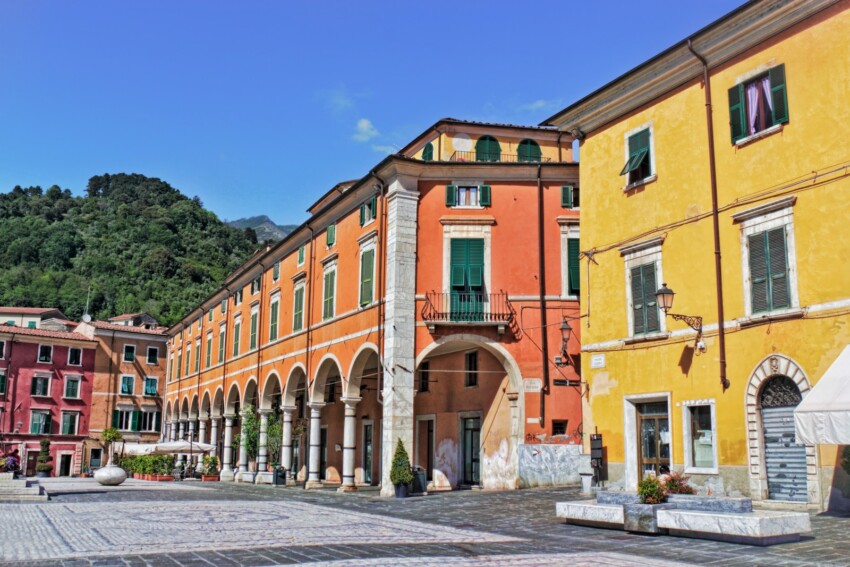
Carrara doesn’t have a reputation as an art city, but it certainly warrants a day or two’s visit before heading off to explore its remarkable marble quarries.
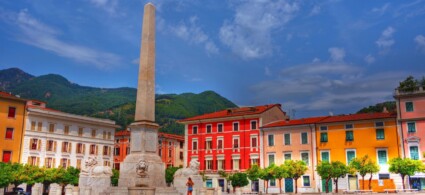
Carrara’s central square is Piazza Alberica, lined with numerous colourful buildings that sometimes feel more Ligurian than Tuscan. The rectangular plaza is dominated by its central fountain, topped by a neoclassical statue of the duchess Maria Beatrice d’Este.
On one side of the square stands the handsome Palazzo delle Logge, named after its distinctive wide loggia. Built in Renaissance style, it was the first palazzo constructed after the piazza was completed.
The Carrara Cathedral, officially the Insigne Collegiata Abbazia Mitrata di Sant’Andrea Apostolo, is the city’s most important place of worship. Located in the heart of the historic centre, it’s an ancient church: construction began in the 12th century and wasn’t completed until roughly 200 years later.
The façade is particularly striking, featuring a splendid rose window, as is the bell tower, built separately from the church. The campanile’s design is Ligurian in inspiration – similar bell towers can be found in Genoa. Inside, the cathedral surprises visitors by being almost entirely free of the frescoes and decorations typical of Italian churches, yet it possesses a unique charm nonetheless.
Among Carrara’s most celebrated palaces is the striking Palazzo Cybo Malaspina, also known as the Palazzo Ducale. Located in the historic centre, this medieval palazzo features the characteristic crenellations typical of castles from that era.
The building can be seen as two distinct sections: the Castello Malaspina and the main palazzo proper, done in Renaissance style. Today, it houses the Carrara Academy of Fine Arts, with library collections and remnants of the palazzo’s historic art collections.
Carrara’s history is inseparable from marble, and the Carrara Marble Civic Museum bears witness to this connection. Located at Viale XX Settembre 85, it was founded in 1982; its rooms and collections are devoted entirely to the production and working of marble.
The museum contains eight sections in total, ranging from geology to industrial archaeology, from artistic craftsmanship to modern sculpture. Opening hours are Wednesday to Sunday, 9am–12pm and 2–5pm. Tickets are purchased at the till, with discounts available for over-65s and groups of at least 10 people; children and students from the province enjoy free entry.
Colonnata, a hamlet nestled on the slopes of the Apuan Alps, is one of the most important things to see in Carrara: this small village is famous throughout Italy for producing lardo and for its majestic white marble quarries.
Despite being little more than a hamlet of just 300 inhabitants, Colonnata draws a considerable flow of visitors, largely thanks to its marvellous natural setting. Beyond exploring the historic village and sampling lardo in all its forms and textures, use it as a base for excursions into the heart of the Apuan Alps: numerous trekking trails of varying length and difficulty depart from here.
Carrara’s main attraction is its white marble quarries. Some are open to visitors, others are privately owned. Various agencies and tour operators organise guided visits, whilst others arrange different types of excursions on foot or in 4×4 vehicles. You can explore the basins of Colonnata, Torano and Fantiscritti, following the disused marble railway line.
Among the principal attractions of the marble quarries area, we’d highlight the Fantiscritti Quarry Museum6, created by Walter Danesi after more than 40 years of research, where you can admire life-sized sculptures that testify to how life was lived in this corner of Italy until the 1960s.
A visit to the Michelangelo Quarry7 is equally worthwhile, where, according to history, the famous sculptor obtained the marble for some of his greatest works. Inside, a vast Genesis mural has been painted by artist Gionata Nesi, known as Ozmo. The Michelangelo quarry tour will also give you insight into the gruelling work of quarrymen and allow you to admire splendid marble sculptures.
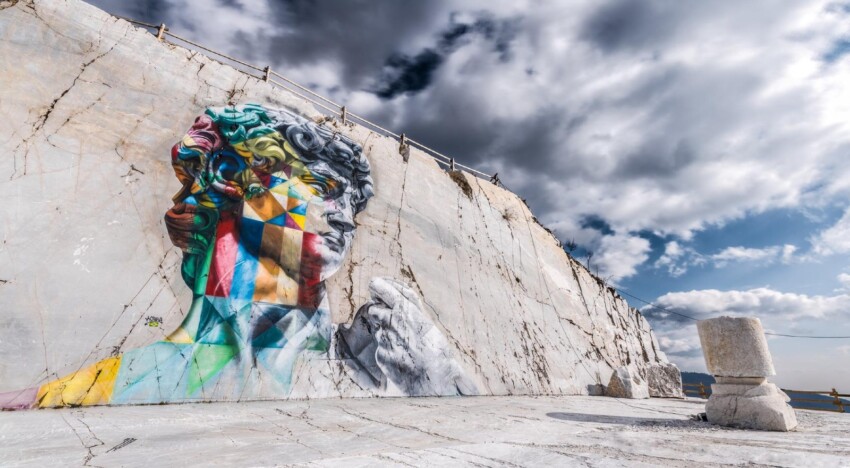
Finally, the last of Carrara’s unmissable marble quarries is Gioia Quarry8. You can reach it on an independent trek lasting about an hour and a half departing from Colonnata, or via a guided tour. At the quarry’s summit is an enormous mural depicting the head of Michelangelo’s David, created by Brazilian artist Kobra. This striking artwork has quickly become a symbol of Carrara and the entire region, so much so that Lonely Planet chose it for the cover of the latest edition of its Tuscany guide.
In the following map you can see the location of the main places of interest mentioned in this article.
Carrara isn’t known as a hotspot for wild nightlife, yet it has its trump cards. The town centre is relatively peaceful but has no shortage of venues for aperitivos, bars, restaurants, and pubs for post-dinner drinks. If you’re after a livelier scene, head to the coast at Marina di Carrara, where you’ll find beach clubs and nightclubs, alongside the usual late-night bars. Note that many of these are open only during the summer season.
Carrara’s centre is genuinely small and easily navigated on foot. Choose to stay here to be close to the quarries and have all the typical services of a town – supermarkets, pharmacies and shopping centres – at hand.
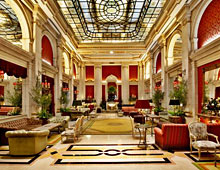
If you prefer to stay closer to the sea, head to Marina di Carrara, roughly 7–8 kilometres from the centre, where the atmosphere is noticeably more holiday-like and relaxed. Accommodation options abound here, mostly hotels, though in recent years several bed-and-breakfasts have opened.
Despite its position at Tuscany’s far north, Carrara is straightforward to reach, being well served by the A12 Genoa–Rosignano motorway. The exit you need is Carrara itself: from there it takes about 15–20 minutes to reach the town centre, following Viale XX Settembre along its entire length.
Florence is roughly 130 kilometres away, a journey of about one hour 30 minutes depending on traffic exiting the Tuscan capital – take the A11 Florence–Sea motorway first, then join the A12 at Viareggio. As for other cities, both Siena and Arezzo are about two and a half hours away, whilst coastal cities are closer and handily positioned relative to the A12: Livorno takes an hour, whilst Pisa and Lucca take about 50 minutes.
What's the weather at Carrara? Below are the temperatures and the weather forecast at Carrara for the next few days.
Carrara sits in north-west Tuscany, right on the border with Liguria, dominated by the Apuan Alps, which stretch out to the north.
 Hotel
Hotel 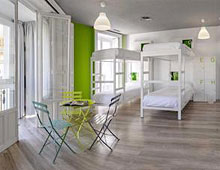 Budget accommodations
  Apartments
  Family Hotel
  Luxury Hotel
  Resorts