Castello Malaspina di Fosdinovo
Fosdinovo - Via Papiriana 2
Book now
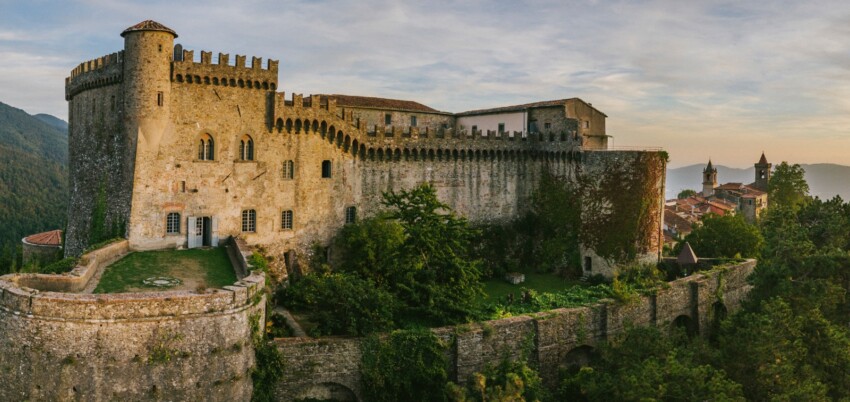
Fosdinovo still dominates today with its intact 14th-century structure, standing at 550 metres above sea level and commanding extensive views of the Tyrrhenian coast below, roughly ten kilometres away, and the Magra valley stretching behind it. Its position was ideal for controlling the outlet to the sea from the Lunigiana and its roads and Apennine passes, among the most heavily trafficked in the Middle Ages.
The origin of this name is disputed: some trace it to the ditch dug as a defence along the walls on the seaward side, others link it to the passage (the mouth) that opens from Fosdinovo towards the inner Lunigiana and the Apennines.
Until the 13th century, the most significant parties in this Consortium bore the names of the Erberia family and the Bishops of Luni, but towards the end of the century the Malaspina joined them, gradually gaining increasing importance until 1340, when one of them, Spinetta, became the sole owner of Fosdinovo.
He was responsible for building the greater part of the castle which, connected to the village walls, became the political and military centre of the Malaspina fiefdoms.
The Malaspina of Spino Secco (the main branch) were Ghibellines and generally had their castles on the right bank of the Magra river (Mulazzo, Tresana, Podenzana, Villafranca, etc.); whilst those of Spino Fiorito (the younger branch) had theirs on the left (Filattiera, Bagnone, Olivola, Fosdinovo, Massa, etc.).
Malaspina power lasted until 1800, and during this period created a signorial state renowned throughout the world for the many illustrious men of the dynasty. After various successions by the Este family from 1815 to 1848, Fosdinovo requested annexation to the Tuscan government in 1848, but in 1849 Francesco VI d’Este reclaimed it with a force of some 27,000 Austrians. Only after the popular uprisings of 1859 did Francesco VI abandon Italy, and in 1861 Fosdinovo was incorporated into the province of Massa Carrara and the Tuscan region.
Fosdinovo suffered greatly during the 1940-45 war: subjected to bombardment by Allied artillery to break through the Gothic Line, it sustained considerable damage. The intervention of a young man from Fosdinovo (Bonotti Ivaldo) who reached the Allied lines and informed them of the weakness of the German forces prevented the village from being devastated further.
Its hillside position, temperate climate and lush, shaded vegetation allow visitors to escape the summer heat of the city and enjoy the warmer months in tranquillity.
Long walks through the woods that encircle the village offer the chance for pleasant picnics or meals at the numerous restaurants scattered through nearby hamlets and along the local and provincial roads.
In recent years, the village has established itself as a retreat for football teams, precisely because of its peaceful setting and climate, as well as its quality accommodation able to meet the needs of even the most demanding clubs.
The earliest lords of Fosdinovo likely possessed only fortified family houses, each with a shared defensive tower, probably located on the very spot where the castle was later built.
The origins of the present structure cannot therefore be dated with precision: it certainly existed as a defensive work before 1200, and the construction of the castle’s most notable sections can certainly be attributed to Spinetta Malaspina the Great and his grandson Galeotto.
It is an imposing and complex structure. It has an approximately quadrangular base with a central courtyard. Four towers rise at the corners, connected in the oldest section by ramparts and crenellated walkways.
The building material is brick mixed with pieces of rough stone and extremely hard rocks known locally as “sassi rospari”.
It certainly once had a drawbridge before the present entrance gate, beside which you can see the loophole of the guard post.
Above the gate is a marble bas-relief depicting a seated dog holding the Spino Fiorito in its mouth: the emblems of Spinetta Malaspina and Cangrande della Scala, united by family ties and friendship.
The castle interior, whose oldest section is the “Piazzetta dei cannoni”, immediately after the main gate, contains many noteworthy and curious features which it would be pointless to list and describe here, as the castle’s own guide will do so. We shall merely recommend paying attention to the numerous frescoes (all executed in 1882 by the Florentine Gaetano Bianchi in 15th-century style, except for the one in the niche of Dante’s small room – depicting an Ecce Homo with one of the Malaspina setting out for the Crusades), the fine antique furniture, and the circular room of the “trabocchetto” in the southern tower, where a trapdoor once opened in the floor, offering a striking acoustic effect.
Also noteworthy are the castle’s impressive internal structure and its grandeur, further emphasised by the panorama that unfolds before visitors as they climb onto the fortress ramparts, between the Ghibelline crenellations.
What's the weather at Fosdinovo? Below are the temperatures and the weather forecast at Fosdinovo for the next few days.
To see all the facilities and book accommodation in Fosdinovo use the form below, entering the dates of your stay.
 Hotel
Hotel  Budget accommodations
  Apartments
  Family Hotel
  Luxury Hotel
  Resorts