Agriturismo Montagna Verde Apella
Licciana Nardi - via apella 11(Check in/out at Agriturismo Montagna Verde at via Apella )
Book now
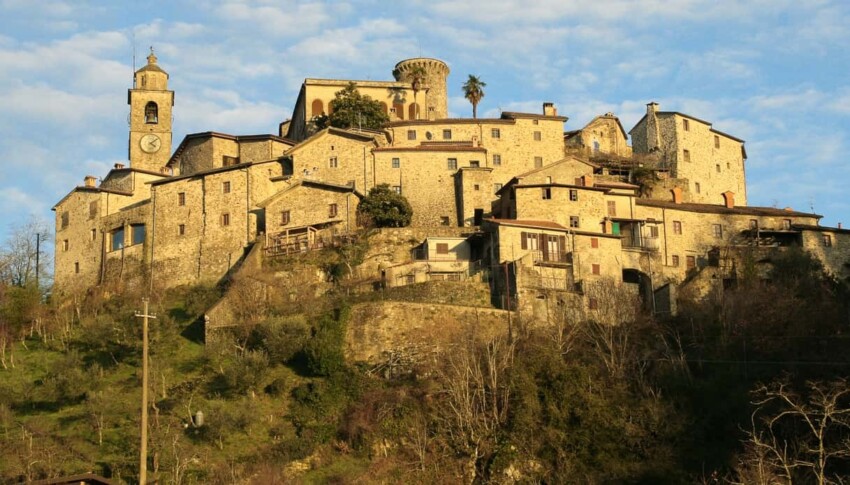
Rock carvings and statue stelae stand as silent witnesses to human presence in the Taverone Valley, dating back to prehistory itself. However, the valley’s strategic importance became evident from the 15th century onwards and remained so until Italian unification.
Four centuries of history are indelibly impressed upon ancient fortified houses, the walls of villages, noble palaces, sandstone portals, churches, and numerous stone shrines erected to protect pilgrims, as well as the blades of old mills now at rest.
Licciana Nardi is one of two communes nestled in the valley traversed by the Taverone. The river itself will be our guide—Taverone or Tavarano, as some prefer. It will lead us from the lower valley, characterised by cultivated land and surrounded by lush hillside groves. We’ll follow it in reverse through wheat fields and vineyards, into the middle valley where terraced olive groves reign supreme. Then we’ll climb to the upper valley to discover mountains clothed in centuries-old chestnut forests. An itinerary immersed in complete landscape variety: plains, hills, mountains, and just a few kilometres away, the sea.
And darkness is the realm of magic: witches’ sabbaths animate moonlit nights as they dance around the “Morian oak” within sight of the Pieve di Venelia, whilst processions of spirits wind through abandoned villages and a colossal dragon has protected hidden treasure in the Convent of the Holy Annunciation at Licciana’s gates for centuries.
Arriving from Aulla on the Cisa state road, after crossing the Taverone bridge, you’ll encounter the hamlet of Terrarossa (m. 75 a.s.l.).
The ancient centre stood on the hill above and is documented from the year 1000. The church dedicated to San Giovanni likely dates from that period, though it has been modified over time. Inside, visitors are drawn to a fine marble holy water font. The village is enhanced by several handsome buildings; a plaque commemorates the distinguished man of letters Igino Cocchi.
The castle stands on the state road. An interesting example of a fortified gentleman’s palace, it was built by Fabrizio Malaspina between the late 1500s and early 1600s and was never fully completed. Today it is undergoing restoration thanks to funds allocated by the European Union. We leave Terrarossa and head towards Monti, taking provincial road 70, known as the Taveroniana, which branches off from the Masero into the lush greenery of Fola.
The hamlet of Monti (m. 170 a.s.l.) is the result of various settlements. The archaic name of the parish, Venelia, is of Ligurian origin. The ancient settlement of Venelia was razed to the ground by barbarians. The church dedicated to Santa Maria was rebuilt after the devastating earthquake of 1920 destroyed it almost entirely. From the original Romanesque building, an evocative apse in pietra serena remains.
From the parish church you climb to the castle (m. 252 a.s.l.). The manor, surrounded by centuries-old oaks, has always been the home of the Malaspina family and is among Lunigiana’s most interesting feudal constructions. From the medieval building, enlarged and transformed into a noble residence with a 17th-century façade, important remnants have been preserved: the gateway with traces of the drawbridge, two towers and part of the defensive wall. The small village, once enclosed within the walls, deserves a visit. Returning to Monti, we leave Piazza Giarella behind and continue on provincial road 26 towards Villafranca, passing through Amola (m. 153 a.s.l.). The surroundings are pleasant and the paths leading to scattered houses, winding through greenery, follow the traces of an ancient mule track. Sunny hillsides welcome visitors and allow for peaceful horse-riding excursions.
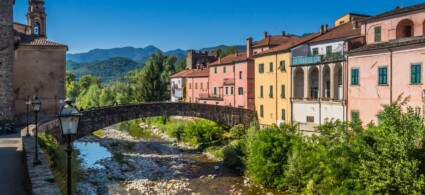
From Monti we continue on the state road towards Licciana. Leaving the town, on the right you’ll find the junction for Pontebosio (m. 149 a.s.l.). It takes its name from a bridge built by the Boso, Bosoni or more likely Bosi family, lords of Verrucola. In the square stands the castle (1600), formerly a noble residence, seminary and secondary school, which still hints at its past as a military structure. The parish church, in baroque style, was built by Ferdinando Malaspina to replace the old oratory. In front, close to the road, is the castle of Poderetto, built by the Malaspina of Podenzana. From the village, passing under the vault, you reach the ancient mill, its now-inactive millstones arranged around it. By the river lie the remains of an old paper mill. Although the state road leads directly to the main town, we recommend reaching Licciana Nardi (m. 210 a.s.l.) via the road that starts from the small square in Pontebosio and winds through the countryside, climbing up to arrive just above Licciana: from there you can admire the lesser-known part of the town, the section that overlooks the river flowing through a deep and evocative gorge. The first documented mention of Licciana dates from 1255, but its existence as a watchtower for the abbey of Linari certainly predates this. It is a typical example of a village that developed in the valley bottom with military defensive functions. The Malaspina, who succeeded the Maregnano family, took charge of fortifying the town.
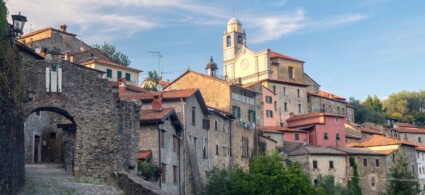
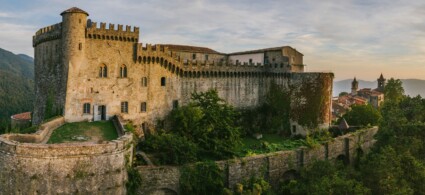
In 1535 Licciana, by imperial privilege, became the sole signory of the Villafranca marquessate. The castle overlooks the main square, transformed in the 15th and 16th centuries into a fortified palace and residential seat; today it appears as a noble palace in 16th-century style, connected by an elevated passage to the church’s gallery. Licciana’s ancient fortifications system included the fortress and an extensive circuit of bastioned and turreted walls, still partly surviving, and a fortification on the opposite bank of the Taverone, called the Piano castle, an interesting example of military architecture. The village, dating to the 13th century, features well-crafted sandstone portals and opens onto the Town Hall square where the ossuary monument of Anacarsi Nardi stands. Opposite is the parish church dedicated to Saints James and Christopher, which was destroyed by the marquess Giacomo Malaspina. Its reconstruction, completed in 1705, features a Greek cross plan with a dome at its centre. Inside are preserved valuable paintings from the Convent of the Holy Annunciation, which was built in a chestnut forest not far away in the 14th century and has been in ruins since 1797 when the friars were expelled. Just as you enter town, on the left, a road leads to the hamlets of Salano, Panicale and Villa di Panicale.
Panicale (m. 286 a.s.l.), is an ancient Obertenga court. On 10 February 1119, Otto of Maregnano celebrated the peace treaty with the monks of San Prospero of Reggio at the castle, ending the long dispute over the court of Naseta. Of Panicale’s old fortifications, one of the gates of the castle precinct and the ruins of a keep remain. The fortress, restored and transformed into a noble palace between the 15th and 16th centuries, is today the residence of the Medici family. Until the 1500s, Panicale was one of the valley’s most important towns.
From Licciana, following a stretch of provincial road 21 towards Fivizzano and climbing towards the terraced olive groves, you arrive at Bastia (m. 489 a.s.l.). From there the landscape is magnificent: you overlook the entire valley and the view alone justifies the trip to the castle. But the village and manor reward the visitor further. The fortress of Santa Caterina has a quadrangular plan, comprising a central keep and four corner towers united by defensive walls. Construction dates from the end of the 13th century and displays all the characteristics of military structures of that period. Many prominent figures lived in Bastia, including a lady, the beautiful and cultured Marchesa Anna Malaspina of the Mulazzo branch, who was a rival to the enchanting Marquise of Pompadour. From Bastia, continuing for about three kilometres, you reach Cisigliana (m. 601 a.s.l.). The town stands near the Torre del Nocciolo and was a “Castellar” or perhaps a medieval fortress and also includes the hamlet of Paretola. On the left side of the current parish church, the Romanesque apse of the old church is visible. We descend again towards Licciana and from there continue on the state road to the junction at Maestà where we proceed towards Tavernelle.
After about a kilometre, you turn left and arrive in moments at the small square of Varano (m. 418 a.s.l.), which from the 15th century was the seat of an Este podesteria. Walking through the village, you immediately appreciate its former importance. The church of San Nicola di Bari is noteworthy: inside, besides an ancient stone baptismal font, there is a 14th-century polyptych depicting the Madonna between San Nicola and the Archangel Michael, a work by the Luccan artist Angelo Pucinelli.
Following the Taverone stream, you arrive at the hamlet of Tavernelle (m. 412 a.s.l.). Don’t be fooled by the recently built houses along the road: rich in historical echoes, Tavernelle is indeed one of Lunigiana’s oldest and best-preserved villages. Splendid portals and windows framed in sandstone present themselves to visitors as precious evidence of past craftsmanship. The small church of San Rocco is also situated in the village; as early as the 1500s, locals here requested to have mass celebrated. Only after the Second World War, however, was Tavernelle officially declared a parish.
As you climb higher, the air becomes thinner and the Apennine chain draws ever closer. Inhabited by only dozens of people, the hamlets of Taponecco (m. 610 a.s.l.) and Apella (m. 672 a.s.l.) were once quite populous. Today they constitute the last two settlements in the Licciana municipality. The first certain historical records of these two centres date from 15th-century statutes.
The village of Taponecco, entirely under vaulted passages, is a jewel enriched by arches, vaults and pillars. The fortified tower, incorporated into the former rectory as the bell tower, is in visual alignment with the towers of Varano and Nocciolo. And the magic of a visit to Taponecco grows when you know that its origins are far more ancient than the village itself. Irrefutable testimony of human presence in prehistoric times comes from the discovery of a statue stele, found by chance in 1975. These menhir statues, numerous throughout Lunigiana, have also been brought to light in Licciana and Monti. Though their origins remain shrouded in mystery, they presumably date back to forms of ancestor worship practised in prehistoric times.
From Taponecco the road climbs further, branches off and one fork leads to Apella. The village is almost entirely abandoned. Worth noting for those interested in the Risorgimento is the house that gave birth to lawyer Biagio Nardi, dictator of Modena during the popular uprising of 1832, and his nephew, Anacarsi Nardi, shot in Calabria in 1844 alongside the Bandiera brothers, whose remains were transferred to Licciana in 1910 and placed in the ossuary monument opposite the Town Hall in 1919. In 1933, to honour the memory of this hero, the municipality took the name Licciana Nardi. Some like to call Licciana a “haven of heroes” because in addition to Nardi, it also gave birth to Alceste De Ambris, a revolutionary trade unionist of the early 20th century. Among notable figures in local culture we should mention Ubaldo Formentini, Igino Cocchi and the poet Marco Vinciguerra.
To see all the facilities and book accommodation in Licciana Nardi use the form below, entering the dates of your stay.
 Hotel
Hotel  Budget accommodations
  Apartments
  Family Hotel
  Luxury Hotel
  Resorts