Tenuta Zamparina
Montignoso - Via Guadagni, 6
Book now
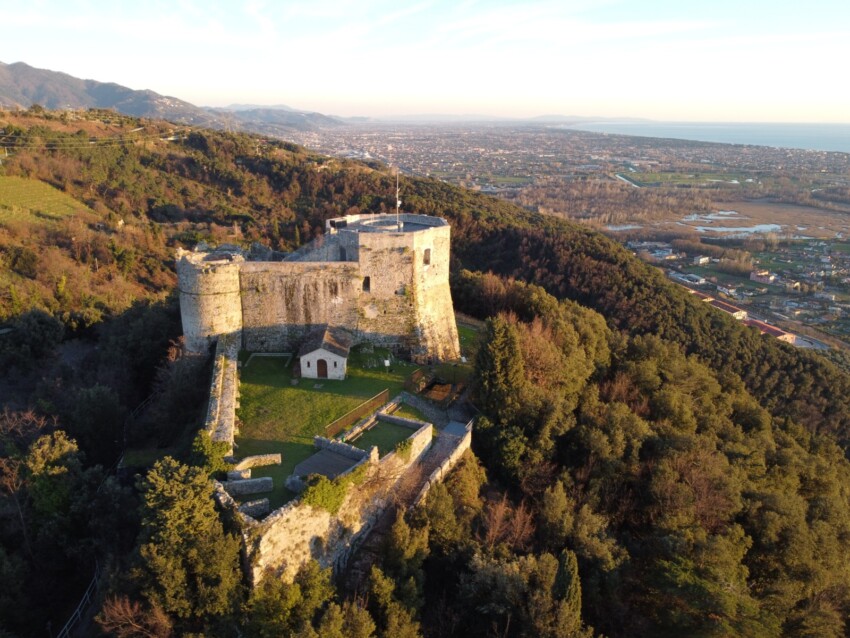
The origins of Montignoso stretch back into the distant medieval period. The earliest records date from 753, when Astolfo, King of the Lombards, donated an olive grove near Castello Aghinolfi to his brother-in-law Anselmo, founder and first abbot of Nonantola Abbey (MO). The oil from these olives was intended to fuel the lamps in the Church.
The Castle, or Fortress as the residents of Montignoso prefer to call it, undoubtedly has more ancient origins and has always been an essential point of reference. It served as a secure bulwark protecting the small hamlets scattered along the Montignoso Canal.
As for the area’s earliest inhabitants, an ancient tradition suggests that some corsairs, who landed on the beaches and pushed inland, built a village called Corsanico, named after themselves. Local residents still consider this the oldest settlement in the Montignoso area. Another account claims that around 577 AD, a group from Luni established Montignoso as a place of exile for criminals.
Whether these accounts are true or false, it is certain that when Luni began to decline due to Barbarian invasions and an unhealthy climate, many of its inhabitants sought refuge in the nearby mountains, where they built huts and houses. Perhaps something similar happened to Montignoso? (G. Sforza – Historical Memoirs of Montignoso).
The people of Montignoso have always been deeply religious, as evidenced not only by the Pieve di San Vito—built before the year 1000 and demolished in the early 19th century (it stood near the Massa side of our cemetery, which is named San Vito)—but also by other churches and oratories scattered across the hamlets of Capanne, Piazza, Prato, Cerreto, San Eustachio and Vietina. Unfortunately, during the Second World War, the territory endured seven months of aerial bombardment and naval shelling by the Allies. As a result, only the Church of San Eustachio and a few other chapels survived. The current churches of San Vito and Santa Maria della Rosa and others are essentially reconstructions of their predecessors.
Montignoso takes pride in having been the birthplace of many illustrious men: Niccolao Giorgini (1773–1854), for instance, became head of the Regency of the city of Lucca on behalf of Leopold II. Cesare Bertagnini (1827–1856) distinguished himself in chemistry from a young age and wrote foundational essays on the subject. Giovanni Sforza (1845–1922) was a historian and archivist of great talent, and his son Carlo Sforza (1872–1952) entered the diplomatic service in 1896, holding numerous posts in Cairo, Paris and Peking. He served as Foreign Minister several times and was made Senator and Ambassador to Paris in 1919 until the rise of fascism. He was responsible for signing important treaties, including the Treaty of Rapallo with Yugoslavia, and made significant contributions to Italy’s adoption of the Marshall Plan and the Atlantic Pact. In 1948 he was still a Senator and died in this office in Rome.
Worth noting too is Villa Schiff Giorgini, a noble 19th-century residence with gardens and marble statues, situated in the narrow valley that rises from the sea towards the heights of the Apuane Mountains. It now serves as the seat of the Municipality of Montignoso.
The Giorgini family was one of the most prestigious families in the area, embodying an ancient nobility whose most notable members left their mark on the political, cultural and scientific world of the time. There are also memories of Alessandro Manzoni, whose daughter Vittoria married Senator Giovan Battista Giorgini.
From that era, the building itself remains, along with its distinctive architectural layout and, most importantly, the park, whose centuries-old plants continue to make the place particularly welcoming.
The second Renaissance altarpiece in Montignoso is located in the Church of San Eustachio and is dated 1495, as can still be clearly read today on the painted base step. It also bears notable fragments of the names of the Saints, and from this base two figures allow a foot to protrude, following the customary perspective device.
The subject is again the Virgin enthroned with Child, flanked by Saints Eustachius, John the Baptist, Mary Magdalene and Vito, united in a single panel according to a more modern conception than the earlier triptych. The altar is completed by a lunette featuring a blessing God the Father between two Angels.
The predella depicts scenes from the life of the patron saint (Eustachius), with a Lamentation at the centre and Saints Paul and Peter at the sides. These episodes are rich in narrative power, set within expansive landscapes. They recount fantastic episodes from the Saint’s life involving animal figures—the stag bearing a cross between its horns, the lion that spares the family of the converted pagan, and the hollow bronze idol shaped like a bull in which the protagonist was confined and martyred by fire for refusing to worship this sacred simulacrum.
Both painters, known until recently by the conventional names Master of Stratonice and Master of the Immaculate Conception, are Lucchese artists among the principal interpreters and disseminators of that figurative language which spread throughout Lucca in the second half of the 15th century, drawing inspiration from Botticelli, Ghirlandaio and Filippo Lippi.
In the same Church of San Eustachio is a splendid wooden Madonna and Child, datable to the early years of the 14th century. It was recently attributed to an artist from the circle of Giovanni Pisano (Tino di Camaino) or perhaps by the master himself.
This work was created with broad chisel strokes, carved in a single flowing execution. The Madonna is seated and the Child, holding a book in his left hand and raising his right hand in blessing, stands upright, leaning on his mother’s leg, which she supports with her hand.
Besides these works of undoubted artistic merit, the territory is also rich in “small shrines” or “majesties” as the locals prefer to call them, of considerable quality. All are now catalogued and stand as witnesses to the spiritual journey and religious devotion of people through the ages.
The most distinctive feature of the territory, which was already frequented by the ancient Liguri-Apuani, is represented by Castello Aghinolfi, a powerful early medieval fortress. Careful restoration work has revealed the different construction phases, which remain visible and are documented on site with explanatory panels.
Villa Schiff-Giorgini is instead a 19th-century residence that was once frequented by figures from culture and politics, including Massimo d’Azeglio. Today it houses the municipal headquarters and its large park, rich with centuries-old plants and marble statues, is open to visitors.
Porta Beltrame bears witness to the passage of the Via Francigena and characterises the area as interesting crossroads and border territory.
The town can boast works of particular artistic richness preserved in its churches. In the parish church of San Vito and Modesto, located in Piazza, there is an altarpiece triptych by the Lucchese painter Michele Ciampanti from 1482, depicting the Madonna with Child between Saints John the Baptist, Vito, Modesto and Peter.
The painted altar is a work of clear merit and quality, shining with clear beauty in its compositional simplicity. It features a central panel with the Virgin enthroned and a Child rendered in Renaissance taste and style, accompanied by two charming little angels on either side.
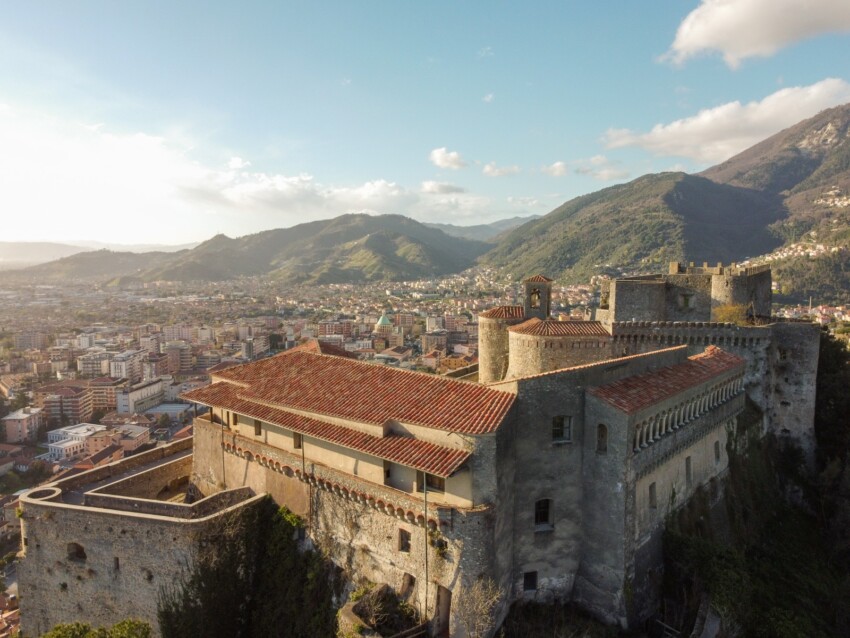
The most distinctive feature of Montignoso’s territory, already frequented by the ancient Liguri-Apuani, is represented by Castello Aghinolfi, a powerful early medieval fortress and one of Italy’s oldest manor houses. It stood as a defensive position for the area and was a fortress never conquered.
In the medieval period, Castello Aghinolfi held particular strategic importance and was fiercely contested and coveted through centuries of conflict by the communities of Lucca and Pisa, by the bishopric of Luni, by the Malaspina and their blood relatives the Marquises of Massa. Written sources testify to the existence of the fortress during the early medieval centuries. A parchment dated 753, authentic in its contents though a later reworking of the original document, mentions an olive grove situated near “castellum Aginulfi”.
The antiquity of the document (the oldest record regarding the castle, considered authentic, dates from 764) and the place name, which is clearly of Lombard origin, led Alfredo d’Andrade, a great expert in 19th-century medieval architecture, to consider the octagonal keep one of Italy’s most interesting Lombard military monuments.
The fortress, enclosed by an extensive post-medieval wall, features a complex internal layout comprising a residential area, the old village, and a more strictly military area, characterised by the presence of the keep.
The panoramic road from Montignoso to Strettoia traverses the entire hill on which Castello Aghinolfi stands.
Near the summit, a dirt track leads directly to the imposing ruins of the castle. Amid thick vegetation, a large spur appears—the extreme northern point of the fortified complex. A guardhouse, supported by corbels still visible today, was positioned here. Inside the bastion is a tower with a semicircular base.
The access road skirts the bastion, built on a rocky cliff. It is on this flank, approximately 50 metres from the spur, that the castle entrance is found, once defended by a bretèche.
You then enter the first courtyard, delimited by an extensive wall with flanking towers.
Numerous buildings were located within this courtyard, serving as shelters for Montignoso’s inhabitants in case of danger. Some traces of these modest structures can still be seen today. Proceeding southward, after passing through a double bend, the road reaches the castle’s upper section via a path carved directly into the rock and protected toward the sea by a parapet.
At the end of the ramp stood a gate, no longer visible, protected by a drawbridge, which led to the innermost part of the castle—a second courtyard around whose perimeter numerous dwellings had been built. Beyond this gate, on the left, lay the parade ground, triangular in shape, distinguished by a crenellated passage supported by numerous arches and dominated by the keep, a substantial building with an octagonal base connected to a circular-based tower via a curtain wall.
This intricately arranged element forms the southern side of the parade ground, where you can still see the remains of a modest rectangular chapel. The most interesting architectural feature of the fortified complex is the substantial octagonal building, recognizable also as the oldest. Although written documentation attests to the presence of a fortified structure as early as the 8th century, the octagonal structure can chronologically be dated to the early centuries of the late medieval period and seems to reveal certain characteristics, such as horizontal bicoloured banding and the internal dimensions of the structure, typical not only of military but also of residential architecture.
The octagonal structure was connected via a curtain wall to the circular-based tower, referred to in the documentation as the “Bastion of San Paolino”. Access to this complex was gained by a retractable ladder placed between the earthwork and the octagonal structure, later replaced by a small stone staircase, visible in 19th-century depictions and no longer extant today. Once you reached the earthwork, you could access the Bastion of San Paolino.
The “Bastion of San Paolino” is distinguished by remains of crenellation and a spiral staircase that, descending into the structure’s interior, leads to a wide opening from which the exterior of the walls could be monitored. From the earthwork, you gain access to the interior of the octagonal building.
Internally, this structure, referred to in the documentation as the “Bastion of San Francesco”, is distinguished by the presence of a circular tower, upon which part of the load of a continuous ring vault rests, the other half of its weight discharged onto the perimeter wall. The vault, preserved only partially, supports a walkable floor, a terrace, whilst the circular tower, not perfectly concentric, rose higher than the octagonal building and served as a watchtower. It is precisely this broad visibility, extending from the top of Castello Aghinolfi across the Tuscan coast all the way to the Ligurian coast, that characterises this important fortress.
Within the architectural complex, structures from different historical periods can be identified.
The octagonal tower appears to date to the early centuries of the late medieval period. Recent dating of charcoal fragments embedded in the mortar suggests the construction dates between the mid-11th and mid-12th centuries. During that period, Castello Aghinolfi consisted solely of the massive tower, which served both defensive and probably residential functions. Among the ruins, no appreciable remains of properly 14th-century structures are visible, though some repairs to the walls of the octagonal structure can be attributed to this period. The castle appears to have been substantially modified in the 15th century, to which the architectural appearance that currently distinguishes it might be assigned. A large circular-based tower, together with an earthwork, served the specific purpose of defending the ancient octagonal structure on its mountain-facing side, which now assumed the function of keep. The complex thus comprised a broad fortified perimeter, referred to in written sources as the first enclosure, and a second enclosure. 16th-century documentation refers to the existence of numerous dwellings, around 130, within the two enclosures, of which only the foundations are visible today. The houses had been built by Montignoso residents as refuges in case of danger and for this reason contained stores of grain, wine, oil and dried meat.
In 1585, the upper section of the keep was demolished, deemed more of a liability than an asset.
By the end of the sixteenth century, the parade ground had been reorganised through the demolition of buildings adjacent to the keep and, probably, the construction of the eastern perimeter wall, complete with the parapet walk and access points to the underground corridor.
The fortress of Montignoso held such strategic importance for the Lucchese by the late sixteenth and early seventeenth centuries that further fortification work was required, particularly to protect the eastern flank, where enemy artillery could have inflicted serious damage. However, the construction of new walls would have been prohibitively expensive, costing some three thousand scudi, and a commission appointed to oversee the work preferred to spend a modest sum reinforcing the existing structures instead.
There are no records of any work carried out on the castle after the seventeenth century, and it subsequently fell into ruin around the middle of the eighteenth century.
Carlo Lodovico di Borbone, Lord of Lucca, purchased it with the intention of restoring it, but his project came to nothing.
Recent research undertaken on the castle in recent years has rekindled interest in the monument and has committed Montignoso’s Municipal Administration to a substantial restoration and enhancement programme. Archaeological and archaeometric research, undertaken in tandem with restoration work, has led to the discovery of important evidence and the acquisition of specific knowledge about medieval construction techniques. In particular, ongoing investigations have uncovered the remains of what may be a quadrangular wall structure predating the octagonal one, dated through archaeometric techniques to the Carolingian period. The findings of the research and the results of the restorations are brought together in a permanent exhibition dedicated to the castle’s history.
Leaving S.Eustachio and Cerreto behind and making your way along a road lined with chestnut woods, where hawks, buzzards, pheasants and foxes are commonly spotted, you arrive at Pasquilio (800 metres altitude), where you can enjoy an incomparable panorama stretching from the mountains to the sea.
From here, the entire Apuan Riviera coast is visible, from Viareggio to the promontory of Monte Marcello, the Palmaria island, and on the clearest, brightest days you can make out the larger islands of the Tuscan Archipelago and even Corsica in the distance.
This is a mountainous area much frequented for outings and walks.
This location was particularly beloved by Enrico Pea, remembered by locals with a marble bust, by poets Giuseppe Ungaretti and Eugenio Montale, and by painter Mino Maccari.
Behind Pasquilio rises the imposing Monte Carchio, once the site of marble quarries now abandoned but still bearing the distinctive pale colour of marble.
Surrounded by chestnut and fir woods, it is an ideal spot for picnics for those seeking a little respite during the hot summer days.
During the Second World War, this summit was crossed by the Gothic Line, the boundary between German and American forces and the scene of brutal clashes that caused considerable casualties among both the civilian population and partisan formations, which had formed following 8 September.
Venturing inland from the coast, you encounter the Lago di Porta, a wildlife sanctuary managed by the WWF and Lega Ambiente, where many species typical of the area have been reintroduced, thus preventing their complete extinction.
It is part of the Regional System of Protected Areas (L.R. 49/95) as a Locally Protected Natural Area (A.N.P.I.L.).
It forms part of Natura 2000, a network of European natural heritage sites, designated as a Special Protection Zone. This recognition is due to the presence in the wetland of the Eurasian Bittern (Botaurus stellaris), a rare heron throughout Europe and protected by European Community Directives.
The Lago di Porta represents Tuscany’s northernmost surviving coastal wetland, having escaped the land reclamation schemes that progressively reduced the marshes that once characterised the Tuscan coast in historical times. Squeezed between the Apuan Alps and the Versilia shoreline, the lake was for many centuries a strategically important area for controlling the coast and the principal roads connecting Pietrasanta and Massa.
The lake is fed by springs that rise at the foot of the Rupi di Porta; the water from the spring near the Torretta Medicea maintains a constant temperature of around 17° C.
The wetland area, preserved by embankments, is largely covered with common reed (Phragmites australis) and the stretches of open water (known as “chiari”) are modest in size.
Around the reed bed and the lake bed, a recently formed woodland has developed, remarkably similar to the historical wetland environments of Versilia, comprising tree species typical of marshy areas: black alder (Alnus glutinosa), various species of willows (Salix sp.pl.) and poplars (Populus sp.pl.).
In small areas, damp meadows still persist, characterised by the presence of sedges (Carex sp.pl., Cyperus sp.pl.) and rushes (Juncus sp.pl.). In these habitats lives a very rare and endangered butterfly, the Lycaena dispar.
Thanks to the variety of habitats found here, around one hundred species of birds can be spotted throughout the year, whether resident, migratory or present only during the breeding season. Specific studies highlight the importance of the area for certain species dependent on the reed bed: Moustached Warbler (Acrocephalus melanopogon), Western Marsh Harrier (Circus aeroginosus), Purple Heron (Ardea purpurea), Little Bittern (Ixobrychus minutus) and Savi’s Warbler (Locustella luscinioides).
The lake is one of Italy’s most important areas for the pre-migratory autumn stopover of the Barn Swallow (Hirundo rustica): at dusk, hundreds of thousands of birds gather over the wetland to feed and use the reed bed to roost overnight.
The wetland is also home to amphibians (green frogs, tree frogs, crested newts), reptiles (green lizards, grass snakes, marsh terrapins), fish (bleak, chub, carp, pike and others).
What's the weather at Montignoso? Below are the temperatures and the weather forecast at Montignoso for the next few days.
To see all the facilities and book accommodation in Montignoso use the form below, entering the dates of your stay.
 Hotel
Hotel  Budget accommodations
  Apartments
  Family Hotel
  Luxury Hotel
  Resorts