Bestseller
Pisa: Entrance Ticket to Leaning Tower & Cathedral
From 24,00 €
Buy the ticket
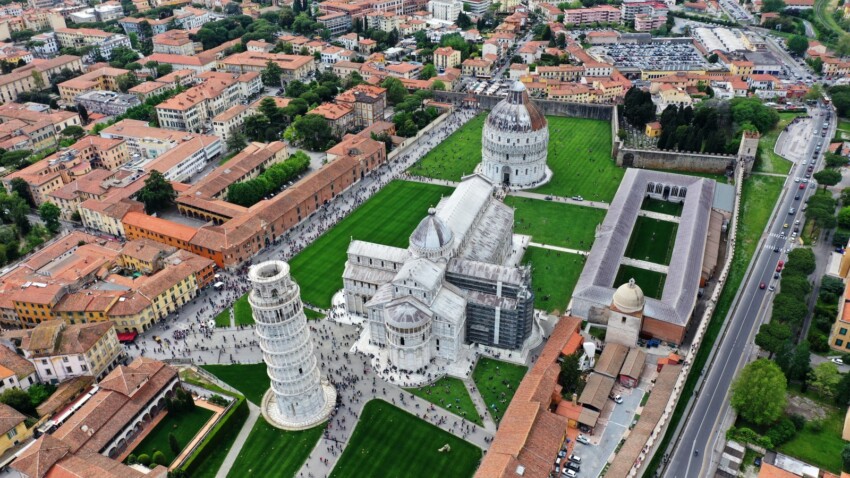
Piazza del Duomo, more commonly known as Piazza dei Miracoli, is Pisa’s tourism epicentre. This modest green square is home to the city’s finest monuments: the Leaning Tower that everyone wants to see, the Cathedral that gives the square its name, the Baptistry of San Giovanni and the Monumental Cemetery. Alongside these celebrated attractions are two lesser-known but worthwhile sites: the Cathedral Museum and the Sinopias Museum.
This remarkable square isn’t located in the city centre, as is the case with many other cathedral squares throughout Italy, but rather in a north-western area of the historic core. It remains easily accessible, nonetheless.
The unofficial but now established name Piazza dei Miracoli owes itself to Gabriele D’Annunzio, who celebrated the beauty of this place in his writings.
Square or Campo?
Many travel guides refer to Pisa’s most famous square by the name Campo dei Miracoli. The term is technically incorrect, however, as Campo dei Miracoli is a fictional location in Carlo Collodi’s celebrated novel “Pinocchio”. The confusion likely stems from the fact that in many Italian cities, including several Tuscan ones, the word campo is synonymous with piazza.
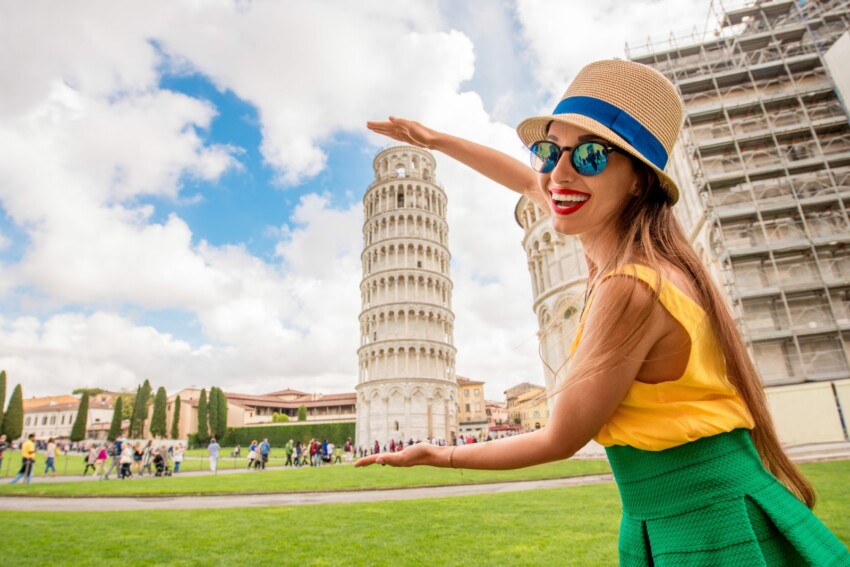
The Leaning Tower is the reason 99% of tourists visit Pisa: it’s an iconic monument, symbol of Italy itself, and rightly considered one of the country’s unmissable attractions; millions of people visit it each year.
It’s a bell tower in the Pisan Romanesque style with an unusual structure, comprising two concentric cylinders connected by an internal spiral staircase. The outer cylinder is adorned with six storeys of elegant loggias featuring arches and columns. Inside the bell chamber are seven bells: the largest weighs over three tonnes! The total height is 58.36 metres.
Construction began in 1173 and continued for two centuries. Despite its name, the tower never served a defensive purpose: it was built as the cathedral’s bell tower and remained so throughout the ages.
The story of the Leaning Tower of Pisa is well known: it began leaning almost immediately during construction due to the porosity of the ground beneath it. As early as the 13th century, attempts were made—unsuccessfully—to compensate for the tower’s tilt, and over the centuries it continued to lean until it reached the dramatic angle that made it famous worldwide.
By the early 1990s, the lean had reached 5.4 metres and was deemed dangerously unstable, forcing the tower’s closure to visitors. Thanks to significant engineering work and mighty steel cables, it was possible to restore the tower to an angle of inclination similar to that of several centuries earlier, deemed sufficiently safe. With the risk of collapse averted, the tower reopened to visitors in the early 2000s.
Modern techniques would allow the tower to be completely straightened, but who would then bother visiting it? The world has become fond of the Leaning Tower of Pisa as it is—a straight tower would seem artificial, out of place. And besides, where’s the fun in pretending to hold up the Tower in a photograph?
Having become Pisa’s symbol, so much so that it’s referred to by the city’s name, the Tower is in fact merely an “accessory”, so to speak, of the Cathedral of Santa Maria Assunta.
This is Pisa’s most famous church, a magnificent cathedral in the Pisan Romanesque style. It’s distinguished by an elegant façade with black and white stripes that vaguely recall Arab architecture, and a profusion of decorative elements blending Norman, Byzantine, Early Christian and Arab styles. The inclusion of Oriental elements testifies to the flourishing commercial relations that the Maritime Republic of Pisa maintained with Islamic countries.
The result is a true architectural masterpiece: this captivating blend was highly innovative for its time.
The cathedral’s interior is no less sumptuous and certainly deserves a visit. Among the precious artworks housed within, the pulpit by Giovanni Pisano stands out.
Construction of the Cathedral began in 1063 and proceeded in two phases, the first directed by architect Buscheto and the second by Rainaldo; the church was consecrated in 1118.
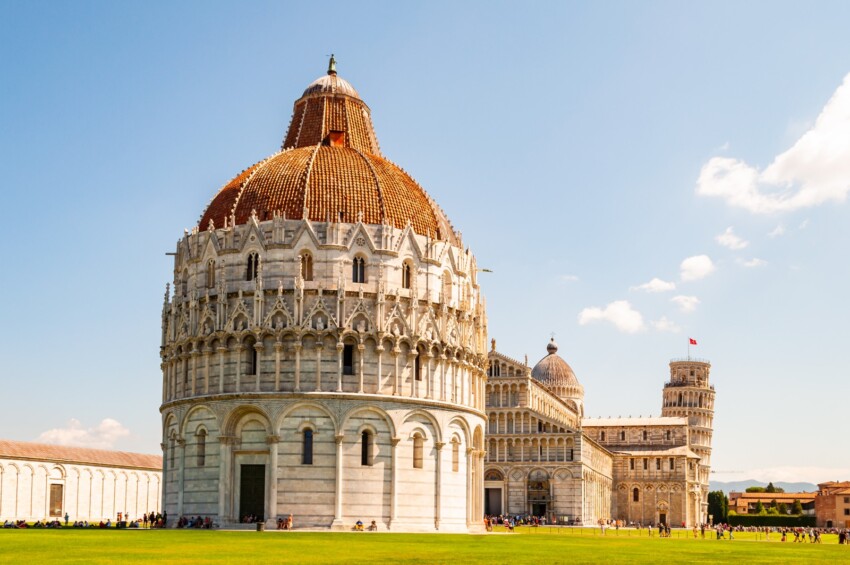
The third architectural wonder of the Piazza dei Miracoli complex is the Baptistry of San Giovanni, an elegant structure crowned by an imposing dome positioned facing the cathedral’s façade. Though distinct, the two buildings are united by the same spiritual and religious function and perfectly harmonised in terms of dimensions, materials and styles.
The original core of the Baptistry was built in the second half of the 12th century under the direction of architect Diotisalvi; two centuries later, the magnificent baptismal font by Guido Bigarelli da Como was added and the exterior was embellished.
Pisa’s Baptistry is renowned for its exceptional acoustics, a taste of which you’ll experience during your visit to the monument. Every 30 minutes, the staff performs a brief vocal intonation that demonstrates the sound effects produced within the dome.
Set somewhat apart from the other monuments of Piazza dei Miracoli stands the Monumental Cemetery, the most recent of the square’s architectural masterpieces. Recent in relative terms: it was founded in 1277 and represents one of the oldest medieval buildings specifically designed for the burial of the dead.
With the construction of the Monumental Cemetery, the tombs of Pisa’s most illustrious citizens, which were scattered around the Cathedral, were brought together in a single, specially created and demarcated area surrounded by a long marble wall. The remains of the most important figures were placed in the central garden, whilst those of less prominent individuals are housed beneath the arcades.
The interior walls of the Cemetery are adorned with precious 14th-century frescoes; the most significant is “The Triumph of Death” by Buonamico Buffalmacco.
In the following map you can see the location of the main places of interest mentioned in this article.
To visit the interiors of Piazza dei Miracoli’s attractions, you’ll need to purchase tickets: choose the one that suits you, depending on your available time and interests.
Select the attractions you wish to visit and: you can purchase the ticket for entry to the Tower and Cathedral, or book entry to all attractions (Leaning Tower of Pisa, Cathedral, Baptistry, Cemetery, Sinopias Museum and Cathedral Museum).
For a more complete and organised visit to Pisa, opt for the guided tour: it includes entry tickets and an authorised local guide who will show you every corner of Piazza dei Miracoli.

 Hotel
Hotel  Budget accommodations
  Apartments
  Family Hotel
  Luxury Hotel
  Resorts