Camere Zimmer Rooms San Francesco
Buti - Piazza San Francesco 2
Book now
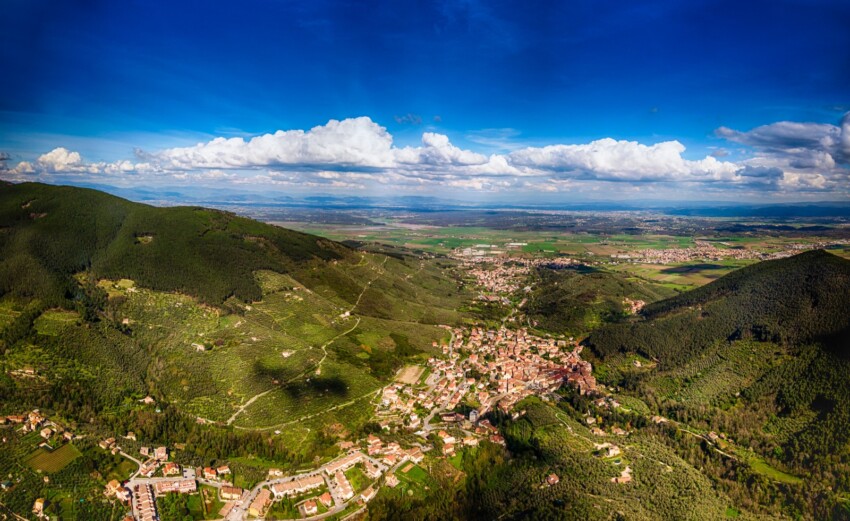
Buti, a small town nestled on the eastern slopes of the Pisan Mountains, has very ancient origins, probably dating back to Roman times.
However, these origins are barely visible today, as Buti was completely destroyed, burnt and rebuilt several times over the centuries during the violent wars between Pisa, Lucca and, finally, Florence.
The earliest reliable records of Buti date back to the year 1000, when it appeared as a centre surrounded by numerous fortifications known as “castles”: Castello di Panicale, Castello di Farneta, Castello di S. Stefano in Cintoia, Castel di Nocco, Castel Tonini, Castel S. Giorgio and Castello di S. Agata.
Whilst some of these have since disappeared or been reduced to ruins, others retain the compact structure and character of the medieval settlement.
Today Buti is a town of 5,500 inhabitants and comprises two residential centres: Buti and Cascine, connected by a road that runs alongside the Rio Magno and passes through the locality known as “La Croce”. Along this road, starting from Cascine and looking to the right, you can spot the Villa di Badia, a reminder of an ancient monastery. This is the Cintoia Abbey, which achieved considerable prestige in the 12th century when it was entrusted to the Camaldolese friars, but which inevitably fell into decline over time.
The vibrant associative life, numerous recreational clubs, and continuous local festivals and events (including the Frog Festival held in Cascine di Buti in June), combined with an important theatrical season, make Buti an interesting and stimulating place to visit and explore. This is further enhanced by the wealth of pine and chestnut woods that make for pleasant walks along the marked trails, or cycling along the 25 kilometres of cycle paths created by the municipality.
Castel Tonini is the castle that still overlooks the town of Buti today, and the entire historic nucleus surrounding it is known as “the castle”. It is bounded by an entrance gate and features several palaces dating from the 16th and 17th centuries. The most important of these is the Tonini family palazzo, which boasts rooms decorated by Giarrè and is known as Villa Medicea, built by the Medici around 1550. Descending from the castle, you can quickly reach the town centre and the Church of S. Giovanni Battista. Of ancient origins, it was enlarged and restructured at the beginning of the 20th century.
During Pisan rule (13th century) Buti was home to as many as eleven churches. Besides the one already mentioned, the Romanesque church of S. Francesco, in the piazza of the same name in the town centre, and the Church of the Ascension, also known as Santa Maria delle Nevi, are worth noting and admiring. The latter can be reached by climbing from Buti along “via dei Molini”, the road leading towards Monte Serra, named thus because it once housed a series of water mills. The Church of the Ascension, of Romanesque origin, is located in the former castle of Panicale and is presumed to date from the 13th century. A single-nave church, it is incorporated into the group of adjacent houses; noteworthy are the fine semicircular apse facing west and the distinctive iconography on the lintel of the side door and that of the central entrance.
Returning to the town centre, you can admire, among other noteworthy buildings, the theatre dedicated to Francesco di Bartolo (1324-1406: the first commentator on Dante’s Divine Comedy). This small theatre, built in 1842, reflects the architectural characteristics of early 19th-century academic theatres, with boxes on two levels overlooking an oval auditorium, preceded by an atrium articulated with arches and corridors, and once featuring a celebrated curtain that the renowned painter of the last century Annibale Marianini had adorned with the exploits of the local heroine Paola da Buti.
The “Francesco di Bartolo” Theatre was born in the first half of the 19th century, specifically in 1842. The 19th century was the golden age for the arts in Buti: with peace achieved following the end of so many wars (with Pisa, Lucca, Florence and Milan) there was a great flourishing of painters, poets and theatre enthusiasts. A group of well-to-do families united in an association called GLI ACCADEMICI RIUNITI and financed the construction of the Theatre with the specific purpose of serving, as stated in the statute of the time, performances of drama and music, balls, dances, entertainment and lectures.
The theatre features the spatial and architectural characteristics typical of theatres of that era, with a “horseshoe” layout, comprising an auditorium, stage and two levels of boxes, plus other rooms for various uses. In this regard, it represents a typical example of an Italian-style theatre, inspired, albeit on a considerably reduced scale, by La Scala in Milan. The “box” structure, adapted to Buti’s more modest needs, established the role of the local aristocracy. Each family owned a box (there are 25 in total), whilst entry to the theatre was forbidden to the common people. The theatre boasts excellent acoustics, making it suitable for musical performances as well.
The beautiful white curtain (depicted alongside and unfortunately now lost) was painted by Annibale Marianini, a 19th-century painter from Buti. The image depicts the Pisan heroine Paola da Buti trampling the Florentine flag, liberating Buti from oppressive Florentine rule. The enormous Murano glass chandelier, which once covered almost the entire ceiling of the theatre, has also been lost. The name “Francesco di Bartolo” was chosen in honour of a great 15th-century poet from Buti, author of the first commentary on Dante’s Divine Comedy. With the end of the 19th century’s glory, the Theatre’s fortunes declined inexorably into decay at the beginning of the new century. During the post-war period, it underwent adaptation as a cinema (with reduction of the stage and gallery boxes), before eventually falling into complete abandonment and closure in 1971. In the late 1970s (1977), the Theatre was acquired by the Municipal Administration, and restoration work began with FIO and municipal funding. The restoration, designed and executed by architect Frassi, was completed in 1987. It is a restoration that meticulously respects the original structure, form and colours, and has returned the theatre to its former glory.
With its 220 seats, it reopened in 1987, becoming in a few years an important centre for theatrical distribution and production, establishing itself as one of the most original phenomena in the Italian cultural landscape. With the new structure came a cultural policy aimed at both preserving the traditions of amateur popular theatre and promoting theatrical experimentation and research, to build an alternative to commercial theatre. The best of experimental theatre has graced its stage. Here a non-conformist season of considerable standing is programmed, unconventional festivals are organised (such as “Piccoli Fuochi”), important productions are mounted and, together with the Maggio Company named after Pietro Frediani, a body of research into the Maggio tradition (the art of singing and acting) is developed, thus recovering a heritage that risked being lost.
What's the weather at Buti? Below are the temperatures and the weather forecast at Buti for the next few days.
To see all the facilities and book accommodation in Buti use the form below, entering the dates of your stay.
 Hotel
Hotel  Budget accommodations
  Apartments
  Family Hotel
  Luxury Hotel
  Resorts