On the site of the ancient medieval Port of Pisa stands Calambrone today, a seaside resort with a Blue Flag award, characterised by Art Nouveau colonies from the 1930s that have been converted into resorts.
Along the Pisan coast, between Tirrenia and Livorno, Calambrone stands as a seaside destination with a fascinating history. Where the Porto Pisano, the great maritime hub of the Pisan Republic that dominated western Mediterranean trade, once stretched across the medieval landscape, golden sandy beaches and period architecture now tell a different story: that of the summer colonies of the 1930s.
The resort has undergone remarkable transformation over the past two decades. The historic Liberty and Modernist-style colonies, built during the Fascist period and left abandoned for decades, have been restored and converted into elegant resorts and residential complexes. Behind the settlement extends the Tombolo Pine Forest, part of the San Rossore Natural Park, which offers shade and Mediterranean scents to those seeking respite from the beach.
The beaches at Calambrone and surroundings
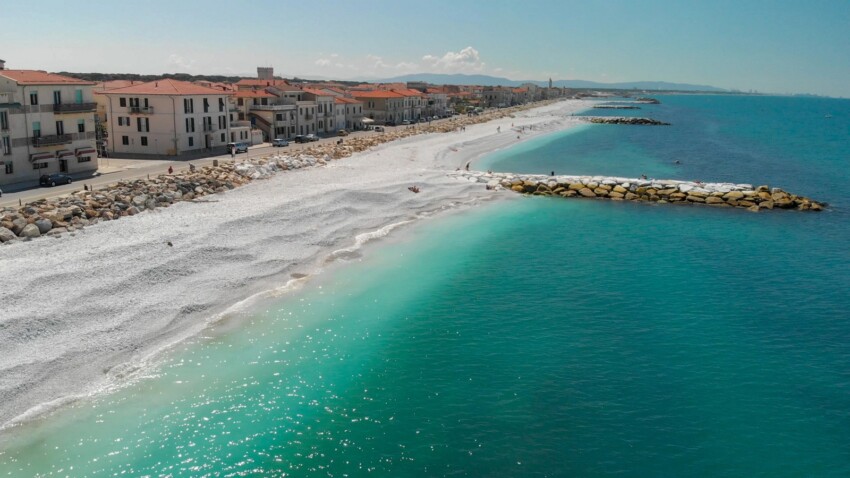
Calambrone’s shoreline stretches seamlessly northwards into Tirrenia, creating a continuous sandy ribbon stretching several kilometres. The beaches feature fine, golden sand and are characterised by sand dunes of considerable natural importance.
Calambrone’s beaches, awarded the Blue Flag alongside the entire Pisan coastline, boast gently sloping seabeds extending into deeper waters. This feature makes them particularly safe for families with children. The sea displays hues ranging from emerald green to azure, with indigo undertones, with clear, crystalline waters.
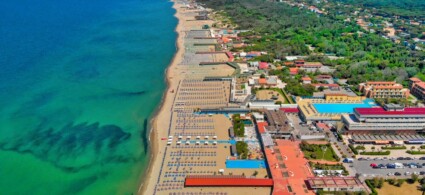
Along the entire seafront, numerous equipped beach clubs alternate with stretches of free beach. The establishments offer a wide range of services beyond the standard parasol and lounger hire: many feature beach volleyball and tennis courts, five-a-side football, swimming pools and children’s play areas. Some beach clubs organise daytime and evening entertainment, making Calambrone a vibrant destination for those seeking fun as well.
Single Fin Tuscany Dog Beach
For those travelling with pets, Calambrone is home to the Single Fin Tuscany Dog Beach, considered one of Tuscany’s finest dog-friendly beach clubs. The facility offers comprehensive services for canine companions: a play area (though fencing could be improved), dedicated showers, water bowls and trained staff to manage dogs’ needs. The option to book your parasol via an app, selecting your preferred location, is a feature appreciated by regular visitors.
What to do and see at Calambrone
The architecture of the summer colonies is the most distinctive feature of Calambrone’s urban identity. Built in the 1930s, these monumental structures represent interesting examples of Liberty and Modernist style with Rationalist influences.
Colonia Firenze, completed between 1931 and 1932, was the first to be built at Calambrone. It comprises a series of pavilions arranged in a comb pattern perpendicular to the shoreline, connected by a longitudinal east-facing wing. The Colonia Principi di Piemonte, designed by Paolo Baldi Papini and built between 1932 and 1933, features a classical matrix with two independent pavilions linked by a columned corridor. Abandoned in 1974, it was restored in the 2000s and transformed into a resort.
The Colonia Vittorio Emanuele II, completed between 1934 and 1938 to engineer Steffanon’s designs, features a highly symbolic layout. The Colonia Regina Elena, designed by Ghino Venturi for the Livorno United Hospitals, reflects the monumental architectural language typical of Marcello Piacentini. After years of neglect, it was transformed into a holiday village in the early 21st century.
The Tombolo Pine Forest, part of San Rossore Natural Park, offers routes for walking, jogging and cycling in the shade of maritime pines. The Mediterranean scrub is home to rich fauna and represents an oasis of cool on the hottest summer days. Nearby you’ll find two golf courses for those who enjoy the sport.
Where to stay at Calambrone
Calambrone’s accommodation offering has been considerably enhanced thanks to the restoration of historic colonies. Resorts created from the conversion of former structures offer spacious rooms, swimming pools, wellness centres and an atmosphere that blends history with modern comfort. These options appeal to travellers seeking quality and high-level services.
Family-run hotels, residential complexes with apartments and campsites within the pine forest are also available. The latter option allows you to stay surrounded by greenery just a few hundred metres from the sea. Proximity to Livorno’s commercial port makes Calambrone popular with business travellers too. The Livorno Calambrone railway station on the Tyrrhenian line makes it easy to travel to Pisa, Florence, Grosseto and other Tuscan destinations.
We offer best rates If you find it cheaper we refund the price difference.
Free cancellation Most properties allow cancellation without penalty.
We're available 24 hours a day For any problem call Booking.com.
Apartments and vacation homes in Calambrone
If you prefer space, privacy and the ability to prepare your own meals to a hotel holiday, book a holiday home at Calambrone. We recommend a few below, but in this case we advise you to book early because houses and apartments for rent at Calambrone are in high demand.
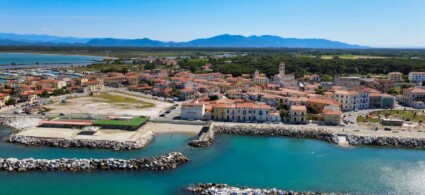
Calambrone is a hamlet in Pisa, situated on the Ligurian Sea between Tirrenia to the north and the municipality of Livorno to the south. It lies thirteen kilometres from Pisa and fifteen kilometres from Galileo Galilei Airport.

 Hotel
Hotel  Budget accommodations
  Apartments
  Family Hotel
 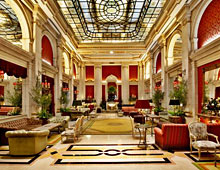 Luxury Hotel
 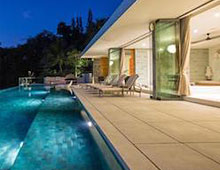 Resorts