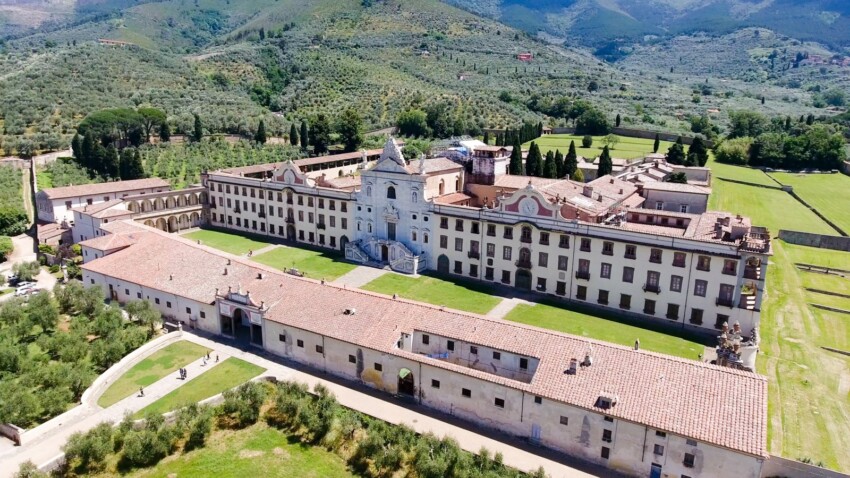
The Certosa di Calci, founded in 1366, stands approximately 10 kilometres from Pisa, nestled in a valley of considerable scenic beauty known as the “Valle Graziosa“.
Suppressed due to Napoleonic legislation (1808), the Certosa passed to state ownership, yet it continued to house the Carthusian order until 1972. The monastery is divided between areas reserved for the Fathers, devoted to prayer, and spaces dedicated to productive activities managed by lay brothers. The Fathers divided their time between solitude in their cells and cloisters, and communal life centred in the church, chapter house and refectory.
Today, the Certosa owes its present appearance to successive phases of expansion and enhancement, particularly throughout the 17th century. Recently, the Certosa has been entrusted to the Superintendence for Environmental, Architectural, Artistic and Historical Heritage in Pisa, and is now largely open to visitors. The spaces once used for productive and artisanal activities—such as granaries, wine cellars, blacksmith’s and carpenter’s workshops—now house the Museum of Natural History and Territory of the University of Pisa.
Although the Certosa di Pisa was founded in 1366, the elegant forms we admire today are largely the result of successive phases of expansion and restructuring that took place principally from the 1630s onwards. Embellished with sumptuous decorative schemes created between the 17th and 18th centuries by accomplished artists, the Pisan Certosa became a favoured destination of the grand-ducal court. Within the museum circuit, which winds through the evocative spaces of the Certosa, you will also find elements of undoubted scientific interest, including the ancient pharmacy and an ingenious hydraulic system.
The pharmacy, founded in 1643 on the right side of the Certosa, was relocated in 1703 to the entrance building of the monastery to allow access to the local population. In 1795 it was renovated with wooden furnishings crafted by Pasquale Matteucci of Pisa, and with ceiling decoration featuring ornaments and allegorical figures, such as the Allegory of Medicine painted by Niccolò Matraini. From 1799 to 1875 it was managed by the Viola family, and ceased operations in 1906. The original furnishings were restored in 1931, as indicated by an inscription in a corner of the olive-wood shelves lining the walls of the sales room. For its elegant decorations, it represents an exceptional and highly valued example. Dating from the end of the 19th century are the ornaments and inscriptions in the waiting room, which provides access to the sales room and workshop. The Pharmacy displays a collection of vessels used to preserve medicines, distillates and syrups produced by the monks.
The hydraulic system, still partially functional, was equally important to the Certosa’s economy. Through a complex network of channels, it conveyed water for various purposes—drinking water supply, irrigation and fish farming—into six tanks and two fountains, whilst a short aqueduct section powered a mill. To cope with periods of low water, two cisterns collected rainwater.
The museum is accessible by bus via CPT lines 120 and 160 to Calci, Castelmaggiore, Tre Colli and Montemagno. The bus station is within easy walking distance of the railway station.
By car: From Pisa, take the Strada Provinciale Calcesana towards the town of Calci, then follow signs to Certosa Monumentale di Calci.
Motorway A11/A12: exit at Migliarino (Pisa Nord), take the Strada Provinciale del Lungomonte Pisano, passing through Pontasserchio and S. Giuliano, following signs to Calci. Florence-Pisa-Livorno superstrada: recommended exit at Navacchio, then continue towards Calci.

 Hotel
Hotel  Budget accommodations
  Apartments
  Family Hotel
  Luxury Hotel
  Resorts