Podere Calvaiola
Montecatini Val di Cecina - Strada Procinciale 14 per Miemo 28
Book now
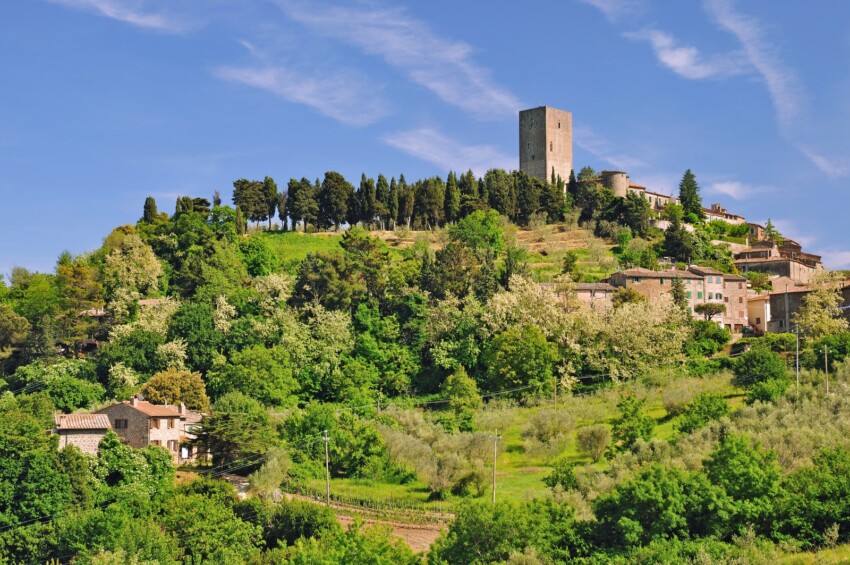
The Castello di Montecatini, initially known as Castrum Montis Leonis, was built by the Belforti family around 960 when they arrived from Germany in the entourage of Emperor Otto I. However, Montecatini first appears in written records in 1099, in a papal bull issued by Pietro, Bishop of Volterra, who held civil jurisdiction over it.
In 1300 it formed part of the Gabbreto community; in 1351 it became Volterran property, and in 1472 it passed under Florentine rule. The historical record then falls silent until the early 1700s, when Montecatini‘s fate became intertwined with that of countless medieval Italian villages caught in the path of foreign armies.
Montecatini enjoyed a remarkable period of economic and social prosperity during the early years of the Italian Kingdom, driven by mining activities: the town boasted two theatres and even two brass bands.
Unfortunately, from the early 1900s onwards, the closure of the copper mine plunged the entire municipality into a slow and profound decline that, save for brief intermissions, persists to this day.
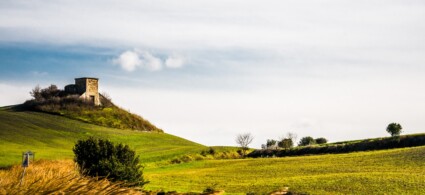
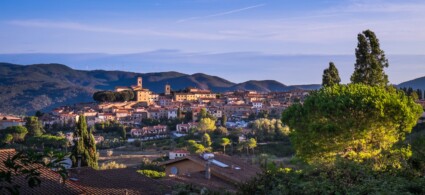
Finally, in the history of this village (see photo below) mention must be made of a vast hilltop facing Volterra, long known as “Camporomano”.
The discovery of artefacts and the lie of the land provide compelling evidence for the lengthy presence of a Roman military camp, linked both to expansionist campaigns that led to the occupation of Volterra and to the area’s rich mineral deposits.
Walking through the narrow lanes and archways, passing through the ancient gateways of the historic centre, we encounter the lovely Piazza del Castello, overlooked by the Church dedicated to San Biagio, erected in 1356, which houses fine works of art, and the Palazzo Pretorio, a 14th-century building with a splendid façade adorned with a portico featuring cross vaults and round arches resting on elegant Ionic columns. The square is dominated by the imposing Torre dei Belforti, erected in the 11th century.
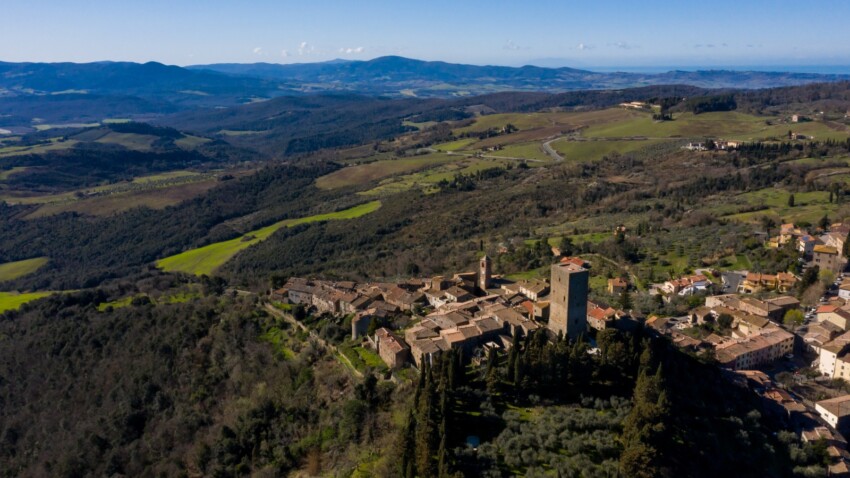
The Church of Montecatini dedicated to San Biagio was erected around 1356 under the direction of Ugolino Guducci and Ciullo Barletti and consecrated in 1361. In 1421, the Church of Gabbreto, already in a state of disrepair, was replaced in its pastoral responsibilities by that of San Biagio. In 1463, Gabbreto ceased to possess the Baptistry, which was transferred to the Rectory of San Biagio, which from that moment became a plebano church.
Between 1463 and 1467 the bell tower and choir were constructed, the latter being frescoed by a Sienese painter on commission from Nicola Nieri of Montecatini. Only traces of these frescoes remain, visible behind the reredos (in cornu epistolae).
Originally, for urban planning reasons, the Church faced north; inside, built with three naves, it contained a simple high altar in the central nave and two side altars in each lateral nave. Between 1514 and 1576, to build the rectory house, the original façade was blocked and the present side entrance was opened, eliminating one altar.
On either side of the high altar stand two marble angels, known as the “ciechini”, attributed to Mino da Fiesole, and in two niches above the choir are two terracotta statues executed by the Della Robbia workshop, depicting San Biagio and San Sebastiano.
In 1787, following the desecration of the Camporciano oratory, the statue of the Madonna known as “Camporciano” was transferred to the present sacristy; legend has it that the statue was discovered in a field on the homonymous hill. Subsequently, this sacred image was moved to an altar in the nave opposite the present entrance, where it remains today.
Recently, the vaults of the naves and the precarious lattice work of the central nave have been demolished, the roof and entire timber frame have been exposed, and the upper windows have been fitted flush with the 14th-century small windows.
This is a 14th-century building that has undergone various modifications, featuring a magnificent façade adorned with a portico with cross vaults and round arches supported by elegant Ionic columns. Under the portico are a commemorative plaque marking the admission of the Grand Duchy of Tuscany to the Italian Kingdom, with the plebiscite results, and another indicating the old units of measurement and weight with their equivalents, plus a stone measure for grain.
The Palace served as the Town Hall seat until 1956.
Today it houses the Documentation Centre for the resources and activities linked to the subsoil in the Upper Val di Cecina. It is an integral part of a visitor circuit of the Mining Museum which in Montecatini Val di Cecina includes the Caporciano mining site, with Pozzo Alfredo—the mine entrance, galleries, and the Muraglione Dam.
The Centre holds documentation of the activity that between 1827 and 1907 made Caporciano Europe’s richest copper mine. The Museum offers an overview of the extraordinarily rich range of subsoil resources that have been exploited in Val di Cecina since ancient times. In the thematic rooms: other copper mines that in the 1800s characterised the most remote locations; the role of rock salt—from antiquity to the present day; the working of the pure alabaster stone; the peculiarity of the geothermal basin and the use of endogenous fluids; the splendour of mosaics obtained with chalcedony; the history of a unique lignite mine; the singularity of sulphurous springs; a rich sample of minerals in their multiform manifestations.
An extensive collection of administrative documentation (payroll books, work schedules, registers, correspondence) and technical material (with gallery plans and profiles, construction drawings) from the mining site.
In the piazza in front stands the characteristic cistern with a square stone edge resting on a slope descending downwards; in the background, the fine castellated gateway with a pediment adorned with alternating white and black ashlar blocks.
The tower is a structure with a quadrangular base and sloped sides (11th century); its walls of extraordinary thickness are built of small dressed stone, with the lower section featuring alternating bands of white and black.
Now stripped of its crenellated crown, the tower belonged to various Volterran families: the Belforti, the Pannocchieschi, and lastly the Inghirami, and was the seat of the Captains of Volterra and Florence before, until just a few years ago, passing to the French Barons de Rochefort.
There are numerous and artistic small windows, and particularly notable are two openings cut transversely on the Belforti’s orders—essentially two telescopes, one aimed at Volterra’s Mastio and the other at the Rocca Sillina.
The tower that dominates the settlement is the outstanding feature of what was once the defensive system. Of this system, several smaller, round towers remain, which probably marked the town walls and the castle’s access route. The tower is currently privately owned.
Possibly Etruscan, but more likely medieval in origin, Miemo (see adjacent photo) is an ancient village with a Church dedicated to Sant’Andrea, a farmhouse, an attractive residential villa and several dwellings. Situated on the watershed of the chain of hills from which the Pisan hills slope down towards the Cecina valley, it has always held strategic importance.
This led to disputes over its ownership between Pisa, Volterra and Florence.
Today the village is home to very few inhabitants and the main activity is dedicated to game breeding, including wild boar, mouflon sheep, roe deer and red-legged partridges.
Also in the area adjacent to Miemo is the farming estate “Frassinello” which, in the field of livestock raising, has essentially dedicated itself to deer breeding, the area having proved a natural “habitat” for this species.
An evocative medieval village (see panoramic photo below) perched on a hilltop spur overlooking the Sterza stream valley to the east.
From the summit of “Poggio al Pruno”, which overlooks Sassa, you can see the sea and admire a vast panorama, commanding much of the Tuscan Archipelago, and from its foot begins the famous avenue of cypress trees running from Bolgheri to San Guido, celebrated by the poet Carducci.
The earliest records appear in a document dated 1008, when Count Gherardo sold half of the houses and properties he owned in a place called Sassa, in the parish of San Giovanni di Casale.
In 1208 it came under the hegemony of the Commune of Volterra, and this may be when the struggle between Commune and bishop began for this village too, despite the fact that Emperor Henry VI had assigned the castle of Sassa to the Bishop of Volterra by his diploma of 1186.
Today the village still displays its ancient architectural structures, dominated by a massive tower that probably once formed the keep of the old fortress.
The Church, enlarged at the end of the 18th century, today presents a double apse, whilst the oldest section consists of a body with an external apse. It currently has two altars: the altar of the Most Holy Rosary on the left and the high altar, rebuilt in 1963.
Of artistic interest is the baptistry font of streaked rose marble, consisting of a small rectangular column supporting another semi-column decorated with acanthus leaf moulding.
The name Querceto derives from medieval floral etymology (8th-10th century).
From antiquity it was a very important castle, as it provided about 600 armed men to the Commune of Volterra, but nonetheless shared the fate of all other locations in the area. First it fell under the hegemony of the Bishops of Volterra, through diplomas issued by Henry VI in 1186 and Frederick II in 1224; it subsequently came under the rule of the Commune of Volterra, to which the villagers freely submitted on 20 August 1252.
However, it is likely that Castello di Querceto (see adjacent photo) fell under Florentine rule before Volterra and the other neighbouring communes.
In 1431 it was conquered by troops of the Duke of Milan, commanded by Niccolò Piccinino, further underscoring the military importance attributed to the location.
In 1447 it was captured by troops of Alfonso, King of Aragon and Naples, who completely destroyed the dwellings, except for the castle itself.
It was during this period that a phase of decline and abandonment began, lasting until 1472, the year of another oath of allegiance to Florence by the inhabitants of Querceto. It was under Florentine rule that Querceto became part of the Vicariat of Val di Cecina. The present Counts Ginori’s rule dates from 1543.
Undoubtedly, today the entire village offers exceptional interest, not only for the Castle, but also for its ancient houses and its Church, dedicated to San Giovanni Battista.
Externally, the building retains the original facing of small arenaria ashlar and has an original design. Indeed, upon entering, it presents a single nave that widens with two side bays, acquiring a cruciform shape. The original apse has been replaced by a rectangular scarsella. Noteworthy are the symbols of two evangelists (the eagle and the lion) either side of the Redeemer depicted as a child, executed in relief on the capital of the semi-column of the right nave.
The extensive and significant fresco in the apse is a recent work by painter Luciano Guarnieri.
It comprises various scattered farmhouses, the most important nucleus of which presents buildings of considerable architectural and urban interest (see adjacent photo).
It consists of a square overlooked by the Church (with interesting 19th-century frescoes) and a crenellated and turreted building, reminiscent of the ancient castle, whilst to the east stands the farmhouse, a stately residential villa from the last century, in neoclassical style. Casaglia, with its ancient Church of San Giovanni Battista, was one of the castles included in the privilege that Henry VI granted in 1186 to Ildebrando Pannochieschi, Bishop of Volterra. The restored castle ruins are found on top of a hill to the right of the Cecina river. This is the Casaglia that is mentioned as the extreme boundary of the ancient Pisan territory, against whose government the country people rebelled in 1345.
The people of Casaglia formed part of the castle of Strido until the Leopoldine law on the administrative regulation of the communities of the Grand Duchy.
Around 1700, Casaglia came into the possession of the Espinassi-Moratti family, who have always maintained it.
What's the weather at Montecatini Val di Cecina? Below are the temperatures and the weather forecast at Montecatini Val di Cecina for the next few days.
To see all the facilities and book accommodation in Montecatini Val di Cecina use the form below, entering the dates of your stay.
 Hotel
Hotel  Budget accommodations
  Apartments
  Family Hotel
  Luxury Hotel
  Resorts