Garden Relais Le Fontanelle
Montescudaio - Via delle Fontanelle 1
Book now
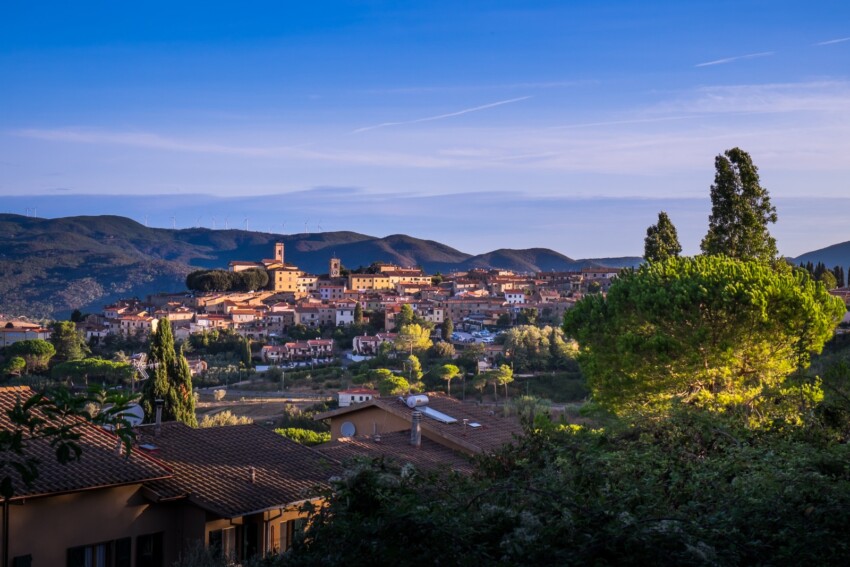
Montescudaio sits atop a hilltop at 242 metres above sea level, inland from the Tuscan coast at Cecina and at the mouth of the strategically important Cecina Valley, which served significant military functions throughout various periods and well into the Middle Ages.
Montescudaio takes its name from the Latin Mons scutorum, meaning “mountain of shields” or “shield-bearer’s mountain”. The original settlement grew up around a Benedictine convent, founded in 1091 by Count Gherardo Della Gherardesca, under whose rule it remained for a considerable period. It’s as though time has stood still – today’s Montescudaio preserves the flavours of that long-distant medieval age along its narrow lanes, squeezed between ancient buildings. From the old castle walls, particularly from an attractive tower known as “La Guardiola”, you can enjoy a magnificent panorama stretching from the Cecina plain to the Tyrrhenian Sea. The views from Piazza del Castello, facing the Abbey Church of SS. Maria Assunta, are equally sweeping, reaching all the way to the sea. To the right of the town hall, near Via del Borgo, stands the Civic Tower, dating back to the 12th century.
The bronze war memorial by Italo Griselli, the abbey church in Piazza del Castello (from where you can see the panoramic vista made famous by a Mini advertisement), the Church of SS. Annunziata, painter Stefano Tonelli’s studio, and the “Spazio Minerva” art gallery run by Brucciani Patrizio.
In 1416, the Church of Sant’Andrea in Castello inherited the title of the suppressed female monastery dedicated to the Virgin. Until 1837, Montescudaio‘s church held a double title: it was the pieve of Sant’Andrea and simultaneously the abbey of Santa Maria Assunta. The earthquake of 1846 devastated the upper part of the town and destroyed the church as well. The new church was built between 1854 and 1857. Larger than its predecessor and featuring a Latin cross design with an apse, the façade faces west and is approached by a broad flight of steps. Inside you’ll find a 18th-century marble statue of “St Francis of Paola” and a canvas depicting the “Annunciation”, attributed to the Venetian school of the 17th century.
This building, erected in the second half of the 15th century, has been completely renovated. The current façade dates from the 1930s and is enriched with two stone columns topped by capitals. The main entrance is also embellished with two columns crowned by a small moulded pediment, interrupted at the centre to accommodate a relief depicting the “Annunciation”. Inside, the tabernacle, decorated with fine alabaster inlay, is surrounded by three tiers of steps that rise in the centre, creating a niche containing terracotta statues of the “Annunciate” and the “Announcing Angel”, painted and preserved since 1598. These figures became focal points of a fervent Marian cult.
The name Montescudaio comes from the Latin “Mons Scutarius or Mons Scutaris”, though the settlement probably dates back to the Villanovan period, as the oldest artefact is an Etruscan cinerary urn from this era (7th century BC). The earliest historical documents date from around 1000, when the Castle belonged to the Pisan counts of the Della Gherardesca family. Recent excavations have uncovered Roman archaeological finds, including “alla cappuccina” tombs and a kiln. The castle walls and the ancient Abbey of Santa Maria, however, date from the medieval period.
From 1406 onwards, Montescudaio became a municipality, submitting itself with its own statutes to the Republic of Florence and achieving the expulsion of the Della Gherardesca counts. Municipal rule ended in 1648, when the Medici granted the fief of Montescudaio to the Ridolfi marquises, who continued under the House of Lorraine until 1749, when feudal holdings were officially abolished. Subsequently, from 1861 onwards, Montescudaio followed the fortunes of Italian municipalities in the Kingdom of Italy. In 1846, a severe earthquake destroyed the older cluster of houses in the Castle area, including the Abbey Church of Santa Maria. With the help of the local population, a substantial grant from the Grand Duke and the efforts of the conscientious Abbot Quirino Bussotti and Dr Benedetto Cancellieri, the town rose from the ruins within ten years.
The coat of arms: it features a five-pointed noble crown surmounting a shield bearing three mountains. The crown denotes the county of the Della Gherardesca. The shield with three mountains represents the three castles (of their domain) of Montescudaio, Donoratico and Segalari.
What's the weather at Montescudaio? Below are the temperatures and the weather forecast at Montescudaio for the next few days.
To see all the facilities and book accommodation in Montescudaio use the form below, entering the dates of your stay.
 Hotel
Hotel  Budget accommodations
  Apartments
  Family Hotel
  Luxury Hotel
  Resorts