Hotel Albergo Villa Marta
Lucca - Via Del Ponte Guasperini 873
Book now
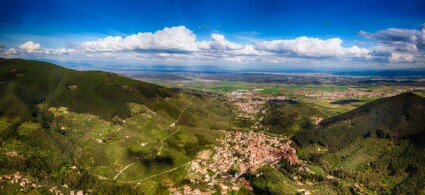
The Monte Pisano, now commonly referred to as the “Monti Pisani” – encompassing the entire mountain range – is located in Tuscany, and appears to divide a plain and two cities, Pisa and Lucca, both of which are touched by two rivers, the Serchio and the Arno.
The villages in the Monti can be easily reached thanks to the existing road network, illustrated alongside. Beyond these, there is a network of unmade roads for fire prevention, mule tracks and footpaths that make it possible to traverse the Monti, with due care and preferably on foot, while fully enjoying the panoramas that, despite the group’s modest altitude, can still offer remarkable views. The various environments that characterise them can sometimes surprise you with their contrast with others.
The Monti Pisani occupy a territory between Lucca and Pisa with a roughly elongated oval shape, extending from south-east to north-west for a length of 20 km and a width of 10 km, with a surface area of approximately 15,200 hectares. Within the group, the highest peaks are: Monte Faeta at 831 m, Spuntone di S. Allago at 870 m, Monte Serra at 917 m, Monte Pruno at 876 m, and Monte Verruca at 537 m, which rise in a fan formation, creating a valley facing south known as “Valgraziosa”.
The group also features various types of habitat created by different sun exposure throughout the day. On the Lucca side to the north-east, you’ll find denser undergrowth and a more humid microclimate, whilst on the Pisa side to the south-west, influenced by proximity to the sea, the environment is sunnier and drier. In the lower areas of the entire mountain chain, vineyards are widespread, followed by terraced olive groves, and at higher elevations you’ll find extensive chestnut groves, coppiced beech and oak woods, interspersed with extensive pine forests.
Despite the increased number of violent and devastating fires that have plagued the landscape in recent decades – the scars of which are still visible – the group retains its considerable environmental value intact. A small area of Larch pine is present, though its origin has yet to be fully understood. These may be small remnants from distant epochs when the species was more widespread.
Thanks to early human settlement and their limited surface area, the Monti Pisani are crisscrossed with footpaths, mule tracks, farm roads, unmade fire prevention roads, not to mention disused private lanes and abandoned paths. This network of routes makes it possible to explore the mountains extensively throughout the year, given the mild climate. This allows you to discover and experience the environment and admire the natural beauty that the Monti can offer to hikers.
The valley known as “Valle Graziosa“, which faces towards the sea and is backed by the Monte Pisano, is dotted with both short and long routes that consistently offer splendid panoramas. Moreover, the localities you pass through are interesting from a naturalistic, environmental, historical, artistic and socio-economic perspective. The valley winds mainly along two streams, the Zambra di Calci and the Zambra di Montemagno, which, thanks to their water power, once operated the wheels of over a hundred mills, oil presses and other workshops in the past – traces of which can still be seen today. Generally, the starting point for various itineraries is Calci’s Town Square. Hikers on our mountain trails will find coloured markings on the ground, created by the Pisa Section of the Italian Alpine Club in collaboration with the Pisa Provincial Administration and the six municipalities involved.
The trail markings consist of white and red signs on the ground, some with their own numbering, according to the standards adopted by the CAI in agreement with the Tuscany Region. Directional and informational signs are also present along the routes and in the inhabited centres from which they branch off. The signage network is based on an axial route or “0-0”, which is managed by the Pisa CAI, while other routes are managed by individual municipalities; these are distinguished by one or two digits preceded by zero, to differentiate them from those managed directly by the CAI in other mountain ranges.
The routes on the Monti Pisani are divided into closed or “loop” trails, from “01” to “08”, and open or connecting trails, from “010” to “045”.
The maintenance and signage of these routes are guaranteed over time by the bodies mentioned below, whilst for all other trails it is not possible to guarantee their accessibility.
For example, many historic mule tracks, once heavily trafficked, are today impossible to find, and narrow footpaths and some farm roads, if not regularly used and cleared, quickly become completely overgrown with brambles or gorse, whilst unmade roads can develop deep ruts caused by rainfall.
Historians and geologists consider the Monti Pisani to be one of Italy’s oldest mountain formations. The earliest evidence of this is “the Schists of S. Lorenzo”, (from the Permo-Carboniferous period, approximately 280 million years ago) found on Monte Cotrozzi, formed during the geological era known as the Palaeozoic or Primary period (a type of rock also found in the core of the Apuan Alps). In particular, a rich fossil flora has been discovered in the S. Lorenzo schists. The type of vegetation, its quantity and level of development suggest a decidedly tropical, warm and humid climate that favoured the growth of luxuriant forests with predominantly marsh flora (Lycopodiales and Equisetales) in deltaic and lagoon environments.
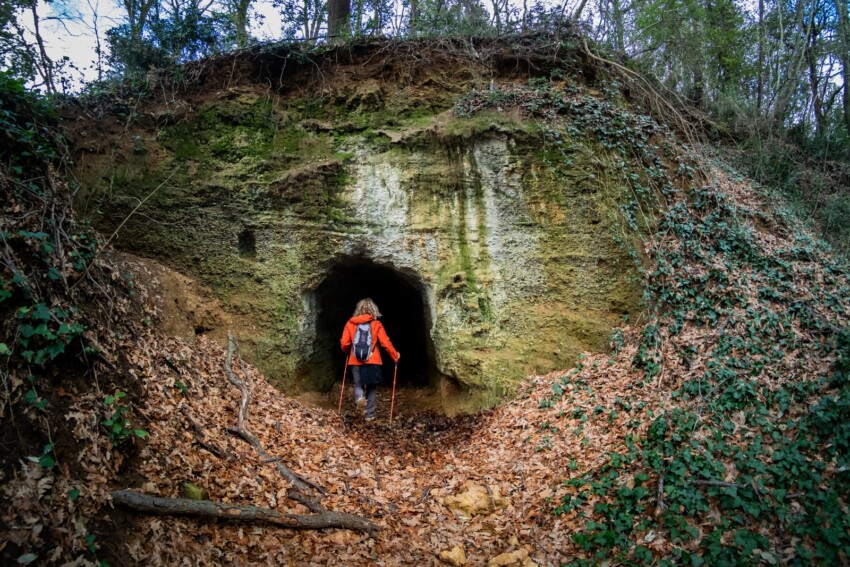
Subsequently, the mountains became one of the few “atolls” during the Pliocene period, when central Italy was mostly covered by water. Their formation is believed to have occurred through an initial phase of uplift followed by a second phase of subsidence, which explains why some slopes are steep and overhanging above the plain. Part of the mountains, particularly the south-west lower slopes, is made of limestone rocks, which has enabled the formation of cavities that have developed into more or less extensive caves in several cases.
It is worth noting that in geological science there is a rock called Verrucana, which takes its name from Monte Verruca itself, found in the M. Pisani (on whose summit stands the ruin of an ancient castle) and which characterises the area through its presence. Human settlement of the mountains began in very remote times. Indeed, thanks to early speleological explorations in crevices and caves conducted from around the mid-nineteenth century onwards, palaeontological and palaeoanthropological remains dating back to the Upper Palaeolithic have been found. From then on, however, the greatest use of the area occurred especially to the south, in the Calci zone, even before the Etruscans, by the Apuani or Liguri, since the valley offered everything that nature could provide: shelter, water, game and forests.
Later, after the Etruscans came the Romans, who, like their predecessors, used the limestone of the Monti Pisani to make lime, and since they were close to the Arno and the sea at that time, they traded it throughout the Mediterranean, as we know from the discovery of Roman ships beneath San Rossore railway station. With the dawn of Christian worship, the area was identified as an ideal place for retreat and prayer. This led to the construction of various churches, oratories and parish churches, enabling the development of the principal settlement: Calci.
To see all the facilities and book accommodation in Monti Pisani use the form below, entering the dates of your stay.

 Hotel
Hotel  Budget accommodations
  Apartments
  Family Hotel
  Luxury Hotel
  Resorts