Marina di Pisa
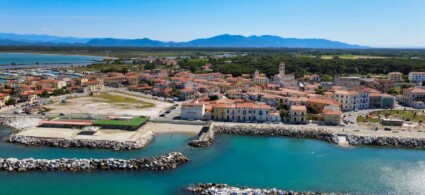
Overlooking the mouth of the Arno, Marina di Pisa is the principal seaside destination for Pisans and local residents, thanks to its beautiful equipped beach.
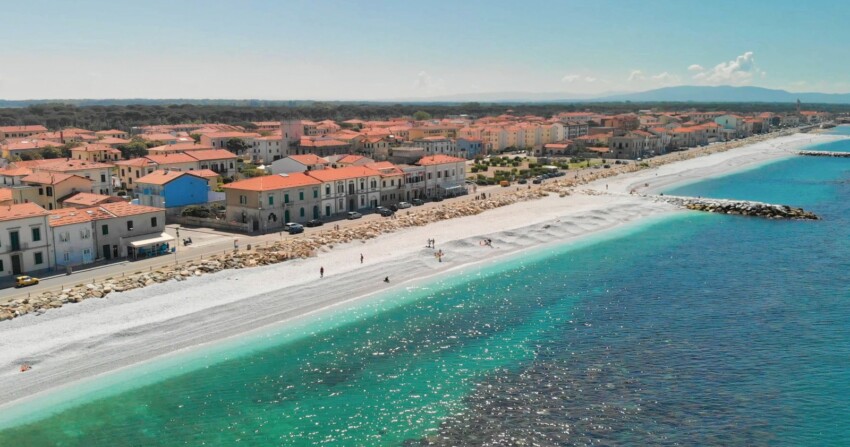
The Pisan coastline stretches for over 20 km from Marina di Vecchiano, near the mouth of the River Serchio, to Livorno. It’s one of Tuscany’s most distinctive stretches of beach, as it develops entirely within the Migliarino San Rossore Massaciuccoli Regional Park, featuring sandy beaches and high dunes interspersed with pine forests and Mediterranean scrubland set within a natural landscape of considerable value. On the clearest days, you can spot Capraia, Elba and Gorgona on the horizon, each recognisable by their distinctive profiles.
The beaches of Marina di Pisa, Tirrenia and Calambrone have been awarded the Blue Flag for the 21st consecutive year in 2025, a recognition from the FEE Foundation certifying water quality, sustainable land management and the enhancement of natural areas. The Pisan coastline now offers comprehensive facilities — beach clubs, restaurants, sports facilities and evening venues — in a setting that remains quieter and greener than the busier Versilia resorts.
Before reaching Marina di Pisa, those following the Viale D’Annunzio along the banks of the Arno arrive at Bocca d’Arno, where the river flows into the Tyrrhenian Sea. It’s a place of remarkable landscape appeal, with panoramic views stretching from the San Rossore Estate to the Apuane Alps. From the river mouth, ferries depart connecting the coast to the islands of the Tuscan archipelago and Cinque Terre. The most pleasant way to reach Bocca d’Arno from central Pisa is via the Trammino cycle path, a recently opened 13 km cycling route that hugs the river, allowing you to reach the sea whilst pedalling through the natural landscape of the Park.
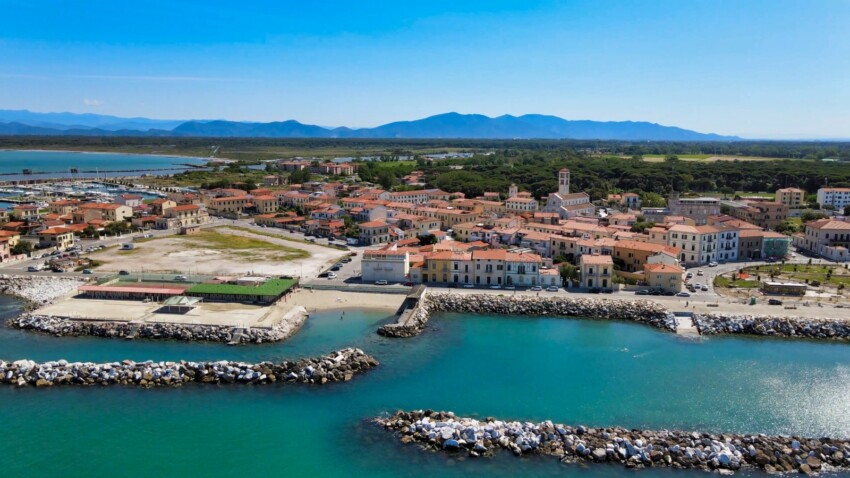
Marina di Pisa is the seaside resort favoured by locals, just under 20 minutes’ drive from the city centre. Established in the second half of the nineteenth century as a fishing village, it enjoyed its first golden age as a summer residence for prominent figures — including Gabriele D’Annunzio and Eleonora Duse — as evidenced by the elegant Art Nouveau buildings that still adorn the seafront. Its maritime heritage is confirmed by a slipway for boats in the town and an anchor embedded in the central square, placed by local fishermen in memory of a friend lost at sea in 1981.
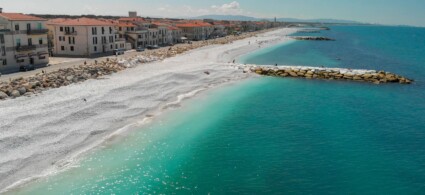
The beaches are characterised by the presence of stone breakwaters that divide them into small sandy coves with calm waters, perfect for families with children. The seafront is lined on one side by artificial rocks where traditional rock bathing takes place, and on the other by residential buildings and shops. Behind the beach, beyond the road, stretches a low pine forest with Mediterranean scrubland. Marina di Pisa’s tourist harbour can accommodate over 300 berths. For those keen on adventure, the Pineto adventure park offers acrobatic courses in complete safety.
Marina di Vecchiano sits at the northern edge of the Pisan coastline, nestled between the mouth of the Serchio and Torre del Lago Puccini, within the natural reserves of Bocca di Serchio and Bufalina that extend to Viareggio. It’s the most convenient beach for those arriving from the A12 motorway, exiting at Pisa Nord, just a few kilometres away. The beach stretches for approximately four kilometres with fine sand and some of the finest dunes on the Tuscan coast, shaped by the wind and dotted with patches of juniper, Aleppo pine, flowering cistus and broad expanses of silene that turn the sand red in spring.
Among the vegetation stands the yucca, a plant originally imported from Central America for ornamental purposes that has since become naturalised, finding here an ideal habitat and adding an exotic touch to the landscape. A road divides the dunes from the Migliarino Scrubland behind, a lush pine forest forming part of the Regional Park. The beach is free and never excessively crowded even in peak season: ideal for those seeking tranquillity and space. Vecchiano council manages paid car parks along the entire coast on public holidays.
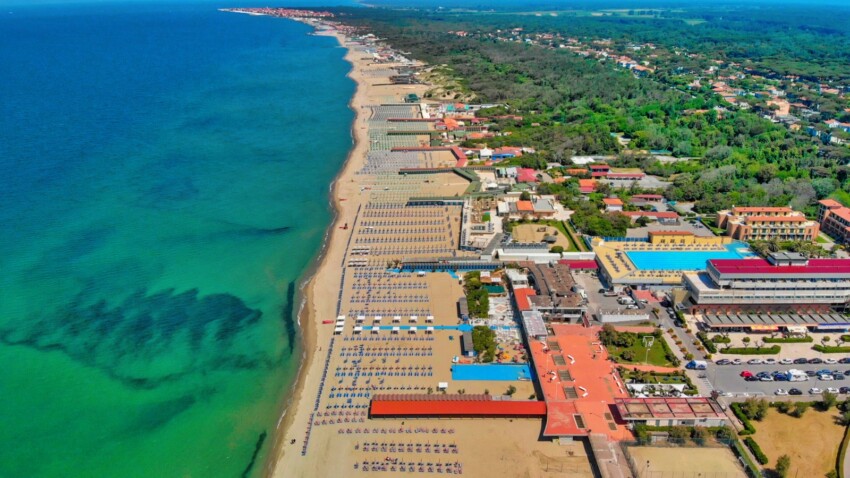
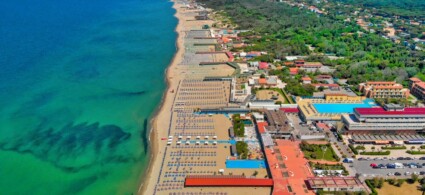
Tirrenia is the most lively and dynamic resort on the Pisan coast, with a history few would expect: between the 1930s and 1960s it was home to the Pisorno film studios, Italy’s most important production facilities, a sort of Hollywood on the Arno. The town’s name itself derives from joining Pisa and Livorno. These studios attracted Sophia Loren, Marcello Mastroianni, Claudia Cardinale, Vittorio Gassman and Vittorio De Sica, drawn by a privileged location between sea, mountains, river and hills — ideal scenic elements.
Tirrenia’s beaches are extensive — over 50 metres wide in the northern area, up to 70-80 metres further south — with fine golden sand, surrounded by a lush pine forest. To the north lies the WWF Tirrenia Dunes Reserve, a protected area of considerable natural value with free access, managed by the WWF with supervision and environmental initiatives aimed at schools and tourists. The sports facilities are impressive: two golf courses just steps from the sea (one 18-hole, one 9-hole), tennis courts, beach volleyball and beach tennis, five-a-side football, rugby and baseball. The Sunlight water park is the reference point for families with children. In the evening, Tirrenia comes alive with restaurants, pizzerias and venues along the shoreline.
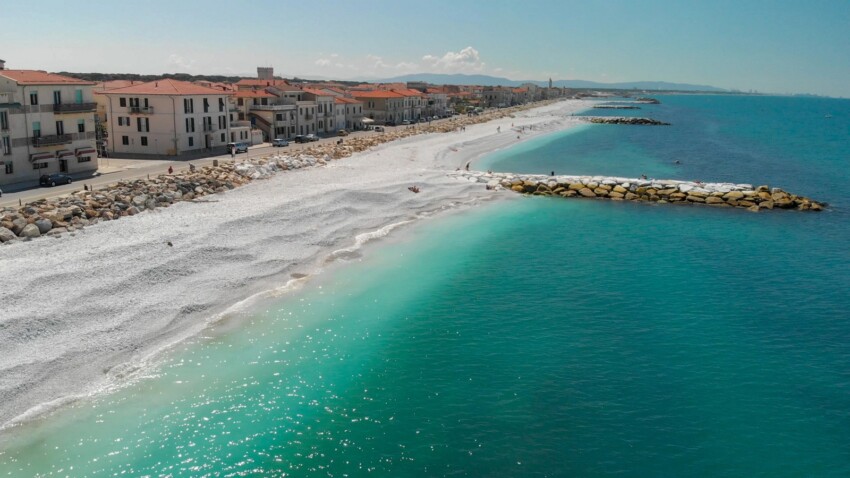
Calambrone is the final resort on the Pisan coast before Livorno and the most tranquil. Characterised by very wide beaches — around 50 metres across — with high sandy dunes and a wilder atmosphere than nearby Tirrenia and Marina di Pisa, it’s the ideal choice for those seeking relaxation and direct contact with nature without sacrificing beach club facilities. Its constant exposure to winds makes it the preferred destination for windsurfing and kitesurfing enthusiasts. Behind it stretches the Tombolo forest with the WWF Cornacchiaia Wood Reserve, in the immediate vicinity of the CONI centre, chosen as a retreat location by numerous Italian national teams across various sports disciplines.
Calambrone is also known for its former 1930s holiday colonies, buildings in fascist rationalist style that have largely been renovated and transformed into modern hospitality facilities. The inner dunes, where pioneering vegetation sways along the wind-swept ridge, form a band of spontaneous plant life between beach and buildings, contributing to this coast’s unique landscape character.
 Hotel
Hotel  Budget accommodations
  Apartments
  Family Hotel
  Luxury Hotel
  Resorts