Hotel La Pace
Pontedera - Via Belfiore,4
Book now
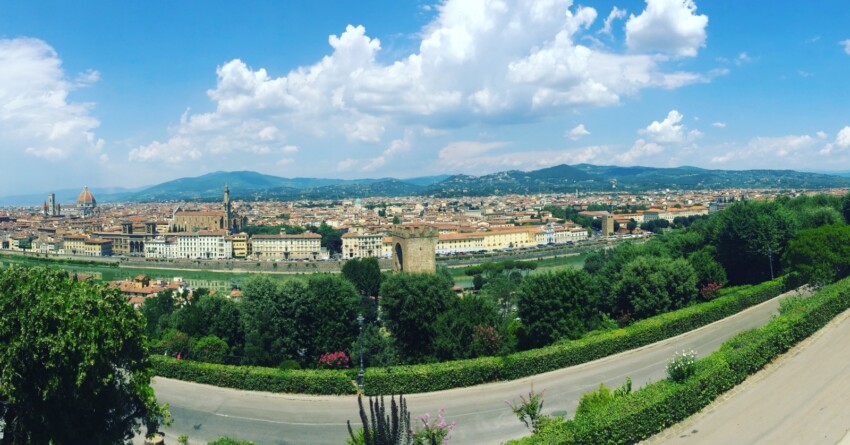
In Valdera, a valley situated inland from Pisa province, Pontedera is undoubtedly one of the most important destinations. This town of around 30,000 inhabitants is a renowned industrial centre, largely thanks to Piaggio, the Italian brand that hardly needs any introduction. Few realise, however, that this icon of made in Italy actually originates from Pontedera, where the company’s headquarters are based.
Pontedera is therefore synonymous with Piaggio, and testament to this is the fascinating Piaggio Museum, well worth visiting whether you’re a two-wheeler enthusiast or not. But there’s more to Pontedera: attractive churches, event spaces hosting splendid temporary exhibitions, and a pleasant historic centre to explore and wander through, allowing you to experience Tuscany at its most hidden yet undoubtedly capable of satisfying even the most discerning visitor.
Those who choose to visit Pontedera will be pleasantly surprised by the abundance of things to see, all worthy of discovery. Here are the most important ones, so you won’t miss a single thing.
The Pontedera Cathedral, officially the Propositura dei Santi Jacopo e Filippo, is the city’s largest and most important church. Located in the centre, it is certainly not Pontedera’s oldest religious building, dating only from 1850. Built in neoclassical style, its exterior appearance was initially rather simple, but shortly after its construction the portico and bell towers were added, though these were destroyed during World War II and later replaced by a single reinforced concrete bell tower.
Inside there are three naves, and you can admire numerous important works of sacred art, such as the Annunciation by Jacopo Chimenti, known as l’Empoli, or the altar panels of the Madonna della Mercede, works by Francesco Curradi dating from the 17th century. Also noteworthy is a copy of Andrea del Sarto’s Madonna with Child, Saint Elizabeth and Saint John the Baptist.
The Napoleonic Bridge in Pontedera takes this curious name because it was built during French rule at the beginning of the 19th century. It is made entirely of white marble, sourced from Monte Pisano, but what we see today is not the original but a faithful reconstruction, as the bridge was completely destroyed during World War II.
Crossing it from east to west, the Napoleonic Bridge leads to Corso Matteotti, Pontedera’s main street, which goes into the town centre.
The Piaggio Museum, named after Giovanni Alberto Agnelli, is an interesting museum dedicated to the famous Italian two-wheeler manufacturer, whose main factory is based right here in Pontedera. Opened in 2000 within the former premises of the Piaggio factory toolroom, dating from the 1920s, it tells the story of all the company’s main products and its principal designers.
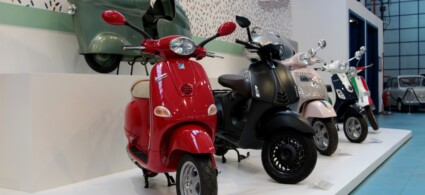
You can admire an example of the Piaggio P148 aircraft, an electric diesel railcar, and naturally countless scooters, models of Vespa, Ciao, Si and all those that made Piaggio a true icon of Italian identity in the last century. There are also special editions, including Salvador Dalí’s Vespa, and a Vespa 180 supersport transformed through collaboration with Englishman Alpha Willis, used for the film Dick Smart Agent 2007.
Inside the Piaggio Museum you’ll also find the Antonella Bechi Piaggio Historical Archive, one of the world’s richest business archives, containing 150,000 documents ranging from period photographs to advertisements.
The Piaggio Museum in Pontedera is located in Viale Piaggio and is open Tuesday to Friday from 9:30 to 12:30 and from 2:00 to 5:00 pm. Free assisted visits are complimentary, though a voluntary contribution is appreciated, whilst guided tours require a voluntary contribution of €5 per person. Please note that the Piaggio Foundation is a non-profit organisation.
The Palp is a space hosting a series of temporary exhibitions and artistic events, promoted by the Pontedera Culture Foundation, established in 2016 through collaboration between the municipalities of Pontedera and Peccioli. It is located in the historic centre, inside the elegant Palazzo Pretorio, a 14th-century building that originally served as the seat of the city’s Podestà.
The Palp also hosts seminars, courses and conferences, but it is the exhibitions that attract the greatest number of visitors, covering all aspects of Italian art, fashion and society. Each exhibition has its own opening times and admission fees, so we recommend visiting the official website for more information.
The Church of Misericordia is located near the Cathedral and is an imposing church designed by local architect Luigi Bellincioni at the end of the 19th century. Its distinctive feature is the large dome with red tiles, which makes it striking and an integral part of the city’s skyline.
At the entrance, there are two small rectangular chapels on either side, whilst inside there are five chapels arranged in a semicircle, with the Stations of the Cross and two wooden altars in Renaissance style. Particularly fine is the wooden crucifix from the 19th century, positioned above the main altar. The interior of the dome is decorated with a series of stucco medallions.
In Pontedera town centre and the immediate surrounding area there are several accommodation options, including a 4-star hotel, two 3-star hotels, and a range of apartments and bed and breakfasts that are fairly simple, though decidedly good value for money. Staying in the town centre will give you easy access to the city’s main attractions and various services including several bars and restaurants for the evening.
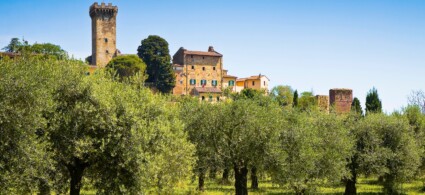
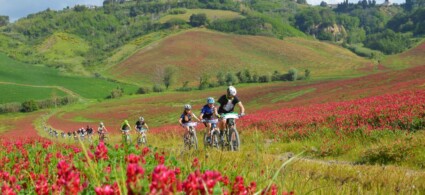
In the surroundings of Pontedera, moving a few kilometres south, the Valdera countryside displays all its charm, and this is where farm stays, country resorts, farmhouses and estates have been established, all completely renovated and refurbished, offering various facilities such as swimming pools, spas and guided tours.
By choosing an accommodation with an on-site restaurant, you can savour the typical gastronomic specialities of the area. Remember, however, that staying at a farm stay in the countryside, whilst guaranteeing maximum peace and quiet at night on the one hand, on the other makes it necessary to have your own car to get around, to reach Pontedera’s centre or to explore the surrounding area.
Reaching Pontedera is quite straightforward regardless of where you’re travelling from, as it sits along the FI-PI-LI dual carriageway. From the exit, aptly named Pontedera, the town centre is just a 5-minute drive away. From Florence it takes just 45 minutes via the FI-PI-LI, whilst from Pisa city centre the distance is even shorter, under 30 minutes. From Livorno it takes around 35-40 minutes, whilst from inland Tuscan towns the journey is longer: from Siena and Arezzo the distance is about an hour and a half. In both cases you’ll reach Florence first, then continue along the FI-PI-LI to your destination.
Pontedera is also very easy to reach by public transport, as it has a railway station called Pontedera-Casciana Terme, served by regional trains on the Florence-Pisa line.
Trains depart from Florence Santa Maria Novella roughly once an hour, with a journey time of 45 minutes, whilst from Pisa Centrale the journey takes just 15 minutes. Once you get off the train, the small station square is a short distance from the town centre, easily reached on foot by walking along Via Dante Alighieri.
What's the weather at Pontedera? Below are the temperatures and the weather forecast at Pontedera for the next few days.
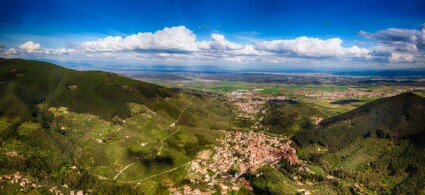
Pontedera lies in the province of Pisa, not far from the border with the province of Florence. It sits in the Pisan plain, a short distance from the towns of Ponsacco and Cascina.
 Hotel
Hotel  Budget accommodations
  Apartments
  Family Hotel
  Luxury Hotel
  Resorts