Florence: Uffizi Timed Ticket & Masterpieces Audio App
7.148 reviews
Buy now
From 27,20€ per person
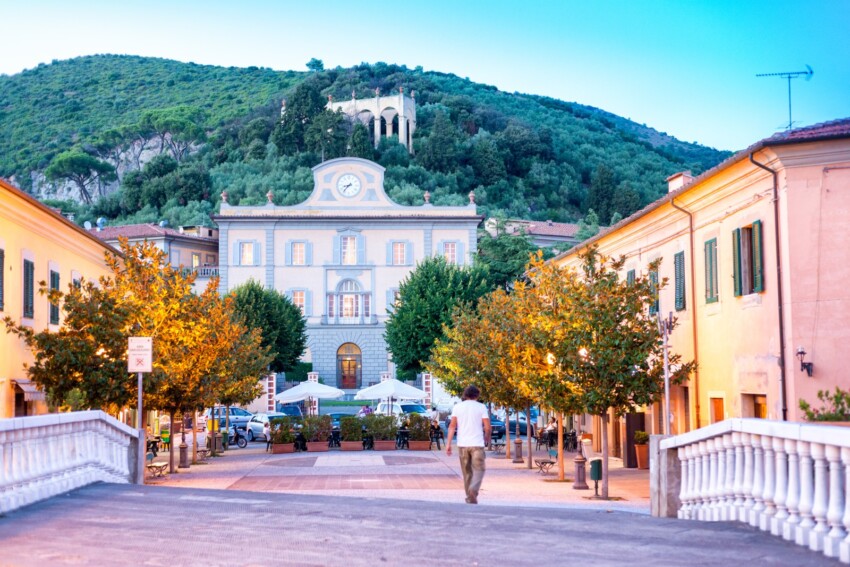
The system of so-called “historic villas” developed between the 1400s and 1800s thanks to numerous Pisan and Florentine families who chose to build these private residences at the foot of Monte Pisano, drawn by the richness of nature and the mild climate.
It was particularly during the 1600s and with the construction of thermal buildings in the 1700s that San Giuliano Terme became an international attraction. In a century when profit was linked to the “universal increase of luxury”, the new face of the Terme became an incentive to beautify, modify and expand the surrounding villas. It was during this period that an architectural itinerary of “delight” developed in the Lungomonte pisano area, extending from countryside leisure to fashionable places, spiritual sanctuaries and wellness centres.
The charterhouses, country churches, thermal baths and villas, marked by the outlines of cornices, friezes and decorative crownings, stand out at the foot of the hills, presenting a unified architectural language.
These places of delight today represent an example of historical, cultural and productive continuity that the local administration is committed to protecting and enhancing through projects and proposals directed at the European Union. For several years, many of these villas have been restored to their original splendour and some have been converted into hospitality centres, restaurants and venues for cultural and artistic events. What follows is an invitation to explore some of the most significant architectural treasures.
A journey from north to south that will lead us back to the thermal capital.
The earliest records of Antonio di Guelfo Roncioni’s property at Pugnano date back to 1468, but only much later do descriptions illustrate the order and clarity of the palace and garden. It was at the beginning of the 1600s that the simple townhouse was definitively transformed into a villa intended for seasonal residence, thus initiating a phase of transformations and extensions. The trompe-l’oeil architectural features are interesting, as if opening from a stage backdrop onto small drawing rooms with various thematic designs. For the villa, the creation of a 50-hectare romantic park, begun in 1826, proved fundamental. The introduction into the park of a manufactory was architecturally striking: the splendid silk mill called the Bigattiera, in Neo-Gothic style, designed by Alessandro Gherardesca. Modelled on the English abbey of San Luca, this work stands out like a theatrical set against the lawn of the garden, creating a curious reciprocity between urban and countryside themes. The woodland, too, is evocative, crisscrossed by paths that mark routes through nature, with an alternation of scenes, interplays of light and shadow, water features, together with eclectic architectural elements. Among the vegetation are also the ruins of an unfinished castle and a Neo-Gothic chapel. For several years the villa has hosted cultural initiatives and various ceremonies.
Built in stages from the early 1700s by Giovanni Saladino Dal Borgo. The current layout is articulated in a “U” shape which, in a Neo-Renaissance manner, modulates the outlines of the openings across successive storeys and concludes the tower sections with a balustraded terrace. With a hypetral stairwell, the vaulted ceilings feature various illusionistic spatial expansions. The decorative arrangements are attributed by Da Morrona to Domenico Tempesti, father of Giovanni Battista. A garden develops behind the villa, extending towards architectural features complementing the greenery, such as the lemon house, a small chapel in late nineteenth-century eclectic style and the guest house with Neo-Renaissance décor.
Its foundation dates to the second half of the 1500s, though its architectural history has been marked by significant interventions since 1640. The building’s current configuration is the result of various works that overlapped between the 1700s and 1800s. By the late 1700s, the spatial arrangement had developed with the formation of a “U” shaped floor plan enclosing the flower garden (hortus conclusus), onto which opens a loggia with Tuscan order. The internal structure and decorations are characterised by trompe-l’oeil architectural textures, in Rococo style, with figurative culture spanning Neoclassical and Romantic tastes. The arrangement of the park, bordered by an annular pathway with a significant waterfall, dates to the 1800s.
Construction dates to the final years of the 1500s when the decision was made to unify a main residence and workers’ house, then enlarge and transform it into a “villa”. Despite various changes of ownership between the late 1500s and early 1800s, the villa underwent no substantial transformations, except for some modifications at the end of the last century. The building’s restrained composition is noteworthy, emphasised by the outlining of openings with frames of quartz and calcium carbonate, which evoke the theme of artificial rock and Mannerist “rustic” style.
Transformed into a villa in 1611, it currently stands in a state of grave abandonment that prevents any clear reading of its historical structure. The place name would seem to identify this as originally a fortified farmhouse complex which, between the late 1500s and early 1600s, acquired, alongside its role in controlling the landed estate, the characteristics of a place “for seasonal residence”.
“.. it has the most beautiful palace in all the area around Pisa ..” so Vincenzo Pitti described in 1616 the property corresponding to Corliano, owned by Iacopo della Seta. The structure is rectangular and classical, but softened with important sgraffiato decorations that lighten the symmetry of the building with symbolism announcing domestic virtues and good auspices for the countryside. The park, which creates an architectural and spatial harmony among all its structures, is particularly evocative.
Built in the mid-1500s, it is one of the few villas in Pisa province to have been directly inhabited by the Medici family. With its rectangular form, it represented the focal point of the villa-farmhouse. Greatly beloved by Lorenzo the Magnificent, who lived here with his court of writers and artists (from Poliziano to Gozzoli), the villa testifies to the presence of Florentine models in the Pisan countryside, updated to Mannerist cultural trends. With a layout consistent with the functional schemes of Medicean villas, the façade solution adopts language typical of mid-sixteenth-century city palaces. The villa is surrounded by a splendid one-hectare park with centuries-old and fruit-bearing trees. The Villa Medicea, today a historic residence open to the public, has been restored on three floors and is available for short seasonal or long residential stays, as well as for events, meetings and ceremonies.
A hunting lodge of Lorenzo the Magnificent, this villa expresses well the “humanistic” meaning of country life and the relationship with nature. The palace layout extends into the garden layout and its fish pond, with an irregular annular pathway that moves away from the building to fade into the verdant growth of lindens, cedars, acacias, magnolias, interspersed with camelia groves, grass clearings and shrubs in a park that develops following the slope of the land.
Built at the end of the 1700s on earlier structures dating between the late 1500s and early 1600s, it was recently restored and converted into a restaurant and events venue.
The architecture centres on a theme common to villas in this area: a blocked layout whose façade, marked by frequent openings framed by pietra serena cornices, projects outward from the roofline, gravitating towards the frieze where the sundial was once placed.
The eighteenth-century characteristics of ostentation and luxury of the original condition remain evident.
 Hotel
Hotel  Budget accommodations
  Apartments
  Family Hotel
  Luxury Hotel
  Resorts