Agriturismo Marrucola
San Miniato - Via Calenzano 40
Book now
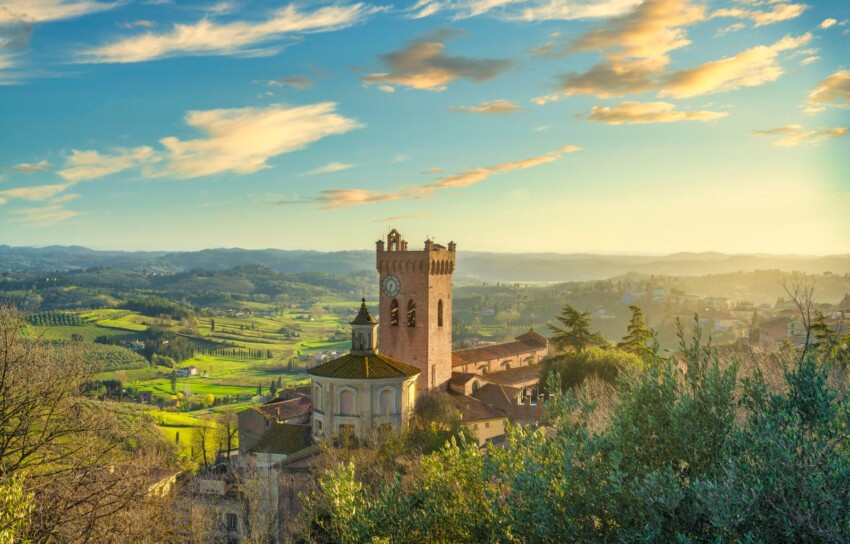
Between Florence and Pisa, perched across three hilltops, sits the enchanting medieval village of San Miniato, the historic heart of a municipality that today has just under 30,000 residents. Geographically part of the Lower Valdelsa region of Florence, yet administratively part of the Province of Pisa, San Miniato is a fascinating destination to explore during a Tuscan tour, thanks to the allure of its historic centre, and because it’s here that truffle enthusiasts will find their paradise. San Miniato is one of Tuscany’s most significant locations for the production and trade of this prized fungus.
San Miniato is therefore a worthwhile destination throughout the year: during the warmer months, when long, sunny days encourage outdoor activities; through autumn, when truffles steal the spotlight; and into winter, when the town is festooned with festive decorations.
You might choose to visit San Miniato and use it as a base for exploring the surrounding countryside, or pop in for a day trip from Florence or Pisa, thanks to its proximity to major transport links. Whatever you decide, this guide will help you make the most of your visit to San Miniato.
The main attractions in San Miniato are virtually all clustered in the historic centre, which is easily explored on foot. Here are the principal ones, so you won’t miss a thing.
The Cathedral of San Miniato, officially the Cathedral of Santa Maria Assunta and San Genesio, is the town’s most important place of worship. Its origins are ancient, with construction beginning in the 12th century. It stands in Piazza Prato del Duomo, the heart of the old town.
The exterior features a stepped façade in red brick, with three Renaissance portals. Behind the cathedral stands the bell tower, rectangular in plan, also known as Torre di Matilde (Tower of Matilda), named after Matilda of Canossa, who, according to local legend, was born here.
The interior of San Miniato Cathedral is particularly striking, with Baroque decorations and a Latin cross layout divided into three naves. It contains numerous sculptures and artworks, along with reliefs and burial monuments. At the start of the nave stands the marble baptismal font, carved by Giovan Battista Sandrini in 1639.
The paintings adorning the walls are equally noteworthy, including altar panels such as the Deposition of Christ, a work by Francesco d’Agnolo, known as Lo Spillo, brother of Andrea del Sarto. Also worth seeing are The Adoration of the Shepherds by Aurelio Lomi and The Resurrection of Lazarus by Cosimo Gamberucci.
The cathedral is also linked to a tragic chapter of World War II: on 22 July 1944, a US artillery shell struck the church, killing 55 people gathered on the forecourt by German occupying forces. To commemorate this tragic event, a memorial plaque inside the cathedral honours those who lost their lives.
The Bishop of San Miniato resides at the Palazzo Vescovile, an elegant building whose construction began in the 13th century with two towers, called Torre Palleoni and Torre dei Capitani del Popolo. The Palazzo Vescovile has undergone several renovations throughout its long history: the towers were demolished in 1746, when a stone portal and access ramps were added. The most recent restoration, whose results are evident today, dates to 1977.
The Palazzo Vescovile overlooks Piazza Prato del Duomo, where its impressive main entrance with its striking façade is located, whilst the rear, which retains a more ancient style, faces Piazza della Repubblica. Inside the palazzo, the Chapel of the Assumption and of St John the Baptist is particularly noteworthy, showcasing splendid frescoes by Anton Domenico Bamberini.
One of San Miniato’s most significant Baroque churches is the Church of the Santissimo Crocifisso. It was constructed in just 15 years, from 1705 to 1718, to house a crucifix dating from the 13th century that was believed to be miraculous.
The Church of the Santissimo Crocifisso sits in the historic centre of San Miniato, next to the town hall, accessed via an impressive staircase at whose centre stands a work by Francesco Baratta: a statue of the Risen Christ.
Yet the church’s finest feature is undoubtedly its interior: here you’ll find frescoes covering nearly all the walls, many depicting scenes from the life of Christ, painted by Anton Domenico Bamberini. The stuccowork and sculptures are equally beautiful, as is the high altar, behind which hangs a panel painting by Francesco Lanfranchi depicting the Risen Christ, which completely frames the tabernacle.
The former Monastery of Santa Chiara is a simple structure in red brick dating to the 14th century; today it houses the music conservatory, established in 1785 as a girls’ school, and a teacher training college.
You can visit the church in front of the former monastery through a portal along the building’s left side, featuring an attractive timber-beamed ceiling and three altars in pietra serena. The high altar holds a splendid panel by Jacopo da Empoli, titled Immaculate Conception Surrounded by Adam, Eve, Moses, David, St Paul and St John the Baptist.
Inside the sacristy you can admire several beautiful works, including Christ Appearing to Mary Magdalene by Cigoli and a reliquary of the Bonaparte family dating to the 17th century.
Also fascinating is the collection of embroidered textile furnishings, part of the former convent’s heritage, created by the Poor Clares, whilst inside the conservatory you can view a silhouetted crucifix by Deodato Orlandi, dating to 1301.
The Episcopal Seminary was an institution established when San Miniato became a bishop’s seat, to train future priests. Originally a modest residence for 12 seminarians, it was later expanded to the form still visible today. Its distinctive multi-faceted façade is particularly striking, adorned with religious Latin mottos, whilst it’s interesting to note the concave form of the building, as it was constructed against the town walls.
The square where the seminary stands was originally known as Piazza del Seminario, and when the building was constructed it was decided to build it on pre-existing structures. This explains why on the ground floor of the building you can still see the old artisan workshops dating from the 14th century, with their characteristic overhangs still visible, where merchants once displayed their wares.
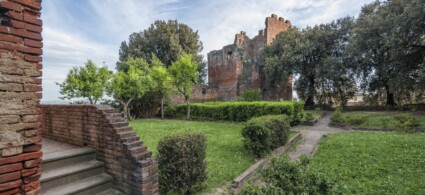
The final sight to see in San Miniato is its unmistakable symbol: the Rocca of Frederick II, or Federiciana Tower, a 13th-century tower destroyed during World War II. It was rebuilt in 1958 to match the original exactly, and today, open to the public, it stands as one of the city’s principal attractions.
It rises from the summit of the highest of San Miniato’s three hills and takes its name from Frederick II of Swabia, who ordered the construction of the fortress to protect the city. Climbing to the top rewards you with a magnificent panorama: on one side you can see San Miniato spread below with its terracotta roofs and churches, whilst on the other your gaze sweeps across the surrounding countryside, taking in the Valdarno valley, the Volterra hills, the Apennines and even the sea.
The San Miniato truffle is the Tuber Magnatum Pico, also known as the white truffle of the San Miniato hills, which grows here in abundance and of the highest quality. In the town, truffle-focused events are of paramount importance to its economic and social fabric, beginning with the National White Truffle Fair of San Miniato, commonly known simply as the San Miniato Truffle Festival. Held since as far back as 1969 in Piazza del Duomo, it takes place over the last three weekends of November.
But there’s more: alongside the fair, there are also a series of parallel festivities held in various locations across the municipality, such as the Corazzano Truffle Festival held on the first Sunday in October, the Balconevisi Truffle and Mushroom Festival on the third Sunday in October, and in spring, the Cigoli Spring Truffle Festival.
San Miniato is also where the world’s largest white truffle ever found was discovered, located by hunter Arturo Gallerini and his dog Parigi and presented in 1954 to US President Eisenhower, weighing a remarkable 2.5 kilograms. A wrought-iron monument by artist Massimiliano Benvenuti commemorates this remarkable find.
The best place to stay in San Miniato is definitely its historic centre: all the main attractions are here, and there’s no shortage of restaurants, bars and shops to enjoy in your downtime. In the heart of San Miniato you’ll find small family-run establishments, including privately managed flats, some bed and breakfasts and guesthouses.
In the immediate surroundings are several agritourism properties where you can unwind in total relaxation surrounded by nature, whilst if you prefer to stay in a town with all amenities, Empoli is just 10 kilometres away.
San Miniato is very easy to reach by car as the Florence-Pisa-Livorno dual carriageway has a dedicated exit: once you’ve exited you’ll find yourself in San Miniato Basso, just a couple of kilometres from the historic centre.
Given its convenient location, San Miniato is also perfect for a day trip: the centre of Florence is about 45-50 minutes away, whilst Pisa is approximately 35-40 minutes distant. It’s also easy to reach from the Tuscan coast: allow 45 minutes from Livorno and roughly an hour from Viareggio.
Those travelling by public transport will be pleased to know that San Miniato has the San Miniato-Fucecchio railway station, served by regional trains on the Florence-Empoli-Pisa line. Located in San Miniato Basso, frequent local buses (route 320) will take you from here to the historic centre.
What's the weather at San Miniato? Below are the temperatures and the weather forecast at San Miniato for the next few days.
San Miniato sits equidistant between Florence and Pisa, though administratively it falls under the latter. It enjoys a strategic position close to Empoli and Pontedera, just a short distance from the Florence-Pisa-Livorno motorway junction.
 Hotel
Hotel  Budget accommodations
  Apartments
  Family Hotel
  Luxury Hotel
  Resorts