Villa Maria
Vicopisano - Via Magellano116
Book now
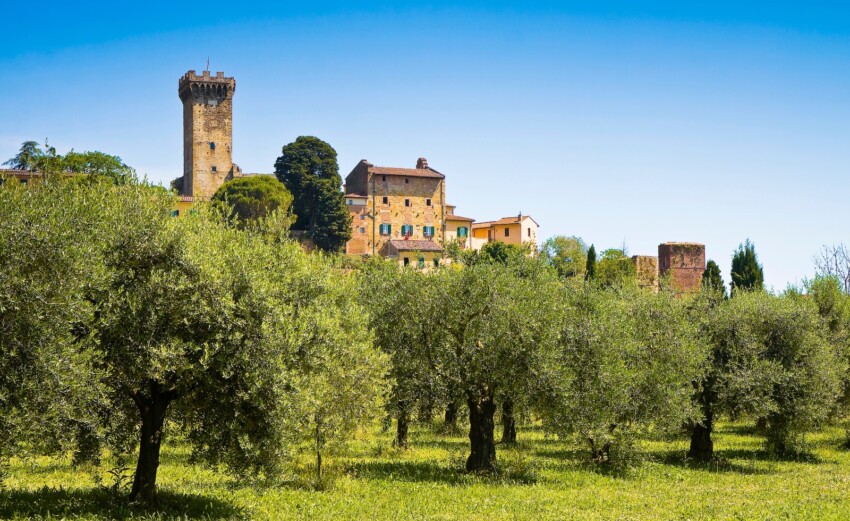
One of the distinctive features of the municipality of Vicopisano, despite its modest size, is that it comprises a remarkably high number of hamlets (San Giovanni alla Vena, Uliveto, Lugnano, Caprona and Cucigliana, plus the settlements of Cevoli and Noce). This stands in stark contrast to neighbouring municipalities, which typically consist of no more than two or three hamlets.
Another notable characteristic is that these “hamlets” are far from being mere administrative subdivisions; rather, they are distinct communities that, despite their limited extent, possess strong individual identities, which are well reflected in the traditional Tuscan sense of local pride and loyalty.
The reasons for this deep-rooted attachment can be traced back to the distinct histories that have defined these villages over the centuries. Each had its own specific economic activity, different commercial outlets and therefore diversified interests, which fostered a powerful sense of belonging to their respective communities. It must be said that in an age where everything tends towards homogenisation and uniformity (with a marked tendency towards flattening of differences), these instances of diversity and differentiation can only be observed with interest, always recognising that differences are an enrichment rather than a cause for division.
In this section we shall examine these hamlets closely, exploring the history and cultural heritage of each. Generally speaking, the hamlets of Vicopisano municipality are all located along the via Vicarese, situated between the course of the River Arno and the foothills of Monte Pisano, in a natural environment poorly suited to extensive cultivation, which instead characterised the immediate surroundings of the village of Vicopisano. This circumstance undoubtedly had a strong influence on the development of these settlements, which were forced to abandon agriculture in favour of other activities: pottery production (San Giovanni and Cucigliana), lime quarries (Uliveto and Caprona and later also San Giovanni) and river transport carried out by the Navicellai (all the hamlets).
The place names and certain archaeological finds indicate the clear Roman origins of most of these settlements: Cucigliana, Lugnano and Caprona were, most likely, the sites of Roman country villas. However, given its particular topography and the presence of an important river route, this area must have been inhabited from much earlier times (this hypothesis is supported by recent discoveries of archaic Etruscan material on the hillsides overlooking the Arno).
All the settlements along the foothills, together with Vicopisano, assumed particular importance for the political and economic life of Pisa during the Middle Ages; they served as military defence points for the territory and were centres of land ownership for some of the most prominent families of the Pisan aristocracy. After the strategic and military importance of the area declined following Florentine conquest, investment in land ownership by important families did not cease in this fertile countryside, suitable for diversified crops. From the 16th century onwards, they chose these pleasant and peaceful locations to build their magnificent country residences, many of which survive throughout the Vicopisano municipal territory today.
On 16 July 1406, a Florentine army succeeded in taking Vicopisano after nine months of siege. It was essential to build a fortress to guard this precious conquest, one that would be impregnable. Thus the Florentine government commissioned Filippo di Ser Brunelleschi (Brunelleschi) with a design that caused a stir even at the presentation of the wooden and clay model to the government commission, which included the young military commander Francesco Sforza, who would later become Duke of Milan.
In 1435, construction began immediately: a large number of churches and palaces located in the area of the summit of the Vico hill were demolished. Brunelleschi’s fortification incorporated an ancient tower dating from the 12th century that had been in the possession of the Pisan archbishops: the Tower of S.Maria became the keep of the Brunelleschi fortress, which presents a still medieval typology: high walls with crenellations supported by arches with murder holes for pouring flaming Greek fire and boiling oil onto assailants.
However, what is surprising—a true innovation—is a series of drawbridges designed to isolate sections of the fortress from the rest when withdrawn, almost like an onion-skin system that would function if the enemy managed to penetrate it. Before accessing the Fortress courtyard, for example, one had to have conquered the gatehouse equipped with a drawbridge and moat. In case of imminent loss of the courtyard, the defenders could destroy the ladder resting on four slender arches that connected the courtyard with the wall walk of the ramparts. If the enemy had succeeded in reaching the ramparts, the defence would have fallen back to the tower: it was possible to isolate the tower from the rest of the fortification by withdrawing the drawbridge connecting the wall walk with the tower’s only entrance. The tower was equipped with its own cistern and provisions store so it could withstand a long siege.
But the most ingenious solution was the powerful crenellated wall that descended from the Fortress to the foot of the hill, where it terminated in a tower approximately 21 metres high that stood near the Arno, the Torre del Soccorso (Relief Tower): if the enemy had managed to penetrate Vicopisano, it would have been impossible to besiege the Fortress and cut off its supply lines and starve it into surrender.
Anyone attempting to assault the wall would have been mowed down by cannon fire from the fortress and the artillery of the Tower’s gun emplacement; from the wall’s crenellations, light infantry fire and crossbow bolts would have been directed. From the Torre del Soccorso, positioned as we know on the Arno, assistance could be received from Florence: boats could land in a cove, defended by fortifications now disappeared, unload men and gunpowder which were passed through a narrow porthole and via ladders, climbed to the second floor of the tower, from where one could access the wall and climb towards the Fortress.
If the enemy had ever managed to capture the Torre del Soccorso, they would have found it very difficult to traverse the crenellated corridor exposed to enfilade fire from the Fortress, but above all they would have found the connection between the wall and the wall walk of the Fortress ramparts cut off: here there was indeed a gate with a drawbridge, and as we can still see today, the gap is approximately three metres across a height of fifteen metres.
Today, from the tower from which messages were once sent to Florence, one enjoys a panorama of fields and hills, in an atmosphere of peace and serenity.
One of the distinctive features of the municipality of Vicopisano, despite its modest size, is that it comprises a remarkably high number of hamlets (San Giovanni alla Vena, Uliveto, Lugnano, Caprona and Cucigliana, plus the settlements of Cevoli and Noce). This stands in stark contrast to neighbouring municipalities, which typically consist of no more than two or three hamlets.
Another notable characteristic is that these “hamlets” are far from being mere administrative subdivisions; rather, they are distinct communities that, despite their limited extent, possess strong individual identities, which are well reflected in the traditional Tuscan sense of local pride and loyalty.
The reasons for this deep-rooted attachment can be traced back to the distinct histories that have defined these villages over the centuries. Each had its own specific economic activity, different commercial outlets and therefore diversified interests, which fostered a powerful sense of belonging to their respective communities. It must be said that in an age where everything tends towards homogenisation and uniformity (with a marked tendency towards flattening of differences), these instances of diversity and differentiation can only be observed with interest, always recognising that differences are an enrichment rather than a cause for division.
In this section we shall examine these hamlets closely, exploring the history and cultural heritage of each. Generally speaking, the hamlets of Vicopisano municipality are all located along the via Vicarese, situated between the course of the River Arno and the foothills of Monte Pisano, in a natural environment poorly suited to extensive cultivation, which instead characterised the immediate surroundings of the village of Vicopisano. This circumstance undoubtedly had a strong influence on the development of these settlements, which were forced to abandon agriculture in favour of other activities: pottery production (San Giovanni and Cucigliana), lime quarries (Uliveto and Caprona and later also San Giovanni) and river transport carried out by the Navicellai (all the hamlets).
The place names and certain archaeological finds indicate the clear Roman origins of most of these settlements: Cucigliana, Lugnano and Caprona were, most likely, the sites of Roman country villas. However, given its particular topography and the presence of an important river route, this area must have been inhabited from much earlier times (this hypothesis is supported by recent discoveries of archaic Etruscan material on the hillsides overlooking the Arno).
All the settlements along the foothills, together with Vicopisano, assumed particular importance for the political and economic life of Pisa during the Middle Ages; they served as military defence points for the territory and were centres of land ownership for some of the most prominent families of the Pisan aristocracy. After the strategic and military importance of the area declined following Florentine conquest, investment in land ownership by important families did not cease in this fertile countryside, suitable for diversified crops. From the 16th century onwards, they chose these pleasant and peaceful locations to build their magnificent country residences, many of which survive throughout the Vicopisano municipal territory today.
The parish church of Santa Maria, originally also dedicated to Saint John the Baptist, dates back in its present form to the 12th century. It is the oldest and principal of the churches located in the immediate vicinity of Vico, and is the only one to have been built outside the walls, without the canonical orientation with the entrance facing west. The facade faces towards one of the castle’s entrance gates, Porta Maccioni, which later became the gate of the Fortress. The church is first mentioned in a document from 934, though this document indicates it had already existed for some time.
What's the weather at Vicopisano? Below are the temperatures and the weather forecast at Vicopisano for the next few days.
To see all the facilities and book accommodation in Vicopisano use the form below, entering the dates of your stay.
 Hotel
Hotel  Budget accommodations
  Apartments
  Family Hotel
  Luxury Hotel
  Resorts