Chiostro Delle Monache Hostel Volterra
Volterra - Viale Del Teatro 4 - Loc. San Girolamo
Book now
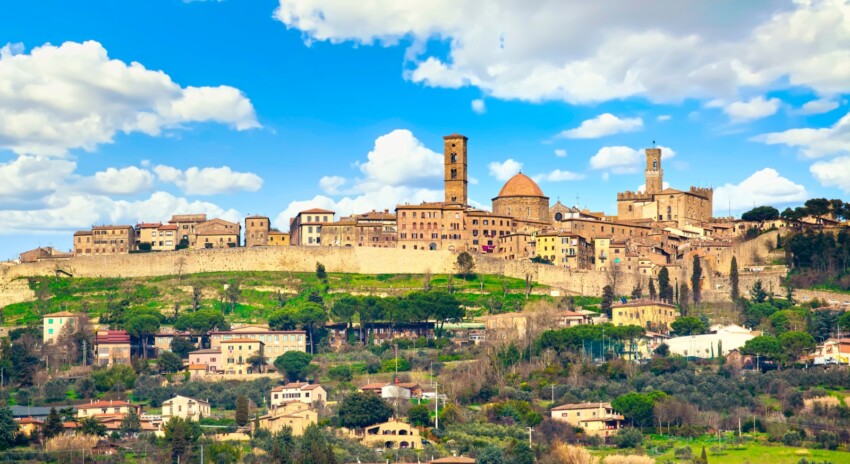
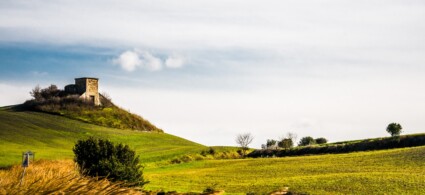
In the heart of the Pisan countryside, yet also very close to the borders with the provinces of Siena and Livorno, stands the splendid Volterra. This town of 10,000 inhabitants was one of the principal city-states of ancient Etruria, hugely powerful in the Middle Ages and boasting a historic centre of Etruscan origins.
Today, Volterra is a highly renowned tourist destination, an unmissable stop for anyone choosing to visit Tuscany, thanks above all to the beauty of its historic centre, but also for its centuries-old tradition of extracting and working alabaster, with which the skilled hands of the town’s artisans create truly magnificent objects.
Finally, Volterra has achieved international fame in recent years as it served as a setting for the hugely successful Twilight saga: author Stephenie Meyer made Volterra the home of the Volturi, a powerful clan of vampires. Some scenes from the TV series The Medici were also filmed in Volterra during the second and third seasons.
Whether you want to follow in the footsteps of your film heroes or explore the town in complete freedom, here are the best things to see in Volterra, so you won’t miss a thing and will return home more than satisfied.
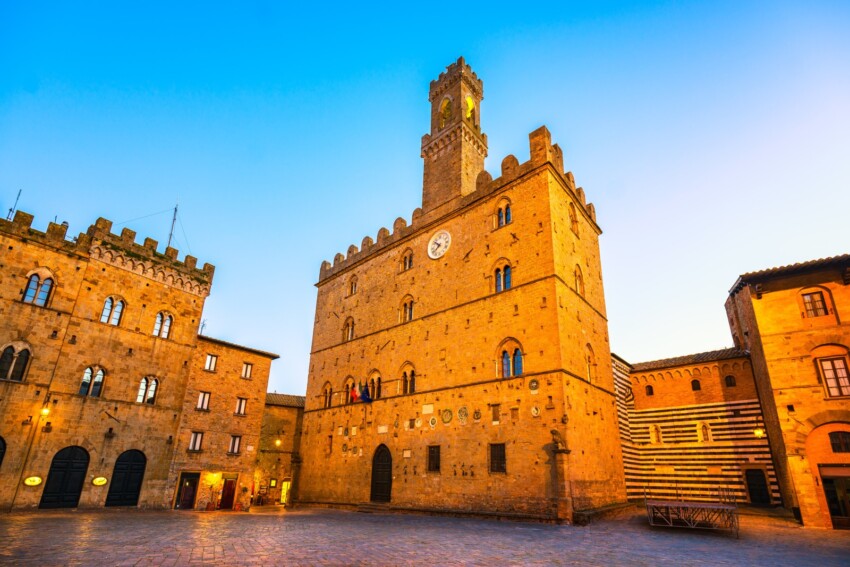
The stunning Palazzo dei Priori is one of Volterra’s principal attractions. Located in Piazza dei Priori, it is notable for being Tuscany’s oldest municipal palace. Its architectural style is strikingly reminiscent of Florence’s Palazzo Vecchio, yet it boasts its own unique history and character. Built in the early 1200s, it now houses the offices of Volterra municipality, but in the past it served to accommodate the 18 Priori del Popolo.
On the outside, the stone façade is characterised by cornices and semi-circular battlements, and is decorated with terracotta plaques recalling ancient Florentine families, testament to the fact that Volterra was governed by Florence from the 15th century. The façade is topped by a tall tower, dating back to the 16th century, and rebuilt 150 years later following damage from the 1846 earthquake.
Inside, visit the elegant atrium, where the coats of arms of the city’s priori are displayed. Don’t miss the magnificent Council Hall, the palace’s most impressive room, located on the first floor. On the upper floors, now used as offices by Volterra Municipality, there were originally the Priori’s bedrooms, as well as a hall for assemblies and meals.
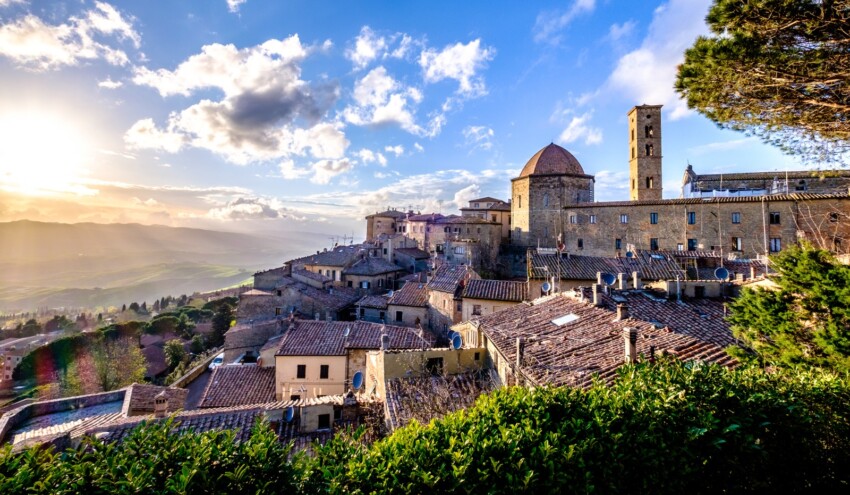
Volterra’s cathedral, officially the Cathedral of Santa Maria Assunta, is the town’s principal church. Built in Romanesque and Baroque style, its construction took 6 centuries, from the 12th to the 18th.
Step inside to admire the Latin cross floor plan with three aisles separated by 22 columns of pink stucco with white capitals. Much of what you can see inside Volterra’s cathedral dates from an important restoration carried out in the mid-1800s, including the white and grey striped walls, the presbytery and the floor. When you’re in the central aisle, look up and admire the splendid coffered ceiling with geometric and decorative motifs, whilst to the sides of the aisles there are 6 chapels, which house artworks by numerous painters from the late 1500s.
The oldest artwork preserved inside Volterra’s cathedral is the sculptural group of the Deposition, dating back to the 1200s and created by local craftsmen. It depicts Jesus Christ being taken down from the cross by the Virgin Mary, St John the Evangelist, Joseph of Arimathea and Nicodemus.
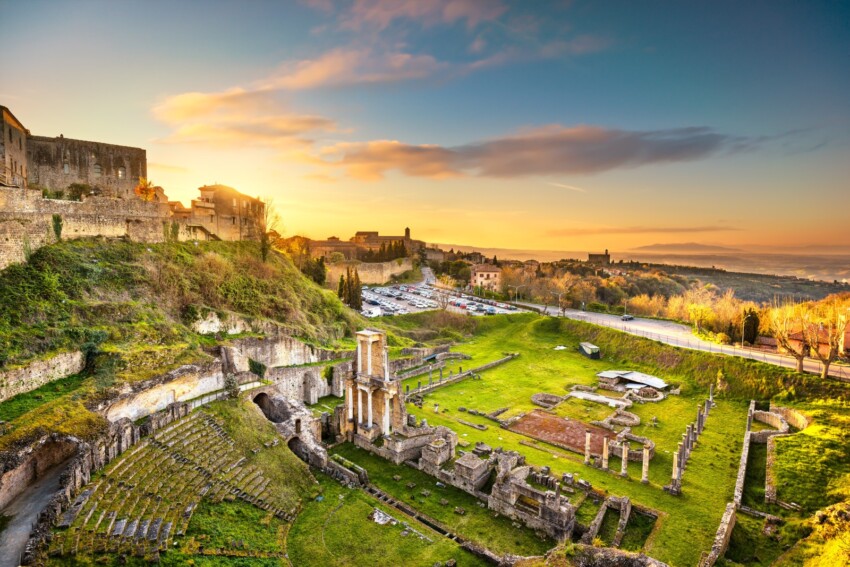
In the 1950s, an ancient Roman theatre was uncovered in Volterra thanks to a series of archaeological excavations north of the historic centre. The theatre has been dated to the late 1st century BC, and is carved into the natural slope of a small hillock, just like Greek theatres. In addition to the theatre, the excavations brought to light seating and some of the staircases.
It is estimated that the theatre could hold up to 3,500 spectators, and it also featured a velarium, a cloth supported by ropes that served as a covering, making it usable even in adverse weather conditions. The theatre is open to visitors as it is contained within an archaeological area, accessed just outside Porta Fiorentina.
Today, Volterra’s Roman theatre has been restored to its former glory as a venue for events and performances, with the International Festival held here every year, where a qualified jury awards the prestigious Ombra della Sera prizes to important figures in entertainment and culture.
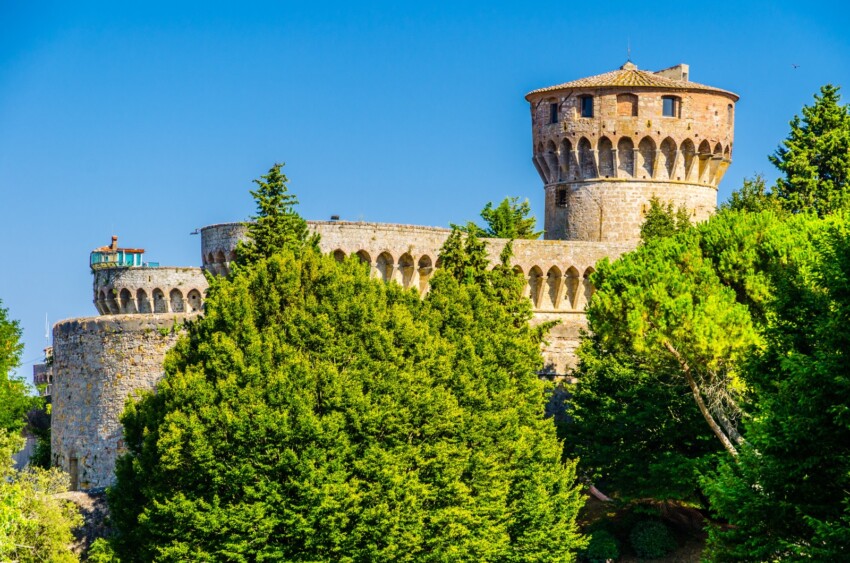
Florentine rule over Volterra is also evident in the town through the presence of the Medici Fortress, an imposing building comprised of two separate structures, connected by high defensive walls. These are the Rocca Vecchia, or Cassero, and the Rocca Nuova, or Mastio.
The first section to be built was the Rocca Vecchia, erected by the Duke of Athens, a neutral leader of Volterra during the 1300s, to try to prevent the town’s most important families from warring with each other to dominate the city. Alongside it stands the Rocca Nuova, built directly by Lorenzo de’ Medici, who destroyed two districts and the Bishop’s palace in the process.
Volterra’s Medici Fortress today serves as a state prison and is therefore not open to visitors, except in exceptional circumstances.
Opposite the cathedral stands the Baptistry of St John, an octagonal building dating from the second half of the 1200s. The façade facing the cathedral is particularly beautiful and distinctive, with white and green marble bands featuring a magnificent portal in Romanesque style.
Inside, the Baptistry of St John has six niches and an altar, the latter dating from the 1700s. There are some very important decorations, including an Ascension by Niccolò Cercignani, painted on wood, whilst to the right of the altar is the ancient baptismal font, a work by Andrea Sansovino from 1502. At the centre of the baptistry is a large baptismal basin, topped with a statue of St John the Baptist, created in 1759 by Giovanni Vaccà.
Via Don Minzoni in Volterra is home to the Guarnacci Etruscan Museum, one of the town’s principal attractions. It showcases Volterra’s Etruscan past with an extensive ancient art collection spread across 38 rooms, arranged over three floors plus a garden, all interconnected.
The Etruscan museum was founded in the late 1700s thanks to private donations, the most significant of which was from Monsignor Mario Guarnacci, who donated his entire collection to the newly established museum, so much so that the museum was initially housed within Palazzo Ruggeri, the private residence of the Guarnacci family.
Inside the museum you can view the world’s largest collection of Etruscan urns. Among the most notable works are the Stele of Avile Tite, the bronze statuette known as the Evening Shadow, the terracotta urn of the spouses, and the Lorenzini head.
The Abbey of Saints Justus and Clement is a religious building now abandoned and in a state of disrepair, due to the 1846 earthquake. But it is precisely this condition that makes it truly unique, and in some ways one of the finest and most distinctive things to see in Volterra.
Of the church, the façade from the late Renaissance period, the apse and the bell tower remain standing. The numerous artworks originally present have been transferred to other buildings in the town, including the diocesan museum of sacred art, the Church of San Giusto, the Volterra civic art gallery and museum, and the municipal library.
The Abbey of Saints Justus and Clement is located to the north of Volterra, a short distance from the famous Balze. You can reach it by taking the SP15 road heading north for just over 2 kilometres.
It’s impossible to leave Volterra without capturing a stunning photograph of its Balze at sunset. The Balze of Volterra are rock formations situated near the town, extending over an area of almost 90 hectares; they are typical formations of rock and clay, reaching heights of hundreds of metres. When you visit them, you’ll be able to admire breathtaking views, with steep cliff faces and countless colour variations.
It’s possible to view the Balze of Volterra from several observation points, or get closer via some walking trails. There is also a clearly marked viewpoint, which is easy to reach and offers splendid panoramic views.
In the following map you can see the location of the main places of interest mentioned in this article.
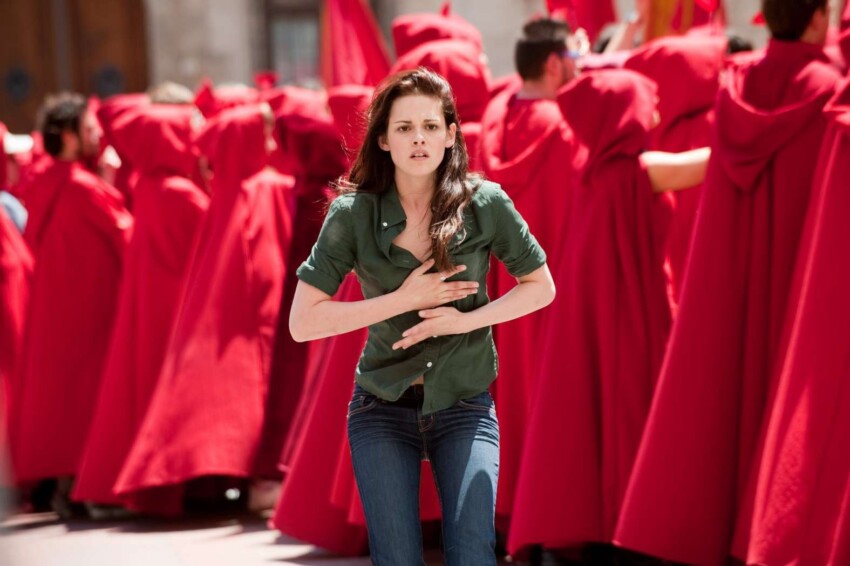
Fans of the hugely popular Twilight saga will already be familiar with Volterra: this is indeed where some scenes from the New Moon episode are set; in the book, Volterra is referenced as the city where members of the Volturi clan live, a royal family of vampires who must ensure the laws are upheld.
Volterra is also where Edward Cullen decides to sacrifice himself, believing his beloved Bella has taken her own life. Next to the square, in Vicolo Mazzoni, according to the saga’s geography, is the manhole cover used by the vampires to descend into the underground tunnels.
However, not everyone knows that the scenes from the Twilight New Moon film were actually shot in Montepulciano: it is here that Robert Pattinson and Kristen Stewart brought the vampire love story to life, and during filming the town was flooded with over a thousand extras dressed in red, in one of the saga’s most climactic scenes, filmed in Tuscany between 26 and 29 May 2009.
Choosing the historic centre for accommodation in Volterra is a smart choice, as this is where you’ll find all the main things to see. As is often the case, there are mainly apartments, B&Bs and small boutique hotels. For larger hotels, you’ll need to venture a little way from the centre, whilst for those seeking complete peace and quiet, the surrounding area of Volterra has plenty of farm stays, where you can enjoy your holiday immersed in the relaxation of the Tuscan countryside.
From Florence you can reach Volterra in approximately one hour and 30 minutes by car, heading south along the Florence-Siena motorway link, exiting at Colle Val d’Elsa Nord. From here, continue along the SS68 state road heading east, which leads directly to Volterra’s centre. In total you’ll need to cover approximately 80 kilometres.
The distance from the provincial capital Pisa is also considerable: around 70 kilometres, which takes approximately one hour and 15 minutes. To reach Volterra from Pisa, take the FI-PI-LI main road heading towards Florence as far as Pontedera, then proceed south along the SP11 passing through Montechiari, Peccioli, La Sterza and then Volterra.
Reaching Volterra by public transport is neither particularly straightforward nor quick. From Pisa you travel by train to Pontedera and then continue on bus number 500; from Florence you travel on regional buses run by Tiemme, number 131 to Colle Val d’Elsa and then 770 to Pontedera, and similarly from Siena. The journey by public transport from any of the three provincial capitals takes approximately two hours.
What's the weather at Volterra? Below are the temperatures and the weather forecast at Volterra for the next few days.
Volterra sits in the heart of Tuscany, in the province of Pisa yet close enough to the Siena border that Colle Val d'Elsa and San Gimignano are just 30-40 minutes away. It's equally well-positioned for coastal access, with the Livorno beach town of Cecina on the Tuscan coast roughly 40 kilometres distant.
 Hotel
Hotel  Budget accommodations
  Apartments
  Family Hotel
  Luxury Hotel
  Resorts